In a recent Blogger Roundtable, new FEMA Administrator Craig Fugate while extolling the value of the CERT program misspoke and called it the “Citizen Emergency Response Team”. The actual name for these citizen-staffed squads is “Community Emergency Response Team.” Yet, Fugate is not alone in occasionally making that same slip. I hear it a lot from people in and out of the program, and I often make myself. (I remember during one deployment last year after a crane collapse here in Manhattan, a CERT team leader about to go on television was repeating “Community Emergency Response Team” to herself so she would not say what came more naturally to her (”Citizen”) during the interview. Well, she ended up saying it the correct way, but the reporter introduced the live segment by calling us a “Citizen Emergency Response Team”.

I would suggest that the government make the small change from “community” to “citizen”. The new name would more precisely describe what and who CERT is and would underscore the fact that it is completely civilian-staffed. Yes, we do come from the community, but what makes us unique in the disaster preparation/response system is that CERT members are all average citizens with other professions. I think there is also value in making the alteration to help promote the ‘citizen/volunteer’ angle of the CERT program with the public, the media and government. True, this is a small point, but as the program matures I would argue that it is a change worth making, particularly as the initials would still fit.
These icons link to social bookmarking sites where readers can share and discover new web pages.
Email Entry
Tags: CERT
Bill Firestone was Florida’s first Community Emergency Response Team (CERT) program coordinator from 1998-2001 (under new FEMA head Craig Fugate). Firestone now runs a consultancy EM Training. He is also a reader of the blog and sent me an email reacting to Fugate’s comment I wrote about urging CERT members to be “ambassadors” in their communities. As Firestone is experienced at all levels of emergency management, I asked him if he would contribute his thoughts on CERT and citizen volunteering:
“I live in Florida and was the State CERT Coordinator for several years and a 25-year history, prior to that, volunteering and as a chapter employee for the American Red Cross. Although I have “moved on”, I still follow CERT, with a particular interest in how urban teams and programs are maintained. In the “resource rich” environment of the urban areas where governments routinely use mutual aid and there is a large number of support agencies and non-profits, it’s extremely challenging to find meaningful roles for CERT volunteers.
In a recent blog post, new FEMA administrator and former State of Florida Emergency Management Director Craig Fugate, in responding to the question on CERT, said he believed that CERTers are disaster preparedness ambassadors. While it’s very unlikely that most CERTers will participate in a mass casualty triage or perform in pairs in fire suppression, CERTers will talk to their neighbor, participate in their children’s schools, attend neighborhood activities. Consequently, they can reach out to people that government and non-profit preparedness messages cannot reach or it is too expensive. I believe that the role of “ambassador” is a good fit for CERT. Your blog shows CERTers participating at tables in neighborhood activities and other outreach to spread the preparedness message and my guess is that the new FEMA director’s words will translate into a direction of encourage that.
In my role as a “CERTer”, here in Florida, I am reaching out to neighbors and talking to them about the network of non-profits in disaster and the importance of knowing what services and assistance they can provide before and after disaster. Here in hurricane-prone Florida I have begun to send along the url for information about the importance of completing an SBA loan application and how that is tied to receiving additional disaster assistance. Most of my neighbors that have incurred damages to their house have been told about the low-interest loans following disaster, but not aware of the other benefits to completing the application.
I am interested in how others, especially in urban areas, how other CERT-trained individuals and teams are fulfilling the ‘ambassador’ role.”
I agree with Firestone. I think he suggests correctly that more emphasis be put on the importance of what Fugate called the “ambassador” role, citizens educating and motivating other citizens. Here in New York City, there has been an effort to do so by offering the type of public speaking and cultural awareness advanced training I recently completed.
Firestone also believes it is key that CERT follow the long-standing volunteer “rule” that the volunteer must see the good from donating his work. There is a laudable effort by New York’s Office of Emergency Management to celebrate members with certificates, events and thanks from the boss. However, I think that designating us as “ambassadors” and increasing our profile in the community and the amount of interaction we have with fellow citizens (usually through public education and other outreach events) makes a lot of sense. A key to CERT (like any volunteer effort) is trying to help provide meaning to the volunteers to sustain long-term involvement, which is what Firestone is advocating for and is also what I try to do on this blog.
p.s. Firestone recommends The Disaster Handbook from the University of Florida’s IFAS Extension as “my favorite disaster preparedness reference”. It has now been put on the web and can be found here.
These icons link to social bookmarking sites where readers can share and discover new web pages.
Email Entry
Tags: CERT · Federal Emergency Management Administration
In the aftermath of yesterday’s Metrorail crash in Washington, D.C. which killed at least 7 9 and injured 70, Amanda Ripley, author of The Unthinkable, offers an excellent post about the role of the public in the accident and in emergencies in general as well as the need for authorities to better account for citizens in their crisis planning. She writes of the incident:
“…It’s already clear that as in most sizeable emergencies, regular people did the hardest work in the most important moments–before rescue workers arrived. Getting out of a wrecked subway train is extremely difficult. Between the darkness (due to the loss of power) and the twisted cage of metal, it is very hard to get oriented. It doesn’t help that subway cars in general are challenging to evacuate.
If you’ve ever looked at the instructions for escaping from a Metro train, you’ll see what I mean. It involves finding the center door, lifting the cover of an emergency door-release handle, pulling the lever and then sliding open the LEFT (not right) door. If you want to know more, you can check out this very irritating Flash animation on the WMATA site. As with many of the announcements on the Metro, a good deal of time is spent telling you to listen to the people in charge (even though, in major emergencies, the people in charge are unlikely to be able to help you for a good long while).
One eyewitness told the Washington Post that people inside one of the wrecked cars were beating on the windows, trying to get out. Many were on their cell phones. As is so often the case in disasters, people did remarkable things for one another. Survivors report fear, confusion and kindness–but not panic: ‘In the moments after the crash, passengers made tourniquets out of T-shirts, struggled to pull debris off others and sought to calm the hysterical and the gravely wounded. Inside the worst-hit car, waiting on ambulances and the jaws of life, an Anglican priest led a group in the Lord’s Prayer. On the ground below, a civilian Pentagon employee told a wounded girl he wouldn’t accept her last wish-she was going to live.’

Metro train cars on top of each other after crash in Washington, D.C. (photo: Associated Press)
[Read more →]
These icons link to social bookmarking sites where readers can share and discover new web pages.
Email Entry
Tags: City Preparedness
Phil Palin from the blog HLS Watch has an interesting, somewhat provocative post this morning. In “Accident or Intention: Responding With Outrage or Deliberation,” Palin asks if the reaction would be different had yesterday’s Metro crash in Washington, D.C. been a terrorist bombing. He suggests that the deliberative, balanced and constructive approach (as opposed to blame and outrage) we often take after accidents might be useful to learn from in dealing with future terrorist incidents:
“Yesterday at 5:49 pm I received a text from DC’s Homeland Security and Emergency Management Agency: ‘Metro reports that 2 trains collided and one train is on top of the other train. Metro reports massive injuries at this time. The green line and the red line are affected. Further information to follow.’”
Consider how different the tone and scope of reporting – and our response – might be, if the text message had read something like, “Metro reports an explosion on a red line train. Metro reports massive injuries at this time. The green line and the red line are affected. Further information to follow.”
[Read more →]
These icons link to social bookmarking sites where readers can share and discover new web pages.
Email Entry
Tags: Preparedness Ideas
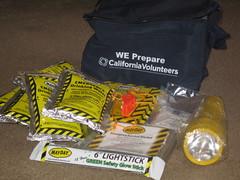
Thanks to CaliforniaVolunteers, I have 10 disaster kits to give away. I originally posted this contest last month, but I am going to extend it. To win a kit, send me one of the following: an emergency preparedness tip, something you have done to prepare for a disaster, or a suggestion to improve preparedness in your community to the Comment section below or in an email to jsolomon@incaseofemergencyblog.com. I’ll choose the 10 winners by random.
As you can see in the photo below (taken by my daughter), the kit contains drinking water packets, a block of survival food, a glow stick, flashlight, whistle and some first aid supplies.
I got the idea for this contest from a blog called Wendolonia which did something similar with CaliforniaVolunteers earlier this year. It was part of an initiative by the state agency to reach out to “Mommy Bloggers” like Wendolonia to promote the WE Prepare family readiness program . (I wrote about that effort last month and then spoke with CaliforniaVolunteers about doing the same kind of contest.) CaliforniaVolunteers is the office that oversees that State’s volunteering initiatives.

Again, to win one of the 10 kits above, please send in either a preparedness tip, something your have done to prepare for a disaster, or a suggestion to improve preparedness in your community to the Comment section below or in an email to me at jsolomon@incaseofemergencyblog.com.
These icons link to social bookmarking sites where readers can share and discover new web pages.
Email Entry
Tags: Contests
As part of the Obama Administration’s voluntarism initiative, the United We Serve summer service program launches today. It will conclude with the National Day of Service and Remembrance on September 11.
You can participate in United We Serve events across the nation this summer by visiting the new White House website, Serve.gov (http://www.serve.gov/).  To encourage participation in service this summer and beyond, the Serve.gov website allows people to search for volunteer opportunities based on location and interests. The site also includes social media tools to share volunteer opportunities with others.
[Read more →]
These icons link to social bookmarking sites where readers can share and discover new web pages.
Email Entry
Tags: Preparedness Events · Volunteer Opportunities
With all the attention being given to Twitter’s important role for citizens in crises (such as currently in Iran), Pete Cashmore from Mashable tweeted this humorous reminder now going around the Twittersphere that it should not be used in every emergency:

These icons link to social bookmarking sites where readers can share and discover new web pages.
Email Entry
Tags: Humor
A new study released by the group Save The Children contends that only seven states are meeting crucial minimum standards to ensure that schools and child-care facilities are prepared to respond to the needs of children during a disaster.
The report, “The Disaster Decade: Lessons Unlearned for the United States.” reviewed four standards in all 50 states and the District of Columbia and found that only seven states – Arkansas, Maryland, Hawaii, New Hampshire, Massachusetts, Alabama and Vermont – are meeting four key standards. The four key standards identified by Save the Children include evacuation and relocation, reunification and plans for special needs children at child-care facilities, as well as multi-hazard plans at schools.
[Read more →]
These icons link to social bookmarking sites where readers can share and discover new web pages.
Email Entry
Tags: Preparedness Reports
Periodically, I’ll collect and post articles I’ve read over the past several weeks on the topic of emergency preparedness and response that I thought were interesting in case you hadn’t seen them:
“Walking The Emergency Preparedness Talk”/Emergency Management Magazine — How and why to prepare (as well as the role of passion and personal anecdotes) from a leading citizen preparedness advocate, Seattle’s Lu-An Johnson.
“Preparing For Storm Season”/The Wall Street Journal – “With family budgets stretched thin and local governments strapped for cash, it’s important to be prepared. Here’s what you can do.”
“Anticipated Hurricanes Leave Consumers Exposed”/Associated Press — As we enter the hurricane season, “many homeowners are finding insurance is either more expensive, or harder to get.”
“UIC Study Explores Emergency Training In Second Life/Chi-Town Daily News — “The University of Illinois at Chicago School of Public Health is recruiting public health workers to participate in emergency preparedness training in Second Life”, the popular virtual reality game. UIC will be looking at the game’s potential for use in emergency simulations such as terrorist attacks and epidemics.”

Second Life users during a mock outbreak | Credit: Courtesy Photo
These icons link to social bookmarking sites where readers can share and discover new web pages.
Email Entry
Tags: Media · Preparedness Resources
As I mentioned previously, I completed a “Ready NY Presenter Training” last month for CERT members interested in doing public preparedness presentations in the community. At the end of the training, each of us had to narrate five of the Ready NY presentation slides and were evaluated by New York City Office of Emergency Management staffers in the audience.
I recently received my written evaluation. I qualified as a “Solo Presenter” which means I can do public presentations myself as part of the OEM Speakers Bureau. I am very excited about it. This is the writeup I received – Strengths: “Enthusiastic! Speaks clearly. Very knowledgable on topics: OEM, CERT, NYC-specific hazards. Good explanation of CERT. Great reference to the guides.” Weaknesses: “Make sure you keep track of time. The whole presentation should be approximately 30 minutes. Try not to stand in front of the projector. Most of the presentations won’t have the same set-up, so just be aware.” Speakers Bureau Recommendation: “Solo Presenter” Notes: “One of your greatest strengths is that you tell what you know. The presentation is rich with valuable information.”
I look forward to doing these speaking events. If anyone is interested in having preparedness presentation, please fill in this OEM form or email me directly.
These icons link to social bookmarking sites where readers can share and discover new web pages.
Email Entry
Tags: CERT