1. “Official” social media accounts created by governmental agencies can become a leading hub for sharing critical information,
2. Social media beats traditional media in reporting news first; people flock to social networks in time of crisis; social media provides information before traditional media or relief workers can get to the scene of a disaster
3. Social media networks are dynamic: the content can be updated in real-time, from diverse users, to share the latest information about real needs and progress
4. Social networks can be used to direct victims on where to go to file claims and seek assistance
5. Social networks can be used to enlist, direct, inspire and thank volunteers
6. Social Media covers the story when major media chooses not to or is unable to do so
7. Social Networks are reliable mediums for conveying important information far, wide, and quickly
8. Social networks help in reaching those who are often difficult to reach
9. Curation: Twitter Lists and Hashtags are well-suited for identifying reliable sources of up-to-date information
10. Geotagging by social network users provides important context to the information being shared
Israel is often cited as a model of civil defense and the nationwide Turning Point drill includes significant civilian involvement. But this piece indicates that the Israel government will have to work on addressing public apathy and cynicism as less than half of the population ended up participating.
The sirens that wailed across the country on Wednesday morning, at the peak of the five-day Home Front Command exercise, highlighted a disturbing chasm between the hyperactivity of the authorities and the apathy of the public.
While the authorities spent hours training for dire scenarios and the media provided a background chorus of strident, even scary, commentary, the public remained completely unfazed.
The Home Front Command is planning a relatively comprehensive survey today to assess how many people heard the siren and how many bothered to look for a nearby shelter.
In a poll after last year’s drill last year, 52 percent of respondents said they participated. This year the number appears to be smaller.
The parenting advice site, Dad Labs, has an amusing and informative video about preparing for disasters. In the video, Daddy Clay and Daddy Brad discuss what parents should have in case of an emergency. What’s nice is that they approach the topic with humor and seriousness both emphasizing the importance of preparedness but also lampooning it a bit.
The “Are You Red Cross Ready?” video, which was filmed on the OSD campus, informs people about three important actions everyone should take to become prepared for emergencies. The three actions emphasized in the video are; 1) Get a Kit. 2) Make a Plan and 3) Be Informed.
Oregon School for the Deaf video “Are You Red Cross Ready In Sign Language?”
The opportunity cost of ignoring volunteers in exchange for making investments in hardware and software rears its ugly head sooner or later. Eventually, disgruntled if not disorganized volunteers will, as ours did Monday night, remind you that the liveware — the people and relationships that make up a community — are assets to be invested in not just protected or neglected.
“If someone is frustrated and angry, then my question is, “what are you going to do about it?â€. Success for any volunteer organization requires a bottom-up grass-roots approach with local membership providing continual positive energy and infinite new ideas being generated. FEMA and the Los Angeles FD can only create the concept of CERT and give moral support — the rest is up to us.”
From different perspectives, Chubb and Garth both describe both the promise of and the challenges facing the CERT program. I know it’s a topic of interest to readers of this blog. (And is timely as CERTs are being deployed to assist in the oil spill response effort).
So, as the program approaches its 25th Anniversary, I thought I would ask my fellow CERT members for their feedback on the program: How is it going? What’s working? What isn’t? How could it be improved? Is there a message about CERT program you’d like to communicate to other teams around the U.S., FEMA, elected officials or the general public?
I will post the responses on the blog and will ask FEMA leadership for their thoughts as well. Either email me at jsolomon@incaseofemergencyblog.com or write in the Comment section below. Thanks.
A CERT training session in Apple Valley, California
These icons link to social bookmarking sites where readers can share and discover new web pages.
With tar balls and oil sheens beginning to reach the Gulf Coast, government officials and wildlife groups are anxious to document the oil spill’s impact. As has been the case in previous oil spills, they’ve rolled out toll-free numbers for people to report any oil sightings or distressed wildlife. Thanks to the widespread adoption of GPS-friendly smartphones, though, it’s now possible to gather this data more precisely than ever. And yes, there’s now an app for that: Oil Reporter.
CrisisCommons, a coalition of volunteer software developers that I’ve been involved with since the Haiti Earthquake, rolled out the Oil Reporter app yesterday. Available for free on both iPhone and Android phones, the app is a simple interface for people who encounter oil along the Gulf Coast. Oil Reporter lets you to snap a picture of the oil or tar ball, describe the context and offer additional details regarding wildlife and wetlands impact. When you submit your report, the app detects your location using your phone’s GPS, so your report can be pinpointed on a map.
The data collected through Oil Reporter, which will be curated and managed by San Diego State University’s Visualization Center, is open for anyone to access and use to create their own visualizations or analysis. CrisisCommons and the university are also inviting organizations to request specific visualizations, as well as custom versions of the app containing new data fields relevant to their oil spill-related response activities.
CrisisCommons also has another oil spill project in the works:
SunSentinel.com in South Florida has an article, “Social Media Likely To Play Role During Hurricane Season,” which describes how local government and media are increasingly using the new information distribution platform in their disaster preparedness plans:
Before a storm hits, the Internet-driven sites will allow people to monitor a tropical system’s progress, receive evacuation orders and learn which shelters are open. Unlike television or an Internet homepage, however, the messages are short and usually direct viewers to a link for more information.
After a storm, the social media will be used to alert the public about open stores and gas stations, warn which roads are clogged and estimate how long power might be out. This will be done by official agencies and the users themselves.
Officials say that social media augments conventional news sources, yet reaches some demographics better. It also has a two-way component that traditional media does not:
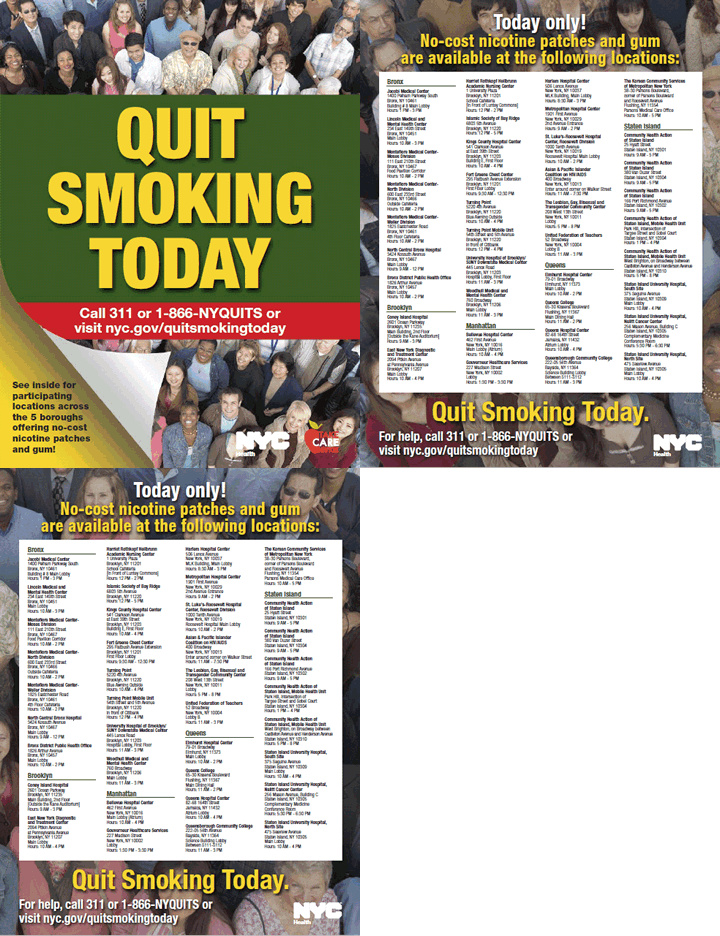
New York City’s Nicotine Patch and Gum Giveaway Program enrolled more than 40,000 smokers in 2010, nearly one and a half times more than last year’s enrollment of 28,000 smokers (and the most successful giveaway since the program’s inception in 2003), the City’s Health Department reported today.
With Virginia’s third-annual tax-free preparedness supplies holiday week starting today, the Governor’s top preparedness adviser told me in an interview that the idea has been a win-win-win’ success increasing focus on disaster readiness among the public, business and the media. ”The holiday gets people’s attention, says Terrie Suit, assistant to Governor Bob McDonnell for Commonwealth Preparedness, “before a hurricane is just off the coast.”
Suit calls the week a “‘man-made’ opportunity to promote preparedness” in a manner that solely an awareness-oriented readiness week cannot. She says it gives preparedness advocates “something to talk about with the public” — Â a tangible benefit — rather than just pleading with them to prepare every hurricane season.
Normally, when government wants to influence social behavior, it goes beyond words and employs carrots and/or sticks: incentives (retirement savings, recycling) or disincentives (it’s ‘click or ticket‘). The former, incentives, is far more appropriate for preparedness. But to date, with the exception of these tax free holidays tried by a couple of states, government has not used any incentives on preparedness. So, it’s not surprising the public has by and large not acted, and the nation has not made enough progress on citizen readiness. In Virginia, using a ‘carrot’ — one of the public sector’s levers (the tax code) — sent a message to Commonwealth residents as well as its media and private sector that government is serious about this policy objective.
Suit says that the “retail community has taken the week and run with it”. A number of major retailers have integrated preparedness products into their overall marketing promotion this week: Walmart will use ReadyVirginia flyers as bag stuffers, Target will run newspaper advertising and place point of purchase info on exempt items, Kroger will run newspaper advertising and make in-store displays. Lowe’s will take out newspaper advertising and make in-store displays of tax exempt items.
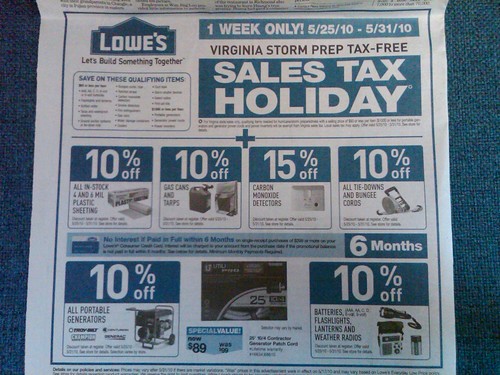
Lowe’s will also be giving customers an additional 10 to 15 percent discount on these hurricane-related products when they shop during the holiday (see ad below). The holiday is also sponsored by the Virginia Chamber of Commerce and state Retail Merchants Association. Profit incentive for private sector makes it more likely they will work hard to promote and distribute products to the public. rather than just putting up signs encouraging people to buy supplies.
Though Suit clearly believes that the holiday is a success, it is difficult to evaluate with a reliable metric either how much the public’s preparedness has increased or the tax holiday’s revenue impact as the state cannot measure sales tax it does not receive. I (and the retailers) would argue that bringing more people into the stores — particularly during difficult economic times — results in incremental sales and taxes on non-emergency items.
Louisiana, the only other state with a tax free preparedness period (May 29-30), did a study that estimated that the weekend cost $2 million in lost tax revenue on emergency products. But I think a better indicator is the enthusiasm of retailers for the holiday, which they believe brings in new (and taxed) revenue in other parts of their stores. And to Virginia’s Suit, who is responsible for preparing a state which has been hit hard by hurricanes, says, “we can’t afford not to do it.” What also needs to be counted in any fiscal evaluation is the amount of paid corporate advertising and increased media coverage, particularly in comparison to the infrequent and inconvenient rotation that the unpaid preparedness PSA’s usually receive.
A Lowe’s newspaper advertisement in today’s Richmond Times-Dispatch promoting Virginia’s Hurricane Preparedness Holiday,
As Virginia’s experience has shown, there much more that could and should be done to create preparedness partnerships with private sector on the local and national level. This week, during FEMA’s webinar kicking off National Preparedness Month, a participant on the call asked officials from the Ready Campaign if the government would be working with businesses to make emergency supplies available for activities during the Month. It’s a great question. But at present, the answer is no, which is missing a great opportunity.
As has been frequently discussed on this blog, government should be reaching out to manufacturing and retail companies in the preparedness field (ie. food, wireless devices, bottled water, big box stores) to work out marketing/promotion tie-ins that would offer free or deeply discounted products — in addition to the sales tax break — as part of preparedness information activities. (As the government has limitations working directly with companies, it would want to include the American Red Cross to work with the sponsors).
For example, why not partner with wireless communications retailers to provide a discount on cell batteries or phones (or free minutes) if people brought in a completed family communications plan into the stores? Or big box store could offer an extra free emergency supply six pack of bottled water with the purchase of a case. Or discounts to fill ‘go-bags’? Here again is a perfect opportunity for a win-win-win for the public, business and government emergency management departments. Businesses want to do more around preparedness because it gives them the opportunity to do good and do well (as this press release from Target indicates). As with most obstacles to citizen preparedness, it takes focus and coordination more than money to move forward.
President Obama just issued a proclamation declaring the 23rd-29th National Hurricane Preparedness Week. But while well meaning the document, to be frank, is just perfunctory words: “I urge individuals, families, communities, and businesses to take time to plan for the storm season before it begins.” By contrast Virginia Governor’s McDonnell’s Preparedness Week announcement has the same exhortations of the President, but it comes along with some tangible initiatives to make it easier for the public to actually follow the recommendations. And all that is necessary is to pass the law and then some organizing by the Commonwealth’s Department of Emergency Management.
“The National Hurricane Center at the National Oceanic and Atmospheric Administration, as well as the Federal Emergency Management Agency, recommend taking several important steps to ensure safety. These precautions include: developing a family disaster plan; maintaining an emergency supply kit; securing homes, businesses, and belongings; and learning evacuation routes.”
Now, that might sound to some people as a lot, particularly relative to what the government does now on preparedness. But if officials are serious about citizen readiness — and I think they are — then government has to followup those words with actions. If not, then let’s not expect citizens to be prepared in advance and make our disaster response plans reflect that. (I also don’t think most Americans would object to targeted, inexpensive and useful initiatives on disaster preparedness.)
Suit, a former state legislator said the tax holiday enjoys bipartisan support in the legislature. It was originally signed by a Democratic governor and is being continued by his Republican successor. Virginia is one of two states (along with Louisiana) that have a tax holiday for preparedness products. The idea is not a panacea, but Suit says any state that wants to being more attention citizen preparedness should try it.
Here in New York, I recommended it to my local State Assemblyman Jonathan L. Bing. He introduced a bill which would create which would create a ‘tax holiday’ for preparedness supplies and “Go-Bags,†in the New York State House. Under the legislation, New Yorkers would be able to buy emergency supplies without paying state sales tax between September 1st-11th (the period between the anniversaries of 9/11 and Katrina) and purchase pre-made “Go-Bagsâ€Â tax free throughout the month.
These icons link to social bookmarking sites where readers can share and discover new web pages.


.jpg)