There was a segment this week on ABC’s Nightline, titled “In The Lap of Luxury On Doomsday,” about the deluxe accommodations/shelters being offered for sale as an escape in the event of a major national catastrophe. The reporter, David Wright, visits an underground development in California’s Mojave Desert offering space for $50,000 per adult (and $25,000 per child), and he looks at the plans for another set of “survival condos” built in a former ballistic missile silo in Kansas being sold for $1.7 million per floor.
Through Environmental Protection Agency Administrator Lisa Jackson’s Twitter feed, I learned that the federal government’s Serve.Gov website for volunteer opportunities has set up a search page for citizens interested in helping on the Gulf oil spill recovery.
Serve.Gov has created a widget (above — to post the widget, click on the “Get Widget” icon) on its “Gulf Oil Spill: How You Can Help” page. The search function allows the user to look for volunteer opportunities by zip code. However, the page notes that at present there is not a high demand for untrained personnel due to the “complex nature of oil cleanup, coupled with health and safety concerns”. At this point, I think it is more useful for interested volunteers to visit the impacted states’ individual citizen Oil Spill pages which are also listed on the widget (several of those sites offer information on citizen training and are collecting names for when/if a number of untrained personnel will be needed).
Florida’s Volunteerism Commission’s website, for example, offers a county-by-county rundown of volunteer needs and offers the overview (below) of the situation for citizens interested in helping out:
There has been a tremendous amount of support from volunteers who have prepared Florida’s coast for the oil spill. As of Monday, June 28, 3,250 volunteers have served 19,467 hours on oil spill response activities.
Volunteers are still needed for other meaningful activities throughout Florida’s communities. Volunteer Florida encourages everyone to get connected with a local organization. Volunteers can support these organizations throughout the oil spill and beyond through appropriate activities such as Coast Watch, pre-oil landfall beach cleanups, fundraising, and meeting other needs of responding organizations.
Volunteers can also receive training as a member of a Community Emergency Response Team, a 211 operator, or a volunteer manager. Even though volunteer opportunities with the oil spill are limited, volunteer opportunities in the local community, not connected with the oil spill, are limitless. This website features volunteer activities happening in your own backyard as well as links to other websites with volunteer opportunities.
These icons link to social bookmarking sites where readers can share and discover new web pages.
Homeland Security Secretary Janet Napolitano announced yesterday that the Department would be launching a nationwide “See Something, Say Something” campaign.
Napolitano made the announcement in New York City’s Penn Station at the beginning of a daylong train tour down the northeastern corridor highlighting rail security.
The “See Something” campaign was initially created by New York’s Metropolitan Transit Authority; it received a lot of attention recently when vendors in Times Square tipped off police to a bombing attempt.
In the coming months, DHS will expand the “See Something, Say Something” campaign nationally with public education materials, advertisements and other outreach tools to continue engaging travelers, businesses, community organizations, and public and private sector employees to remain vigilant and play an active role in keeping our country safe.
I think the expansion of the “See Something, Say Something” campaign is a terrific development that this blog has long been advocating for. I would suggest that the campaign be more specific and robust in explaining what the public should be seeing and saying if it is to be most effective. There is a need to better educate citizens about what “somethings” to look for in part by offering more instances of successful civilian tips.
In addition to the “See Something, Say Something” announcement, Napolitano held a swearing-in for the new head of the Transportation Security Administration John Pistole inside Penn Station waiting area.
These icons link to social bookmarking sites where readers can share and discover new web pages.
As the arrival of Alex signals the start of the hurricane season, I wanted to highlight a recent U.S. Census Bureau study that found in the last 50 years the population in coastline counties has almost doubled, with growth along the Gulf of Mexico soaring by 150 percent.
“Coastline counties along the Atlantic and Gulf, as well as the Hawaiian Islands, account for nearly two-thirds of the nation’s coastline population and are home to four of the nation’s 10 most populous counties,†said Steven Wilson of the Census Bureau’s Population Division, who co-authored the report. “As hurricane season begins, this report should put into perspective the number of Americans living along the coast who might be affected.â€
All in all, 87 million people, or 29 percent of the U.S. population, live in coastline counties, including more than 41 million in Atlantic and 32 million in Pacific counties. In 1960, only 47 million lived in coastline counties.
The danger of growth in coastal areas has been a regular talking point of FEMA head Craig Fugate throughout his tenure in Washington and beforehand as Director of Florida’s Division of Emergency Management Agency. Fugate frequently points out that local coastal development policies have contributed to turning natural hazards into natural disasters.
With storm season beginning in earnest and the first named Atlantic hurricane heading towards the Texas coast, I thought I would mention that the National Oceanic and Atmospheric Administration has altered the way it will report the five-category Saffir-Simpson Wind Scale eliminating estimates on storm surge and inland flooding from rainfall.
The scale was changed to alleviate confusion over storm surge and flooding predictions that didn’t match what actually happened as a hurricane made landfall, said Chris Landsea, science operations officer at the National Hurricane Center and leader of the team that made the changes.
The new scale still classifies hurricanes by maximum sustained wind speeds, starting at 74 mph with Category 1. Category 3 and above is considered a “major hurricane,” and the strongest with winds greater than 155 mph is Category 5.
More importantly, it tells people how strong a storm it will take to bring down the trees, fences, power lines and walls around them. The damage descriptions to homes, shopping centers and industrial buildings are more specific than the previous version and updated to reflect more coastal development.
Hurricane Alex approaches land as seen from a NOAA satellite photo (Associated Press)
Officials hope the new approach will alleviate public confusion:
Three U.S. Senators have asked President Obama to launch a “National Call to Service” aimed at engaging volunteers to assist in Gulf Coast oil spill recovery efforts.
U.S. Sens. Sherrod Brown (D-OH), Sen. Sheldon Whitehouse (D-RI) and Robert Casey (D-PA), wrote the President yesterday requesting that he fully utilize the Corporation for National and Community Service (CNCS) as part of an effort to recruit citizens to help in the Gulf. According to a press release:
“The future of our nation depends on the drive, the talent, and the values of our young people, and tremendous good can come from giving them a mission in this time of turmoil when their country needs them,” the Senators wrote. “By leading a nationwide, proactive mobilization of the resources of the CNCS, Americans across this country will be given the sense of mission they seek: to support the clean-up and revitalization of the Gulf Coast.”
‘As the oil continues to flow in the gulf, thousands of college graduates are entering into one of the toughest job markets since the Great Depression. These young adults are among the most eager to volunteer and help with community development along the Gulf Coast. By increasing the visibility of the CNCS, individuals and businesses will have an avenue to volunteer their support and donate their resources to address this crisis.”
I wrote about a similar idea from a Connecticut prep school headmaster that was mentioned by “Hardball” host Chris Matthews earlier this month.
These icons link to social bookmarking sites where readers can share and discover new web pages.
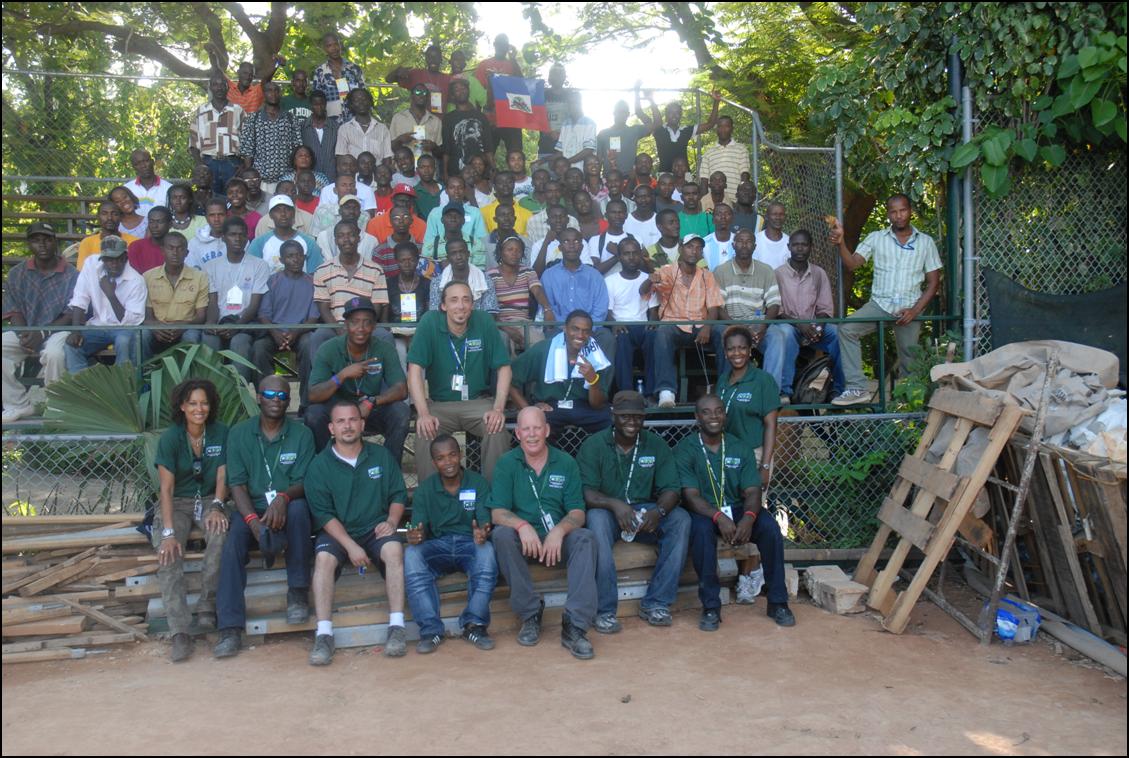
Earlier this month, I wrote about a Community Emergency Response Team (CERT) group from New York City that went to Haiti to train earthquake survivors in emergency preparedness and response.
CERT team members along with their Haitian students
We have just under 100 trainees today, including 18 women. The trainees are organized into two companies, A and B, each with four sections. Each section is composed of 14 people, including one Rapid Responder. These Rapid Responders had previous leadership roles in the camp and manage all administrative duties in their sections, like taking attendance, selecting volunteers, moving groups from one place to another, taking questions, etc. Their assistance allows the fire and health trainers to focus purely on instruction.
The class portion is conducted with two instructions using a PA system to speak to all 100 students seated in bleachers. The practical sections are broken down by sections (14 people). Each day, every trainee gets an MRE (Meals Ready-to-Eat) for lunch. I had to bring my own sandwich today, because the MREs are too salty for me.
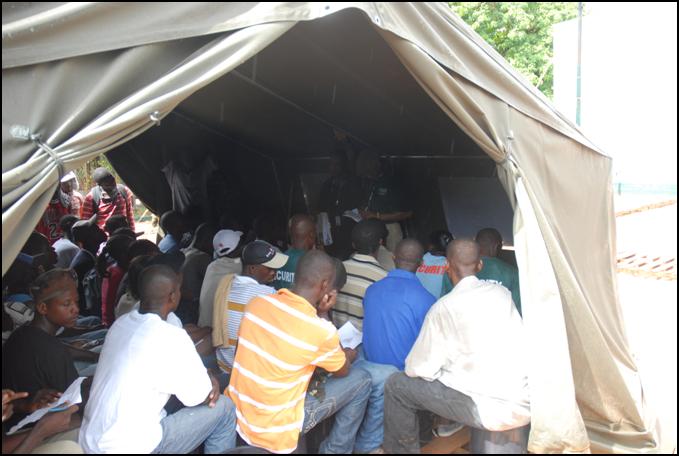
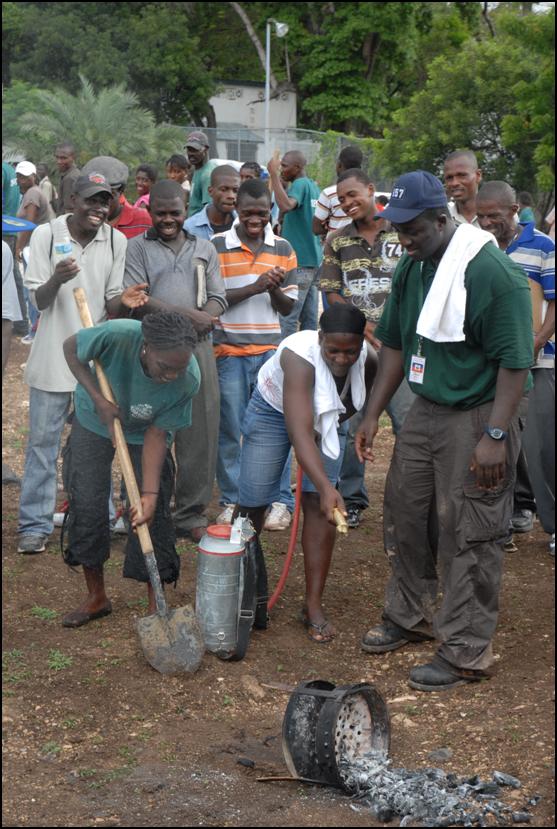
On June 8, we trained the volunteers in fire safety. The course was interrupted by an hour-and-a-half monsoon and we had to move into two large tents to finish the classroom portion. When the storm passed, we practiced putting out different types of fires: five charcoal fires, one wood fire, and one plastic fire. The plastic fire helped highlight the different health threats and firefighting techniques required by various fires. The trainees felt empowered by the lesson and decided to collect all the plastic trash in the camp to reduce the threat it could add to fires.
California Governor Arnold Schwarzenegger just announced that the state is creating the “first-in-the-nation Disaster Corps to professionalize, standardize and coordinate highly trained disaster volunteers statewide.”
Schwarzenegger colorfully tweeted out the news on Friday: “Check out our Disaster Corps…Because we believe in the 7 P’s. Proper prior planning prevents piss poor performance.”
Gov. Schwarznegger’s tweet announcement (photo credit: David Konig)
This white paper is intended for people who must help communities prepare for surprises. It assumes that no community can protect itself from every conceivable threat, but can increase its ability to be resilient or ‘bounce back.’ The resilience approach described below is written in plain language and as culturally-neutral as possible in order to make it globally applicable across a broad range of communities.
We recommend that communities assess their resources and adaptive capacity for a variety of community systems: ecological, economic, civil society, government, and infrastructure in order to find the balance that achieves the degree of resilience most appropriate for them.
This approach also requires attention to the intersections and overlaps of these systems. The ideas presented here are consistent with the most current efforts at defining and assessing resilience, even if the terminology varies. The paper concludes by outlining the next steps for concept refinement and validation through case-based research and development of assessment tools for practitioners.
A University of Illinois study commissioned by FEMA and just released publicly says the New Madrid seismic zone is capable of producing a massive earthquake that could devastate parts of the central United States — and notes the lack of preparedness for such an event.
“I think everybody knows, as we saw things unfolding (in the study), that there are significant gaps in the preparedness for this type of earthquake,” the study’s lead author, University of Illinois professor Amr Elnashai said Friday. “FEMA will have a very clear idea of what is missing, and hopefully they will have some type to fill some gaps.”
FEMA is working toward holding a national-level disaster drill next year that simulates a big New Madrid quake. ”This comprehensive study has not only assisted in our planning and preparedness efforts, but should serve as a reminder to the public that disaster can strike at any time, and we all need to be prepared,” FEMA spokesman Bradley Carroll said in a statement.
The study was completed late last year but was just recently released. It focuses on Missouri, Arkansas and Tennessee, where the New Madrid seismic zone lies deep underground, as well as Illinois, Kentucky, Mississippi, Indiana and Alabama.