With the hurricane season officially beginning on Monday, we will soon be hearing some names over and over. The National Hurricane Center website shows the list of names for Atlantic storms in 2009: Ana, Bill, Claudette, Danny, Erika, Fred, Grace, Henri, Ida, Joaquin, Kate, Larry, Mindy, Nicholas, Odette, Peter, Rose, Sam, Teresa, Victor & Wanda. Some background information on the naming process from the Hurricane Center follows:
Since 1953, Atlantic tropical storms have been named from lists originated by the National Hurricane Center. They are now maintained and updated by an international committee of the World Meteorological Organization. The original name lists featured only women’s names. In 1979, men’s names were introduced and they alternate with the women’s names. Six lists are used in rotation. Thus, the 2009 list will be used again in 2015.Â
Â
The only time that there is a change in the list is if a storm is so deadly or costly that the future use of its name on a different storm would be inappropriate for reasons of sensitivity. If that occurs, then at an annual meeting by the WMO committee (called primarily to discuss many other issues) the offending name is stricken from the list and another name is selected to replace it. Several names have been changed since the lists were created. For example, on the 2007 list (which will be used again in 2013), Dorian has replaced Dean, Fernand has replaced Felix, and Nestor has replaced Noel. Here is more information about retired hurricane names. In the event that more than 21 named tropical cyclones occur in the Atlantic basin in a season, additional storms will take names from the Greek alphabet: Alpha, Beta, Gamma, Delta, and so on.
Roberto De Vido (who keeps me apprised of Japanese public preparedness efforts from his home on the outskirts of Tokyo) just brought something to my attention here in the U.S. —  the Quake Quiz (www.quakequizsf.org) created by the San Francisco’s Office of Emergency Management and found on its public preparedness site, www.72hours.org.
Quake Quiz is an engaging and informative interactive test that asks users what they would do if an earthquake occurred when they were at home, the office, in the car, the beach, commuting or dining out. The Quiz also offers preparedness tips (some of which will be helpful no matter what the disaster). Particularly striking is that the screen shakes like an earthquake before every question. I will admit to a missing a few answers, but I definitely learned some things. I recommend checking it out both as resource and as a creative way of delivering preparedness information.
These icons link to social bookmarking sites where readers can share and discover new web pages.
Starting today, NotifyNYC, New York City’s emergency alert system, will cover the entire Big Apple. Notify NYC was first launched on a limited basis in December 2007, offering participants in four pilot areas of the City the ability to register for alerts and notifications about significant events in their communities. Notify NYC services are available by email, text message and voice message to home, office and cellular telephones.
Edward Skyler, the Deputy Mayor who oversees NotifyNYC, kicked off the program’s citywide launch at the Office of Emergency Management’s(OEM) headquarters in downtown Brooklyn this afternoon. In an interview, Skyler pointed to last month’s incident when a 747 aircraft and two fighter jets flew over lower Manhattan scaring many area residents as an example of the value of these alerts. In that instance, the U.S. Department of Defense did not tell City officials who therefore were not able to send out a warning through NotifyNYC until afterwards. However, a couple weeks later during another scheduled flyover NotifyNYC did have the info beforehand and did send out an alert.
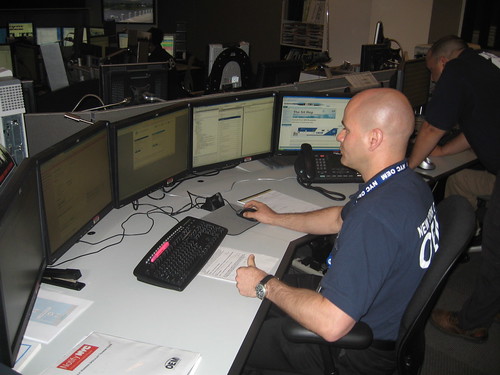
Public Warning Specialist Rion LoBrutto (above) oversees NYCNotify alerts today in the Emergency Operations Center of New York City’s Office of Emergency Management.
Subscribers to Notify NYC will receive these alerts, which provide information about the most severe emergency events, such as AMBER Alerts and natural disasters, in whatever distribution method they choose. Users will also have the option of registering for Significant Event Notifications, which provide informational advisories about less-severe emergency events which may still cause disruptions on a localized basis. Examples of less-severe events are brush fires, extended disruptions of mass transit services and major utility outages affecting water, power and telecommunications. The City will work with utility providers when major outages occur, and provide the public with updates about how and when services will be restored. Another optional category will be Public Health Notifications. Those interested in registering for NotifyNYC alerts (which are free) or learning more information about the program can go to www.notifynyc.gov.
“Attended by well over a hundred persons from the public and private sectors, the two-day workshop was an eye-opening experience that showed the challenges, frustrations and enormous gaps that still remain in this country when it comes to addressing the needs of persons with disabilities and special needs… [I] left the two-day experience moved but extremely frustrated by what I learned…nearly 20 years after the passage of the Americans with Disability Act, we remain a nation woefully unengaged and not pro-active enough in providing some of our most vulnerable citizens with the basic essentials they need to respond to emergencies – the essentials a majority of Americans take for granted.”
Cooper also lays out some of the report findings he finds particularly disturbing, including:
• Only the State of Texas provides a 24-7, 365 means (that is fully compliant with the Americans with Disabilities Act) of notifying deaf and hearing impaired persons of approaching dangers.
• When it comes to emergency preparedness exercises, persons with disabilities and special needs are often forgotten about or not included. As a result, when a real emergency occurs, some (certainly not all) first responders and building evacuation personnel don’t know what to do with those who might need extra assistance.
Despite his frustration with the current situation, Cooper does correctly note the good work of disabled advocates and others in emergency preparedness field. (In fact, I would argue that disabled community has been a model how to improve citizen preparedness for its constituency. Unfortunately, the general public does not have anyone representing its interests in this area with such focus.)
“By offering this criticism, I do not mean to undercut or denigrate the tremendous leadership and progress that has been made by many emergency managers and first responders in the public and private sectors on these issues. Their efforts are reason for praise and recognition, but much more has to be done to improve accessibility for and inclusion of the disabled and special needs populations in emergency preparedness and response efforts.”
To listen to the report or watch it in American Sign Language click here,  or view the first part on YouTube below:
A video (above) with a woman reading the first part of the “Emergency Preparedness for Persons with Disabilities and Special Needs” Report from the American National Standards Institute’s Homeland Security Standards Panel in American Sign Language.
These icons link to social bookmarking sites where readers can share and discover new web pages.
President Obama today issued a proclamation declaring May 24th-May 30th “National Hurricane Preparedness Week”. The proclamation reads:
Each year, hurricanes threaten the safety of American families in coastal and inland communities. These powerful storms can cause heavy rainfall, high winds, tornadoes, and storm surges, which can in turn bring severe flooding, power outages, damage to homes and businesses, and loss of life. Awareness and preparation are critical to surviving and recovering from hurricanes. During National Hurricane Preparedness Week, I call on all Americans — including private citizens and those working in government, business, and the nonprofit sector — to plan ahead and help secure the safety and property of those who face advancing storms.
Â
Americans can take basic steps before a hurricane arrives. The Federal Emergency Management Agency and the National Hurricane Center recommend developing a family disaster plan, creating and maintaining a disaster supply kit, securing one’s home, and designating a safe place to go during a storm. Throughout a storm, individuals should always remain aware of weather conditions. More information on precautionary measures is available at www.nhc.noaa.gov/HAW2/english/intro.shtml.
In a compelling essay which is part of terrific new collection, Brothers: 26 Stories of Love And Rivalry (Jossey-Bass), David Kaczynski writes about his relationship with his brother, Ted, the so-called “Unabomber.” In his piece, “Missing Parts”, Kaczynski discusses the “terrible dilemma” he faced when he realized his brother might be a terrorist: “do nothing and run the risk that Ted might kill again, or turn him in and accept the likelihood that he would be executed for his crimes.” He also describes the close relationship with one his brother’s surviving victims, Gary Wright, who called Kaczynski on 9/11 to make sure he was all right: “I know you take a lot of trips to New York City. I’m so glad to know that you’re OK.”Â
Brothers is edited by Andrew Blauner, editor of the well-received anthology, Coach: 25 Writers Reflect on People Who Made a Difference, and one of my best friends. In Brothers, Blauner has assembled an eclectic and distinguished lineup of contributors, including one of my all-time favorites, The Washington Post’s David Maraniss. The book is resonant to me not only as one of two very close brothers, but also as I watch the relationship develop between my two young daughters.
Brothers would make a good Father’s Day gift for any dad who is a brother or is raising them. But I also think it’s a collection that will be appreciated by anyone with a sibling relationship (not to say that ‘only children’ will not enjoy it as well). You can purchase the book here.
These icons link to social bookmarking sites where readers can share and discover new web pages.
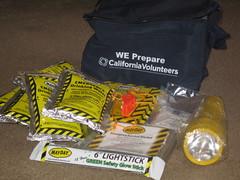
Thanks to CaliforniaVolunteers, I have 10 disaster kits to give away for a new contest. CaliforniaVolunteers is the office that oversees that State’s volunteering initiatives including its family preparedness program, WE Prepare.
To win a kit, send in one of the following: an emergency preparedness tip, something your have done to prepare for a disaster, or a suggestion to improve preparedness in your community to the Comment section below or in an email to me at jsolomon@incaseofemergencyblog.com by June 7th. I’ll choose 10 winners by random.Â
As you can see in the photo (taken by my daughter), the kit contains drinking water packets, a block of survival food, a glow stick, flashlight, whistle and some first aid supplies.
I got the idea for this contest from a blog called Wendolonia which did something similar with CaliforniaVolunteers earlier this year. It was part of an initiative by the state agency to reach out to “Mommy Bloggers” like Wendolonia to promote the WE Prepare family readiness program . (I wrote about that effort last month and then spoke with CaliforniaVolunteers about doing the same kind of contest.)
Again, to win one of the 10 kits above, please send in either a preparedness tip, something your have done to prepare for a disaster, or a suggestion to improve preparedness in your community to the Comment section below or in an email to me at jsolomon@incaseofemergencyblog.com by June 7th.
These icons link to social bookmarking sites where readers can share and discover new web pages.
On Memorial Day and with thousands of U.S. Navy personnel here in New York City for Fleet Week, I wanted to highlight again one of the best television shows I’ve seen in a long time,  “Carrier,” PBS’ 10-part documentary, which follows a six-month deployment of the USS Nimitz to the Persian Gulf. (At present, the Nimitz is in the Pacific Ocean where tragically one of its helicopters crashed Tuesday night with five people aboard.)
The first episode of “Carrier” is particularly good –informative, funny, inspiring, frank, and beautifully shot. There are many interesting moments throughout (as a father of two young daughters, I was particularly taken by the stories of the women serving in so many capacities on the ship). But for the purposes of the blog, I want to mention one theme that comes through right from the start that I think is very much applicable to citizen preparedness back here at home. The episode opens with a stirring three-and-a-half minute video overture accompanied by a song from one of my favorites, The Killers, called ”All The Things That I’ve Done”. (You can view the segment at pbs.org/weta/carrier/full_episodes.htm). Towards the end of the opening montage, a senior fighter pilot tells the interviewer about the ship’s prevailing team-oriented, management philosophy:
“All the departments are vital to make a jet fly off a carrier to put a piece of precision ordinance onto a target…without one department, without religious ministries, without the legal department, without the reactor department, without supply department, without hot water cold water and steam for the catapults none of it works.”
During the show, that ethic comes through repeatedly from the top levels of the ship, and it filters down throughout the Nimitz — that an aircraft carrier is only as strong as its weakest link and the enterprise will be strongest when everyone is doing their job all down the line. Further, and maybe even more importantly that objective can be compromised by anyone at any level. We need to bring that same approach in communicating with the public about our homeland security
Â
The deck of the Nimitz from “Carrier”.
I have had the opportunity to interview many political leaders, homeland security and emergency management officials, as well as first responders. And almost all of them tell me how important the public is to preparing, preventing and then responding to emergencies.
If they really believe it (and I think they do) then the first step is for them to more actively tell us how and why we are important. In fact, I would argue that should be a priority of the next President to tell us exactly that – both encouraging and challenging us to take on that responsibility. Understandably, people aren’t going to take on responsibility if you don’t tell them why and how they should.
Obviously, a kitchen dishwasher is not as vital as a Navy top-gun airman to the ultimate objectives of the carrier. Nor is the average citizen as crucial as a first responder to preparing and responding to emergencies. However, as we see over and over, most recently during the recent floods, the public is a key element in dealing with disasters. And we also have the ability to hamper that process as well. It may well be partially propaganda but you get a clear sense in “Carrier” that even the lowest ranking person on the Nimitz still feels part of a team.
Obviously, we have military — and uniformed responders – that are on the so-called point of the spear. But the rest of us have a role too and right now our talents, energy and spirits are not being tapped fully. Our leaders need to tell us how and why we are important in order to foster the same team mentality at home that, at least according to Carrier, the leaders of the Nimitz have successfully done on the water.Â
These icons link to social bookmarking sites where readers can share and discover new web pages.
During those periods, sales tax will be lifted on purchases of preparedness-related supplies and equipment including batteries and flashlights; bottled water and coolers; tarps, plastic sheeting and duct tape; smoke detectors and fire extinguishers; portable radios; cell phone chargers; first aid kits and more. Portable generators and inverters also are included. A complete list for Virginia can be found at: www.tax.virginia.gov/web_pdfs/Exempt_Products.pdf. In these recessionary times, Virginia is promoting the week for both its preparedness and cost value. As the Ready Virginia web site suggests:
“It’s smart to get ready for hurricane and flash flooding season, which arrives June 1st. And it’s smart to save money. You can do both by shopping for such products as batteries, food storage containers, generators, first aid kits, bottled water, radios and more between May 25 and 31. When you do, you won’t pay sales tax on many useful products that cost up to $60 or on generators costing $1,000 or less. That’s a savings of 5 percent.”
Ready Virginia is kicking the tax free week off with events at stores and a Radio Disney partnership. According to the Virginia Emergency Management official Laura Southard:Â
“We are partnering with Radio Disney for hurricane season to target families with young children in the Hampton Roads and Richmond regions. (This is one demographic group that is likely to take steps to prepare.) Our effort, called Get Ready Virginia, includes a series of fun, family-oriented gameshow events. We start Monday with an event at a Wal-Mart in Richmond and another at a hardware store in Virginia Beach to kick off the sales tax holiday. Other events will be held throughout the summer and fall. Parents will be given goody bags that include Ready Virginia materials, including a blank family emergency plan that they can discuss and fill out. The campaign also includes public service announcements and 30-minute public affairs programs on the two Radio Disney stations in Virginia.”
I am a great supporter of these tax-free periods because they provide an incentive for the public to prepare and result in greater attention (particularly from retailers and the media) to the often overlooked subject of citizen preparedness. Last year, I suggested to my local assemblyman Jonathan Bing that the idea should be considered here in New York. And Bing recently introduced legislation in the state house to establish a tax-free period between the anniversaries of Hurricane Katrina and 9/11.
These icons link to social bookmarking sites where readers can share and discover new web pages.
U.S. Health and Human Services Secretary Kathleen Sebelius announced today that the Department of Health & Human Services is joining the Ad Council and Sesame Workshop, the nonprofit educational organization behind Sesame Street, to launch a national public service advertising campaign designed to encourage American families and children to take steps to protect themselves from the 2009 H1N1 flu virus and continue to practice healthy habits. As part of HHS and the Ad Council’s campaign, Sesame Workshop produced a television PSA featuring Sesame Street’s Elmo and Gordon explaining the importance of healthy habits such as washing your hands, avoid touching your eyes, nose and mouth and sneezing into the bend of your arm.
Â
A new PSA (above) featuring Elmo & Gordon from “Sesame Street” focusing on helping families protect themselves from the H1N1 flu.
The campaign was unveiled this morning by HHS Secretary Kathleen Sebelius at the HHS/Department of Education Childcare Center in Washington, D.C. The PSAs will be distributed nationwide today and will be supported in airtime donated by television stations. ”We are doing everything we can to protect public health and teach children how they can stay healthy and safe,” said Sebelius. “Elmo, Gordon, Sesame Workshop, and the Ad Council are delivering an important message to our kids.”
The new PSA campaign focuses on the importance of providing parents, teachers and children with accurate information about how to practice healthy habits, highlighting proper hand-washing and simple everyday actions that lead to staying healthy and keeping germs away. Created by Sesame Workshop, the television PSAs encourage audiences to visit www.cdc.gov to get more information on how to stay healthy. The PSAs are an extension of Sesame’s Healthy Habits for Life initiative, which helps young children and their caregivers establish an early foundation of healthy habits.