From the same folks who brought you the Cross Blog comes “Ready Radio”, an internet-based biweekly show dedicated to emergency preparedness and related subjects. I just listened to the first episode, and I can tell you that hosts Lise Harwin and Robin Parker of the Red Cross/Oregon Trail Chapter bring the same creativity, enthusiasm and usefulness to the radio show as they do on their website.
Their goal is to “try to make preparedness relevant and even a little bit fun” and “give you practical tips for practically anything”. And already in their debut they are delivering. The show fills an open emergency preparedness niche in the radio world, and I recommend it. Ready Radio can be heard Thursdays at 1:00pm on the Small Plate Radio Network. But it also available for download and you can subscribe through iTunes (which I have done).
These icons link to social bookmarking sites where readers can share and discover new web pages.
So, for this contest I thought I would make the entry: “What have you done in the last year to prepare yourself, your family, your workplace, your kids school or your community over last year?” Either write your answer in the Comment section below or send it to me at jsolomon@incaseofemergencyblog.com. I’ll pick three winners by random and print their answers.
I recommend those who cannot wait or who do not win the contest should buy the book here.
These icons link to social bookmarking sites where readers can share and discover new web pages.
The U.S. Department of Homeland Security (DHS) has just started a new blog called The Blog @ Homeland Security”, an addition to the Department’s web presence “designed to increase transparency and facilitate the dialogue between DHS and the American public.”  It will augment the existing Leadership Journal blog, which, according to DHS New Media Specialist Graves Spindler:
“will remain the Department’s primary channel for policy-related posts; The Blog, however, has a slightly different focus and will be updated throughout the day. The idea is to provide a different look at the department and provide more access and transparency by making the day-to-day activities at DHS more visible. The Blog will have a range of regular content features including the Daily News Roundup and various reports from the field, as well as photos, videos, cross-postings, and an open comment policy for dialogue beneath each post.”
Chris Battle of the Security Debrief blog offers some good advice for those overseeing the new platform:
“It remains to be seen how responsive and interactive DHS’s new blog will be. For a particularly good example of a responsive and transparent government blog, check out the Transportation Security Administration’s blog. (Formerly known as the “Evolution of Security” blog, it has been rebranded with the more mundane but unquestionably more, er, practical, title of “TSA Blog.”) However, the DHS press shop has promised that “TheBlog @ Homeland Security” will be more dynamic, with far more frequent postings.”
“The Blog @ Homeland Security can be found at www.dhs.gov/theblog. Welcome to the blogosphere.
These icons link to social bookmarking sites where readers can share and discover new web pages.
Though I am too old for summer camp, I did get to go away this weekend to CrisisCamp in Washington, D.C.. CrisisCamp was a gathering of about a hundred campers from all over the country and the world with an expertise or interest in crisis management/disaster preparation and response, especially in how new technology and communications applications can be brought to bear in this area. It was a really remarkable event in its content, format and spirit. Below is a postcard from Camp. (Though to get the most complete idea of what happened at CrisisCamp — and what will be happening going forward — I suggest you go to the CrisisCamp Ning page, the initial invitation, and the tweets with #CrisisCamp tag. Also, one of the outcomes of the event was the establishment of a CrisisCommons Wiki “to capture knowledge, information, best practices, and tools that support crisis preparedness, prevention, response, and rebuilding”; check it out and contribute.)
“where several campers exchanged a host of ideas on the need to better connect people with their social networks and information through the use of technology, especially during times and places of crisis. For example, campers shared how mobile innovation on mobile health and alternative power supplies was happening in Africa. Others shared how citizens used their technical skills to aggregate data to help people (often in another part of the world) synthesize desperate pieces of information into something they could understand. We uncovered a dividing line between international humanitarian relief and domestic crisis response. We saw common themes across all efforts including: the use of mobility, the Internet as a common coordination platform, the need for volunteers and the ability to provide alternative community communications access areas. By the end of the tweet-up, we had 40 volunteers sitting around in a circle with an agreement that there should be a forum to exchange these ideas. And it was there, where a common goal brought government, NGOs, private sector, hackers and activists together to create CrisisCamp.”
This weekend’s Camp began on Friday evening at the World Bank’s headquarters with drinks and a series of presentations. The presenters followed the Ignite format which means each was allowed 20 slides and 15 seconds per slide. That’s just five minutes for the speakers to get through much of their life’s work. But it is a great format that moves things move briskly and gets through a lot of material (and also helps hold the audience’s attention on a Friday night when the open bar just outside remains open throughout). Videos of all the presentations can be found here. The slides are being collected here.
On Friday night, one of the presenters, Paul Berger, discusses the Emicus emergency response system which will be piloted this summer during hurricane season in Florida. (Photo: Erik Endress)
“CrisisCamp DC is a global movement that is bringing together volunteers, academics, non profits, companies and lessons learned to advocate for further use of technology and telecommunications to assist citizens and communities during crisis.”
Heather told the campers that she was particularly interested in examining two major themes — 1) how to take some of the more advanced crisis preparedness and response tech applications being used around the world and bringing them to the U.S. 2) how to get the public more involved in the technology and communications being discussed at this camp. (I couldn’t have agreed more with both objectives as they have been frequent topics on this blog.)
We then went around the auditorium for introductions and giving three tags that would describe ourselves/interests. I had never been asked to do that and I kept on changing my three as I listened to others. I finally ended up with ‘emergency preparedness’, ’social media’ and ‘citizens’. Since CrisisCamp was an “unconference” , there was no preset topic agenda.
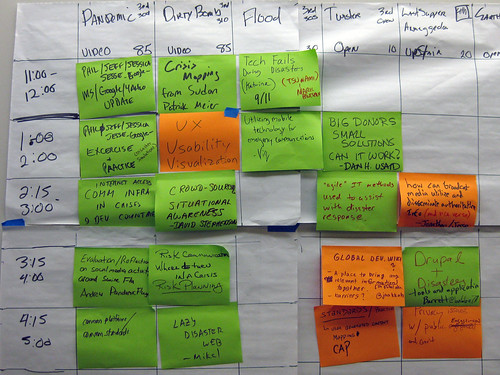
Silona Bonewald got up on the stage to solicit suggestions from the audience on the subjects we should cover in the next two days. After about 20 minutes or so of brainstorming, the topics began to take shape. Campers then began to discuss whether to merge some of the suggestions and who should lead the panels (though of course they were more interactive discussions than lectures). Then, the  ideas were placed on the wall creating a schedule for the five classrooms upstairs — aptly named Dirty Bomb, Flood, Earthquake, Last Supper/Armageddon, and Pandemic (as in “I think I’m going to attend the “Microsoft/Google/Yahoo Update” session in the Pandemic Room at 11:00am)
CrisisCamp schedule being assembled on building’s lobby window. (Photo: Erik Endress)
And, in fact, that update in the Pandemic room was quite a remarkable opening session. On the same ad hoc panel were representatives of Microsoft, Google and Yahoo talking about some of their work in this space and what the future could bring. Some of comments of twitterers in the audience expressed amazement (”microsoft, google and yahoo sitting together talking about what they do re:crisis. Freaking amazing” said one tweeter.) Here were fierce competitors who at least for this hour (and then throughout the Camp) were talking about shared goals and taking suggestions from the audience. Making things even more interesting is that while the discussion continued you could follow the Twitter stream of people in the crowd (and in remote locations) on your laptop commenting on what they were hearing and offering questions to the panel.
Representatives of Yahoo, Google and Microsoft in the Pandemic Room (Blurry Photo: Me)
After that session was finished, I moved across the floor to the Flood Room for a panel on “Using Mobile Technology In Emergency Communications.” This is a topic I know a little better so I contributed a couple of comments about the need to teach citizens how to use their mobile phones and social media in advance so they will know what to do in an emergency. There was some discussion about how much you could really train people before a crisis. (In fact, one of the questions that came up in this session and in other places during the weekend is how much will the public really prepare in advance of crisis or whether realistically most of the focus should be on response).
It’s a fair question but — as the proprietor of a citizen preparedness blog — I would argue it is worth doing. But I suggested in the session that being prepared is not necessarily knowing all the information on a ‘dirty bomb’ or ‘bioterrorism threat, but instead being familiar with how to use tools (ie. technology) beforehand so you can react to whatever happens. Personally, I think your cellphone/pda is the most important item anyone can have in their emergency kit for that very reason. In this session, there was further discussion on another major theme of the Camp: getting those who are not tech savvy or otherwise disconnected. There was also some talk about suggesting that the large wireless (and other communications) companies make an effort along with the government and Red Cross to promote the safety uses of their devices to the public (during, for example, National Preparedness Month in September).
Between sessions there were plenty of sidebar discussions among folks who may have known each other previously just though web communication and were meeting for the first time. Andrew Wilson from the U.S. Health and Human Services Department’s social media unit, including PandemicFlu.Gov which was useful during the H1N1 outbreak, and I had a discussion about the value of government official/experts twittering to complement the ‘official’ social media information.
In fact, a highlight for me was getting the opportunity to meet in person several people I have had email or Twitter relationships. David Stephenson of Stephenson Strategies has been a pal and advisor through the web for the last several years; others include Erik Endress of the Xpedite Network, and  Mark Prutsalis of  Sahana, Catherine Kane and Carrie Houseman from the Red Cross, and Tim Tinker and Michael Dumlao from Booz, Allen. Erik was one of the organizing group which did a tremendous job (and took the videos and many of the photos on the Ning page). David, Mark, Tim and Michael each gave fascinating presentations on Friday night.
Saturday’s Schedule. Some of the sessions included: “Crisis Mapping”; Risk Communication Where To Turn In A Crisis Risk Planning”; “Common Platforms Common Standards”; and “Tech Fails During Disasters”.
Today, Sunday June 14th, is my parents 50th anniversary. And they said it wouldn’t last…Congratulations and thank you mom & dad. It is also World Blood Donor Day.  And as someone who over the past seven months has benefited from a lot of blood, I hope you will consider donating wherever you are reading this in the world. I know it is not fun to have your arm pricked (I had it done twice on Wednesday and grimaced both times), but the pain passes quickly and you will doing a great thing for someone else. As I (a previously very periodic donor) found out, you never know when you’ll need some plasma yourself.
A new policy brief, “Before Disaster Strikes: Rate and Raise Public Preparedness Now,” recommends the new National Security Council Resilience Directorate “task the Department of Homeland Security to work with federal and non-federal stakeholders and independent experts to develop agreed measures of public preparedness, and develop and execute cost-effective, innovative approaches for ensuring timely progress in preparedness.”
The thoughtful and well-timed (as the Obama Administration begins developing its public preparedness approach) seven-page brief is written in the form of a memo to top Administration officials. The author is Debra K. Decker from the International Security Program/Project on Managing the Atom at Harvard Kennedy School of Government’s Belfer Center. The Resilience Directorate at the White House is a new creation which was recently announced by President Obama.
Decker brief makes two overall recommendations:
1. Task DHS to work with stakeholders to develop well-considered measures of public preparedness and then to be responsible with those stakeholders for establishing and achieving target levels of preparedness, with regular reporting to the public and to the new Security Council Resilience Directorate (Preparedness), which should monitor outcomes. 2. Make public preparedness a high-priority measure for selected agencies in the new federal performance system.
She suggests the next steps should be:
“The new White House Preparedness Directorate should direct DHS to lead this effort and other federal stakeholders to participate and should monitor progress, including by ensuring that public preparedness is part of target agencies’ and departments’ performance evaluation. DHS should designate an individual/office responsible for the public preparedness effort and its outcomes.”
The individual/office would:Â Establish an initial process plan to effect the effort;Â Coordinate the development of agreed measures of levels of public preparedness, with attention given to the different needs of populations and of regions at different times, and to the desirability of the approaches;Â Develop, evaluate, and execute agreed approaches for ensuring timely progress in these measures, with agreed milestones for different stakeholders’ contributions and for public preparedness target outcomes based on community requirements;Â Monitor progress, review program needs, and report back to the Security Council and the public.
Though Dicker outlines a robust commitment to public preparedness, she concludes her memo with this truism: “This need not be an overly complex effort. Establishing initial basic measures and targeting some simple gains may greatly reduce risks.” As I have discussed frequently on the blog, increasing citizen readiness and engagement is as much a matter of focus and commitment as anything else. Thanks to Molly Duggan for bringing this piece to my attention.
These icons link to social bookmarking sites where readers can share and discover new web pages.
In a report released yesterday, the Federal Emergency Management Agency (FEMA) says ”too many Americans don’t know how to get critical information or where to go in the event of a disaster,” the report, “Personal Preparedness in America: Findings from the Citizen Corps National Survey” concludes. “60% of respondents were unfamiliar about their local evacuation routes. 54% of respondents were unfamiliar with their local shelter locations.” (The survey was conducted in the Fall of 2007 before the growth of social media emergency information sources, but I think that the results wouldn’t be very different if fielded now.) Yet, only 37% of respondents think a natural disaster will ever affect their community and less than 1 in 5 believe terrorism will strike nearby.
In order to increase citizen readiness and engagement, the report recommends that government officials at a national and local level better inform Americans about what specifically they would need to do in response to a broader range of threats; explain (and even convince people) of the benefits of preparedness for disasters; involve the citizenry in practice exercises; improve collaboration between the public and law enforcement; and expand research in this area. A summary of the report’s findings can be found here.
FEMA’s Community Preparedness Division and the Citizen Corps also released a companion report, “Citizen Corps Urban Area Survey” which did separate research in the cities of New York, Houston, San Francisco and Indianapolis (summary sheet here). There are a lot of meaty conclusions and recommendations in the reports (which I suggest for anyone interested in citizen preparedness.) Below are some that were most striking to me:
There is a need to convince the public of the efficacy of preparedness, particularly in the event of terrorist attack:
“Many individuals did not believe that preparing for terrorist attacks would make a difference in an actual event. Preparedness and response education must contain messages about response efficacy for the recommended actions for each hazard. A particular emphasis on response efficacy is needed for hazards that are less understood by the public (hazardous materials accidents, severe disease outbreaks, and terrorist attacks).”
Public education is necessary, particularly in responding to less understood hazards, such as an explosion, chemical release, or dirty bomb:
“Many individuals lacked confidence in their abilities to know what to do in the first few minutes of different types of disasters. Communication and outreach strategies should educate individuals about specific response skills needed for natural hazards most likely to occur in their communities and include a particular emphasis on less understood hazards, such as an explosion, chemical release, or dirty bomb.”
An “All Hazards” approach must also highlight the difference between various hazards:
“Perceptions of the utility of preparedness and confidence in ability to respond varied significantly by type of hazard. Because all hazards messaging may dilute critical differences in preparedness and response protocols, preparedness and response education should include a focus on hazard-specific actions appropriate for each community.”
Though most people are not prepared, many of those who say they are really aren’t:
“Greater appreciation for the importance of household plans and knowledge of local emergency community procedures and response resources is needed. Individuals who reported being prepared lacked critical plans and information.”
Citizens should get an opportunity practice what is being preached:
“Practicing response protocols is critical for effective execution. Greater emphasis on drills and exercises is needed.”
Much of the public is (mistakenly) relying on the cavalry to show up and help them:
“Individuals’ high expectations of assistance from emergency responders may inhibit individual preparedness. communicating more realistic expectations and personal responsibilities is critical.”
There is a need to build upon “See Something, Say Something”:
“Individuals believed they had a personal responsibility to report suspicious behavior, but greater collaboration between citizens and law enforcement is needed.”
Over the past few years working on the issue of public preparedness and engagement, I have found myself noting songs and lyrics I’ve heard that I think touch on related themes. Last year, I posted videos from YouTube (along with some selected lyrics) of four songs that I find particularly resonant and representative of the ideas raised in this blog. (These songs also provided me with inspiration during the past eight months as I deal with leukemia.)
I am pretty sure that none of these songs were written about civilian preparedness, but I think each relates in some way to the need for citizens to be ready to react and respond to whatever emergencies we face individually, as a nation and as a planet. After I listen to these songs, I find myself getting charged up about doing something. When I initially wrote this post, the Utah Commission on Volunteers’ Lani Nisbet and the Oregon Red Cross’ Robin Parker offered their own songs which I have added at the bottom of this post.
If you have suggestions for other songs that you think also relate to citizen preparedness, please write them in the Comments section or email me at jsolomon@incaseofemergencyblog.com and I will post them:
1) Five For Fighting, “World” – ”What kind of world do you want/ Think anything/Let’s start at the start/Build a masterpiece/Be careful what you wish for/History starts now.”
2) Patti Smith, “People Have The Power” –”The people have the power/The people have the power/The power to dream /to rule/to wrestle the world from fools/it’s decreed the people rule/it’s decreed the people rule/I believe everything we dream/can come to pass through our union/we can turn the world around/we can turn the earth’s revolution/we have the power/People have the power.”
3) The Eagles, “New York Minute” – “In a New York minute/Everything can change/In a New York minute things can get a little strange…And in these days/When darkness falls early/And people rush home/To the ones they love/You better take a fool’s advice/And take care of your own/One day they’re here/Next day they’re gone.”
4) Foo Fighters, “Times Like These” — “It’s times like these you learn to live again/it’s times like these you give and give again/it’s times like these you learn to love again/it’s times like these time and time again.”
And, second, Robin Parker, from the award-winning Cross Blog in Portland, Oregon suggests Andrew Bird’s “Fiery Crash”. (“To save all our lives you’ve got to envision the fiery crash before you get on the plane.â€)
ANDREW BIRD, “FIERY CRASH”
Keep the suggestions coming to jsolomon@incaseofemergencyblog.com, and I will continue to post them.
These icons link to social bookmarking sites where readers can share and discover new web pages.
In the June issue of Homeland Security Today magazine, there are a couple of interesting articles with relevance to public preparedness:
1) “From Florida To FEMA” by Michael Peltier is an interesting profile of new FEMA head Craig Fugate. The piece notes Fugate’s focus on changing the public’s expectations, mindset and responsibilities on preparedness. In Florida, he tried to get residents out of a “victim mentality and into taking a more active role in their own survival. He, in fact, dropped the word ‘victim’ from his public vocabulary.”
2) “Social Networks To The Rescue” by Mickey McCarter discusses the increasing role and potential of social media in disasters. The article describes how both FEMA and CDC are aggressively trying to determine how best to harness these new tools for disaster preparedness and response.
These icons link to social bookmarking sites where readers can share and discover new web pages.
As has been mentioned regularly on the blog, Israel offers a helpful model for the U.S. when it comes to civilian preparedness and engagement, including in its drilling and school-based programs. Of course, Israel’s special circumstances (terror threat, size, militarily-trained populace, etc.) mean that not all its lessons are readily transferable. Yet, these exercises which involve Israelis of all ages help keep the citizenry informed, engaged and prepared.
URIEL SINAI / Getty Images Schoolchildren in Tel Aviv act as wounded victims during a large national drill to prepare the public for any catastrophic attack.
These icons link to social bookmarking sites where readers can share and discover new web pages.