Among the panel discussions I plan to attend today are “Rethinking The Emergency Alert System” and “Rethinking How We Characterize And Communicate Risk” (both are subjects that this blog has been rethinking as well so I am very interested to hear from the panelists and audience). FEMA Administrator Craig Fugate will give the Workshop’s keynote speech later today.
Recommendations for National Academies Disaster Roundtable posted by Workshop attendees
If you want to follow the Workshop’s panels, speeches and activities, you can check the Center’s Twitter feed which will be tweeting coverage; hashtag is #haz. (I will be following the feed from here as there a number of panels I am interested in that are running contemporaneously.) The Workshop schedule can be found here.
These icons link to social bookmarking sites where readers can share and discover new web pages.
The Preparedness Toolkit offers ways to encourage individuals to volunteer and a comprehensive guide to developing their own “do-it-yourself” readiness projects. The site will help citizens create a service project to prepare their family, friends, neighbors, and colleagues for disasters in their local community. It offers detailed steps for a volunteers to follow, including these steps: 1. Identify Local Partners 2. Build a Team 3. Set Goals 4. Serve Your Community 5. Celebrate Success. For more information and to download the Toolkit, visit http://www.serve.gov/toolkits/disaster/. Anyone who might be interested in volunteering in the disaster preparedness area or even helping organize their own readiness effort should go to this site.
These icons link to social bookmarking sites where readers can share and discover new web pages.
The National Commission on Children and Disasters recently approved an initial set of recommendations in its interim report to President Obama and Congress. The final report, due in October, will reflect an assessment of persistent gaps in emergency preparedness, response, and recovery for children and include policy suggestions to fill the gaps. The panel’s preliminary recommendations are:
* Creating an office within the Federal Emergency Management Agency specifically focused on incorporating children into disaster planning, response and recovery;
* Creating a standing advisory body to the Secretary of Health and Human Services to formulate guidance on emergency medical countermeasures for children;
* Adopting standards for providing safe and age-appropriate environments and supplies to children housed in emergency shelters;
* Elevating child care to an essential service in community recovery efforts;
* Requiring comprehensive disaster plans, training and exercises for facilities that serve or house children-schools, child care centers, group homes and juvenile justice systems-and are developed and approved in partnership with local and state emergency managers.
I had the opportunity to attend Thursday’s U.S. H1N1 Flu Preparedness Summit held at the campus of the National Institutes of Health (NIH) in Bethesda, Maryland. The all-day event was organized by the Obama Administration to focus attention on preparation for and response to a possible more serious H1N1 outbreak in the Fall. Five hundred public health officers came from all over the nation to hear presentations from federal, state and local officials and discuss lessons learned from the Spring.
Administration officials announced that an H1N1 vaccine is expected to be ready in October and that more vulnerable populations, such as school age children, pregnant women and individuals with underlying illnesses will be the first in line for vaccination. There was also an announcement of increased federal funding for state and local preparedness initiatives and the launch of a one-stop government website, Flu.Gov. Particularly interesting for this blog was that much of the discussion focused on getting the public ready and informed — whether it be family preparation, school/workplace policies, mass vaccination and risk communications.
I thought it would be helpful to outline some of the key issues/questions regarding the public that were discussed during the Summit. In addition to attending the panels, I spoke to officials to find out what they want the public to do as well as their concerns, obstacles and challenges in getting Americans prepared by the Fall. (I videotaped a few interviews and include them below.) This is a long post; I hope it’s useful.
At the Summit, federal officials offered a clear message to the public to start preparing for a possibly more lethal H1N1 outbreak in the Fall. However, they are still working out the policy and logistical questions that citizens would face in the event of a serious outbreak. The gathering was an opportunity for local officials to ask questions, provide input, and relay on-the-ground concerns to the feds as they will ultimately be responsible for implementation in their communities. The Summit addressed many of the concerns raised by the experts that I spoke to and blogged about earlier this month, though the answers are still being worked on.
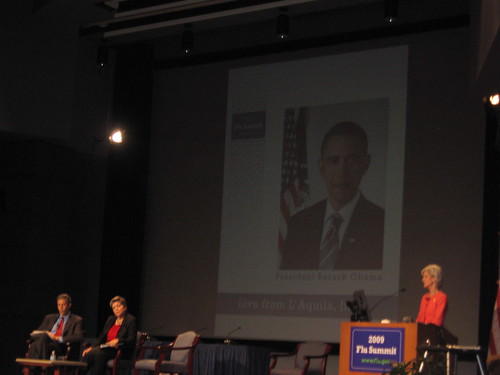
Cabinet secretaries Arne Duncan, Janet Napolitano and Kathleen Sebelius listening to their boss, President Obama, speak to the Summit via phone from Italy.
The day began with cabinet secretaries Kathleen Sebelius, Janet Napolitano and Arne Duncan along with White House Homeland Security Advisor John Brennan speaking to a standing room crowd at NIH’s Natcher Conference Center. President Obama called in from Italy where he was attending another summit, the G-8. (Ironically, he was in the town of L’Aquila, the site of a recent natural disaster, last year’s earthquake). After the initial plenary, there were panels and smaller breakout sessions largely focusing on schools, work place issues, vaccine distribution and communications. The focus was on examining the lessons and experiences from the Spring — what worked and what didn’t — in a largely open, self-critical manner.
Federal officials outlined their initial plans and raised the questions that they are currently trying to figure out (e.g. what should school closing policy be?); it was both a briefing for state and local officials and a way to bring them all into the planning process. In addition, the day served as somewhat of a pep rally for health leaders across the nation who have had a challenging spring and may have an even tougher autumn and winter. It was also a way to get media and public attention that H1N1 was not going away as a problem, and that the government was still on the case.
Governors from across the nation on a videoconference offering their perspectives and asking questions of the cabinet members.
I thought I would highlight a few of the overarching themes I heard throughout the day regarding public preparedness for H1N1:
* Preparing Not Scaring — In his remarks, President Obama said: “We want to make sure that we are not promoting panic, but are promoting vigilance and preparation.” And throughout the Summit, speakers looked for ways to underscore the seriousness of the potential situation (”We’re planning for the worst case scenario”, “It’s a deadly threat”, “Time is of the essence” were some of the phrases used), but in the same breath emphasize that to date the illness has largely displayed only mild virulence. The hope is that the public is able to hold  that balance in their minds going forward. One of the goals of the Summit was to get Americans’ attention that H1N1 was a threat (and underscore their responsibility to prepare) without frightening them. Towards the end of the day, Sebelius summed up the message: “It’s not about panicking people or striking fear but motivating Americans to prepare.” That approach is useful not only for pandemic preparedness but emergency preparedness in general.
* Giving The Public An Information Inoculation: “Be Prepared To Be Surprised” – Secretary Sebelius said that when it comes to this flu we should all “be prepared to be surprised.” It was a phrase repeated throughout the day. New Centers for Disease Control (CDC) Director Thomas Frieden noted in his remarks that influenza is among the most unpredictable of illnesses. As an example, many speakers mentioned that in most of their pandemic plans there was the expectation that the flu (most likely Avian) would come from another part of the world rather than just south of the border. And as a result, we would have more time to prepare. John Brennan called it a “very dynamic situation” with a lot still unknown. I think there is great value in putting that word out in advance to the citizenry in order to sensitize them to expect — and not be shocked — by change, and that we need to be prepared for whatever eventuality and be able to turn on a dime. It is almost as if this Summit was the first round of an information vaccination protocol which hopes to build up resistance and resilience in each of us by the Fall.
*Â Help Wanted: Leading & Listening – Officials repeatedly said that they did not have all the answers and would need to engage all aspects of society, including the public, to help them in preparing and responding to an H1N1 outbreak in the Fall. “We can’t do this alone,” Sebelius said. Brennan offered an honest but reassuring “we don’t have all the answers, but we’re committed to finding them.” Obama ended his remarks by saying: “If there are any issues we haven’t raised, please let us know.” I think that this kind of leading and listening — we’re doing all we can but we can use your help and input — is a winning communications strategy. As part of that approach, Sebelius urged state and local officials in the audience to convene ‘mini-summits’ at home; that sounds like a good forum to engage and involve the public.
The National Institutes of Health, site of the H1N1 Summit
* Top-Down & Bottom-Up — Most of the decisions in a pandemic are made by local and state authorities, but they need clear guidance on tricky issues that have far reaching effects (e.g. when to close schools) from the federal government. One of the goals of the Summit was to get everyone in public health on the same page. To me, this top-down and bottom-up approach echoes the optimal manner of dealing with other emergency preparedness challenges: most disasters are local responsibilities but there are things that only the federal government can do and say in a crisis. In the case of the Spring H1N1 outbreak, information was coming not only from feds but also from other governments and even an international body, the World Health Organization. In this era of unfamiliar, potentially serious threats as well as a new media environment, local officials cannot do it alone. It needs to be both the grass roots and tree tops working together.
* You Can’t Spell TEAM Without DOE, DHS, HHS, ASTHO, ETC. – One of the challenges I have found in the area of emergency preparedness is that it tends to blend different disciplines — emergency management, health, public safety, critical infrastructure — that have different languages, approaches and org charts but which must work together on challenging issues, sometimes in a crisis situation. Having the three top Cabinet officials jointly oversee this Summit underscored the need to deal with H1N1 across agencies and stove pipes at all levels both vertically and horizontally. Brennan called it a “team approach,” and you did feel that spirit in the Natcher building on Thursday.
* Not A Waste No Matter What Happens In The Fall – Secretary Napolitano made the important point that the preparation that government, business, schools and the public undertake for H1N1 will be useful even if the flu turns out to be not to be severe. Preparing for a pandemic will only increase the public’s (and in turn the nation’s) resilience going forward for other emergencies. Again, this is an idea — preparation is worth the time because it will come in handy sometime for something — that is the rationale for all citizen emergency preparedness. I would suggest that H1N1 citizen preparation be integrated into activities for the Department of Homeland Security’s National Preparedness Month this September. In fact, I would urge federal agencies involved in citizen preparedness to consider tying their communications to the public in this area more closely together. For example, many of the same preparation and response recommendations for a pandemic would be made for a bioterrorism attack (obviously, there are differences: washing your hands may be effective for the former but not the latter.)
Between sessions I spoke to Richard Besser who, as Acting Director of the CDC, earned widespread praise for his leadership during the Spring outbreak. I asked him what the public should be doing now to prepare for the Fall (n.b. the button on my Flip camera was sticking so the video continues a little bit beyond the end of the actual interview, and I haven’t yet learned how to edit — but I will soon):
Dr. Richard Besser advises the public what to do regarding the H1N1 Flu.
“What can’t iPhone applications do? There are apps for almost every interest and every need. But while apps for politics or saving money are great, you can live without them. However, the same cannot be said for the seven apps highlighted in this article. These apps do everything from check your vitals to getting you important first aid information during an emergency. Anything can happen, so it’s always best to be prepared.”
CLOSE CALL APP
Parr: “Very simple. Very effective. Close Call is a free app takes your iPhone wallpaper and layers it with emergency contact information in case the worst happens.”
POCKET FIRST AID & CPR GUIDE APP
Parr: “Similar to CPR & Choking, this app informs you of procedures for saving a person’s life, but this $3.99 application is definitely more extensive. It not only has videos to teach you how to provide first aid, but Pocket First Aid lets you create detailed medical profiles and contains up-to-date information from the American Heart Association.”
All can be downloaded, of course, at the Apple App site. I use a BlackBerry, and at some point I should do a comparison on the blog between the emergency capabilities of the various smart phones. Thanks to David Stephenson for bringing the Mashable post to my attention.
These icons link to social bookmarking sites where readers can share and discover new web pages.
The combination of Twitter and epidemiology presents an interesting opportunity: What if doctors twittered about symptoms they observed and diagnoses they made? What if that information was aggregated in a way that helped track disease outbreaks in real-time, share treatment plans, and save lives?
Combining health data with social media tools to track disease outbreaks is a simple concept. Executing this in the real world, however, is extremely difficult. Dr. John Snow, the father of epidemiology, tracked the 1854 Broad Street Cholera outbreak in London’s SoHo district. Dr. Snow recorded the locations of the 600 cases of Cholera on a spot map, spoke with SoHo residents to learn more about how the disease spread, and finally concluded based on the locations of the cases and personal encounters that the Broad Street water pump was the main agent responsible for spreading Cholera.
Fast forward to 2009. How can we combine social media tools with electronic medical records (EMRs) to help track disease outbreaks like the Swine flu?
Today, Dr. Snow’s interaction with SoHo residents could theoretically have been done via his Twitter feed. The modern day equivalent of Dr. Snow’s spot map may look something like this Google Map/Twitter “mash up”, which combines the visual affect of a digital map with the real time tweets from Twitter users talking about the Swine flu. However, when looking at that mash up, you’ll see that there is no filtering of the tweets’ relevance to an epidemiologist’s needs. Any communication referencing Swine flu, from jokes to local news stories, appears on the map.
Bio-surveillance company Veratect is trying to track diseases in a similar way by monitoring social media traffic on blogs and Twitter feeds talking about the Swine flu. Even though Veratect’s project is much more robust than the Swine flu map mash up, it still suffers from a high signal-to-noise ratio. What exactly constitutes evidence of a disease outbreak when you’re monitoring social media traffic? How can doctors and epidemiologists verify the information being sent in?
Imagine this. Doctors around the world are conducting their rounds and examining patients on electronic medical records, which document diagnosis codes. As the physician makes a diagnosis or documents symptoms, he has the option to “tweet” that observation. This allows other doctors to follow that feed and observe trends. Even better, epidemiology-specific analytics can be layered on top of the feeds to recognize patterns as they develop.
With a lot of people visiting New York this summer, I thought I would highlight a fun and interesting spot I recently went with my family, which involves disaster-related themes. The Sony Wonder Technology Lab is located in midtown Manhattan, and it offers kids and their parents a chance to take part in a simulated television coverage of a storm. The mock tv studio is one of a number of engaging interactive exhibits at the Lab.
Children and adults in the Sony Lab’s ‘production studio’
An Institute of Medicine panel has released a report saying that while a home-made nuclear bomb detonated in U.S. city would likely kill hundreds of thousands of people, there are actually things that can be done to increase the survivability for many others. That is, the committee argues, if the public is informed of those steps in advance. According to an interesting article in New Scientist magazine by David Shiga,
…as catastrophic as such an attack would be, it would not level an entire city, and a timely response could save many lives. Recent advances in techniques for mapping the path of radioactive fallout after an attack, combined with novel therapies for treating radiation victims, will improve survival chances, the report says.
“Clearly there would be loss of life, but it’s not hopeless,” says Georges Benjamin, head of the panel of doctors and public health officials that was convened by the National Academy of Sciences to assess the nation’s level of preparedness for such an attack. “We feel that there are things that one can do to mitigate it.”
Just knowing about the value of ’shelter in place’, for example, could be a lifesaver, according to the report:
For many people, the safest option would be to seek shelter in buildings or underground. Just staying inside could slash the immediate death toll from radiation by up to a factor of 100, or even 1000, [Fred] Mettler [of the New Mexico Veterans Administration Health Center] says. However, people must be told this in advance. “Without prior education, it would be a horrible issue,” he says.
I am in Bethesda, Maryland to cover the “H1N1 Flu Preparedness Summit” which will take place Thursday at the National Institutes of Health. The schedule of speakers is here. I will be writing about the Summit on the blog. But if you want to follow the proceedings contemporaneously you can do so on the web in a number of ways:
The plenary sessions will be streamed live at http://www.flu.gov/. You can follow the U.S. Health & Human Services’ @FluGov Twitter feed; David Hale (@lostonroute66) will be live tweeting the Summit on @FluGov. The hashtag for the Summit is #09fs if you want to search Twitter for posts from and about the event. I hope to get some answers on the public issues on H1N1 that we have been discussing on this blog. If you have any questions you would like to have answered, either email me at jsolomon@incaseofemergencyblog.com or tweet me @JohnDSolomon.
The National Institutes of Health in Bethesda, Maryland where the “H1N1 Flu Preparedness Summit” is taking place on Thursday.
These icons link to social bookmarking sites where readers can share and discover new web pages.