Following a 60-day review period, the bipartisan task force will present its findings to Napolitano, who will in turn discuss them with other Cabinet agencies before making a recommendation to the White House.  I think it is terrific that the Secretary has assembled an accomplished and thoughtful group to look at this difficult communications challenge. It is very important not only as the alert system needs an overhaul but also because the color codes became a symbol of the government’s inability to communicate with and inform the public on emergency issues. The HSAS review offers a great opportunity to reintroduce the concept of homeland security to the citizenry and underscore their role in (and responsibility for) it.
The Department is now accepting comments on the future of the HSAS, which can be sent via email to hsasreview@dhs.gov. My suggestions are below. I have focused my analysis on the public aspect of the alert system not the other audiences that the HSAS was also designed for (ie. state and local governments, law enforcement, the private sector). My overall recommendation would be to suspend the current system and work on a more integrated approach that makes governmental alerts part of a stronger citizen preparedness effort, involves local and state initiatives, is two-way and provides more contextual information, covers all-hazards, includes robust ongoing communication between government and governed, and takes better advantage of new technologies.
* Consider The Public Separate From Government & Business – ”The mission of the Task Force,” according to its press release, “is to assess the effectiveness of the system in informing the public about terrorist threats and communicating protective measures within government and throughout the private sector.” I would argue that those tasks are not one in the same. One of the biggest problems with the current alert system is that it tries to serve too many masters. Alerting the citizenry is a different task than doing so for government and business. If the Task Force decides to maintain the HSAS in any format, I would definitely decouple the alerts so there is one specifically for the public.
* Put On Your Citizen/Parent Hats – Too often in these panels, the public perspective is left out: 1) because the governmental and business audiences are seen as more important, 2) the public warning is actually more difficult to design, or 3) there is no one in the room who is representing citizens as their top priority. I would hope each member puts aside their official titles and responsibilities and uses their citizen/parent eyes and ears when discussing public needs in these meetings. “If I was at home with my family and I heard this.” they need to ask themselves, “would it make sense? Would it be enough? And would I know what to do?” The good news is that Task Force Co-Chair and former Bush White House Terrorism Adviser Frances Townsend is very aware of that objective. In fact, she has told me in previous interviews that she views citizen preparedness policy through the prism of a mom. That’s a viewpoint necessary in the development of an effective alert system and, for that matter, citizen preparedness in general.
* Design With/For Public– Public emergency information is frequently designed without real public input and guidance. If there is any citizen review and approval, it is typically comprised of a couple of focus groups filled with people who aren’t totally sure what they’re offering feedback on. I would argue that there is no clear analog for alerting and informing the public on the range of threats (many new and unknown) we now face. And on the distribution side, there is definitely nothing in history like the new personal technology available to the government and the public. So, this is a very complex communications challenge. Getting meaningful citizen input and guidance is not simple, but it is crucial to developing a resonant, effective system — and in turn fostering a resilient public.
Further, the Task Force must make sure that they design a public alert system that is tailored specifically for the public not for other official stakeholders. For example, the World Health Organization’s pandemic levels may have been helpful to public health officials but they were confusing for citizens (particularly when a “pandemic” was declared and nothing changed). Similarly, as Amanda Ripley among others have pointed out, the U.S. hurricane categories are not as helpful alerting impacted communities about the severity of their situations as they should be. That’s because they only take wind into consideration not potentially more destructive storm surge.
Former U.S. Homeland Security Secretary Tom Ridge introducing the Homeland Security Advisory System on March 11, 2002 (AP Photo)
* Integrate Revamp Of Alert System Into Revamp Of The Larger Public Emergency Information/Preparedness Program – In announcing the Task Force Napolitano said, “My goal is simple: to have the most effective system in place to inform the American people about threats to our country.” I believe that achieving that goal cannot be done with a solitary alert system, but requires a more complete, integrated approach. To increase both its effectiveness and acceptance by the public, I think the alert system needs to be tightly tied into the overall governmental citizen readiness campaign (which I would expect will also be updated by the Obama Administration). Doing so would offer more context for the public and align the government’s citizen emergency communications. It would also help answer the question that Americans have when they hear a new alert: ‘Ok, now what should I do?’
* Work Towards Integrating Local, State, And Federal Technologies/Messaging – Similarly, it would be helpful to the public if any federal system is aligned with those of states and localities who are currently signing residents up for their text and email alerts. That’s important for consistency in communicating with the public, but it will also help in tailoring alerts by region, subject matter, and various specific “public’s”. Further, there is a need to decide and then to explain how any new alert initiative is related to the current Emergency Alert System and new-generation technologies such as IPAWS. (It would also be useful to explain the difference between an alert, a warning and an advisory!)
There might be a concern that broadening the subject matter would dilute the impact of a warning for a major terrorist attack. Yet for the public (but not necessarily other stakeholders) many of the post-alert steps are the same whether it’s a serious pandemic or bioterror incident. Or a major hurricane for that matter. At the H1N1 Summit, top officials said that citizens should be preparing their homes as well as checking into the contingency plans for their places of work and children’s schools for the flu — well, that’s exactly what governments have been telling the public to do on for terrorism and natural disasters for years. This messaging could be coordinated so the public understands how they relate and overlap, with one complementing the other. Again, a key for the panel is looking at this from how the public consumes and acts on emergency information and alerts.
* Less Colors More Communication– It is very possible that the current graphic representation could be replaced largely with a robust commitment to ongoing communications. Last month, Napolitano held a news conference to highlight a couple of new Department initiatives, including a new mission statement, “The Department’s Five Responsibilities” in which she asked “Americans to live in a constant state of readiness, not a constant state of fear.” That seems like a good qualitative description of the nation’s (and the public’s) optimal status. And, in fact, I was interested in hearing her elaborate, because I thought it would offer some public guidance on this exact issue. But I didn’t get through. (A Department press aide suggested I post the question on my blog, and they would try to get an answer.)
It may be that there isn’t a need for an alert chart, but instead just being in the “state of readiness” — at which we now live our lives as parents, employees, etc. anyway — is a good enough description. It’s called citizenship in the 21st Century. Of course, government may have to tweak its description depending on the situation. Whether or not the alert color codes remain, it is crucial that officials keep an ongoing conversation on these issues with the American public.
* Make “Advisory” Two Way – New communications technologies allow for relevant information now to be provided by the public to the authorities in emergencies. Every American with a mobile phone is a potential ‘alert-er’ to collect and distribute information. Alerts and warnings no longer should just be top-down. Any new approach should incorporate the public as part of the system. The Task Force will have to look at both the content of the alert messages but also the distribution of them. This presents authorities with both a great opportunity and challenge.
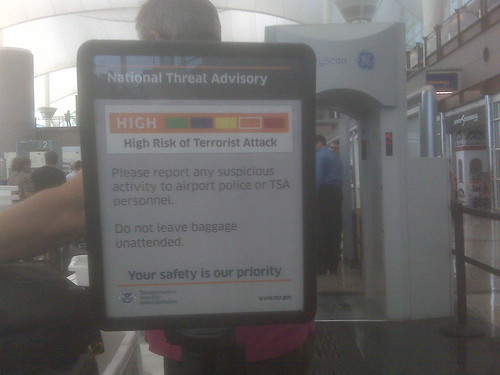
Color code chart in front of  the TSA security checkpoint I went through at Denver International Airport on Thursday * Let The Public Into ‘The Bubble’ A Bit – One of the biggest problems to me about the current alert system is that the public has little context for understanding what they are being alerted to. A threat is publicized and then does not occur, which then makes many Americans skeptical about the initial communication. Some of the threats may have been real, others not, still others it may be unclear. But without any information it can sound like crying wolf.
Clearly, there is a limit to what the government can say without imperiling sources and methods. But many security officials I’ve spoken to believe there is more that can be told. In fact, many say that they would like to offer the public more information so Americans understand the threat situation better. It makes their jobs easier, establishes more credibility, and it may innoculate the public when/if something does happen. A new Administration has the opportunity to start fresh on informing the public and taking us a little bit into ‘the bubble.’
This disconnect between the government and the public on this was brought home to me in 2008 when Michael Mukasey was appointed U.S. Attorney General. After initial briefings, he acknowledged being “surprised to be surprised” about the range and scope of terrorism threats to the U.S.. Mukasey was a federal judge who presided over terrorism trials, and he felt uninformed; think about the level of knowledge of the average citizen.
Follow Up With The Public — To me, another part of the public education process on alerts is following up on them whenever possible. For example, on August 1, 2004, the alert was raised from Yellow to Orange, specifically for the financial services sectors in New York City, Northern New Jersey, and Washington, D.C.
”as a result of new and unusually specific information about where al-Qaeda would like to attack.” Plans and photos of various U.S. buildings, one of which was the Citigroup Center here in Manhattan, were found in a computer at a suspected terrorist’s home. Security was immediately ramped up and pedestrian access to the shopping center on the lower levels was restricted. As a result of the lower traffic, a number of small retail businesses there were forced to close.
Four years later, I still don’t know what happened and think about it everytime I pass the building. And I do believe New Yorkers (and all Americans) have the right to know whether the threat was serious, not serious or still unknown. Should we still be concerned about an attack on that building? Or not? Or is it still unclear? I say that because if warnings are issued and nothing happens it erodes the attention and credibility of those warnings. If, as it seems to have been the case, that this threat (and the subsequent color change) was ultimately not a real danger , then tell us. We are not going to be upset (unless of course the warnings were politically manipulated which is another issue); we know how difficult the intelligence business is. (And, in fact, I think that officials don’t tell us enough about threats that are credible but were either discouraged or actually foiled.)
* Take The Risk To Talk About Risk — I would also use the relaunching of an alert system as an opportunity to launch a discussion on risk with the American public. To me, there is no more important homeland security subject. How we react to these potential threats is in many ways tied to how we manage risk in government, the private sector and the public. And the citizenry’s understanding of the risk tradeoffs can have a significant impact on how the other stakeholders end up acting.
* Use The Ivory (Warning) Tower — Another group that should be consulted are academics. There are a number of scholars who have done extensive research on alerts as well as the role of social media and other technologies in emergencies. They should be part of the process. Last week, at the University of Colorado’s Natural Hazards Workshop, I attended a panel with some of the leading experts on warnings. I asked what they would suggest the Task Force do. They were skeptical that the current bad situation would be improved, and worried that the alert system could be made even more confusing. “First, do no harm.” is a good caution, though I am more optimistic about the Task Force’s work.
* Look Across The Pond– As members of the panel undoubtedly know, the British government produces a National Risk Register which publicly lays out its biggest concerns, both natural and man-made. It is very much a public document that is aimed at engaging and informing the English population. Being so up front has the effect of making them partners not only in dealing with threats but also in helping choose what the country’s emergency preparation priorities should be — and giving people a sense of the tough choices officials must make when it comes to security.
* Plan On A HSAS 3.0 — The task of alerting the public is not an easy one. It cannot can be finished and completely tied up in 60 days.  There is challenging content (unfamiliar threats) and distribution (social media and other technology) issues. The current overhaul should be seen as a starting point. Events, technology and experience will inform, change and improve whatever the task force comes up with in the months and years to come. This will be an evolving situation in which the government will both lead and learn. This blog will be following and hopefully contributing to that evolution.
Anyway, those are my initial thoughts. I am confident in the Task Force which includes a number of folks who have regularly been in the pages of this blog, including Townsend; James Carafano of the Heritage Foundation; Clark Ervin of the Aspen Institute; Mary Fetchet from Voices of September 11th; and Ed Skyler, the Deputy Mayor of New York City. If you have any thoughts on this subject, please comment below, email me at jsolomon@incaseofemergencyblog.com and/or send a public comment to hsasreview@dhs.gov.
These icons link to social bookmarking sites where readers can share and discover new web pages.
In this video, she debunks some myths about social media during disasters and urges citizens to learn how applications such as Twitter, Facebook and MySpace can help them in an emergency situation.
Jeannette Sutton, Natural Hazards Center
These icons link to social bookmarking sites where readers can share and discover new web pages.
MercuryNews.com has an article, “Got Swine Flu? Tweet It?”, about Santa Clara (California) County’s Public Health Department’s H1N1 flu prevention campaign which will aggressively utilize social media tools to focus on young people:
When students return to school this fall, school nurses will once again chase after them with hand sanitizer. Familiar posters about sneezing into elbows will plaster the hallways. But when it comes to managing a potential swine flu outbreak in high schools, county health officials are going beyond cartoon admonitions.
“We’re going to start the ‘Don’t Let the Flu Get You’ page on Facebook,” said Joy Alexiou, head of the Santa Clara County Public Health Department’s flu prevention campaign. “Students know best how to talk to each other. We just want to give them the tools and information so they’re communicating the correct information.” The county will use the Facebook page, as well as posts to MySpace and Twitter, to get health updates out as quickly as possible. It will also equip students with T-shirts and details about a swine flu prevention video contest, counting on the wisdom that knowledge sinks deeper into students’ heads if it comes from their peers.
The teen-centered strategy responds to one of swine flu’s quirks: Unlike the seasonal flu, which mostly affects the elderly, this strain primarily befalls the young. To date, the county has 120 confirmed cases of the H1N1 virus, or swine flu, with 75 percent of those cases occurring in people under 24 years old. At least 32 of those cases resulted in hospitalizations; one 44-year-old Santa Clara County woman with a history of medical problems died from swine flu complications three weeks.
Thanks to Twitterers JGarrow and Nedra for bringing this article to my attention.
As New York City braces for a second wave of swine flu this fall, health officials are making plans to carve space out of hospitals, clinics and other buildings to screen people before they can overwhelm emergency rooms.
Hospital and city officials said in interviews that the biggest surprise from the swine flu that swept the city last spring was the surge of visits to emergency rooms by people, especially children, sick with the flu and by a far larger number of people fearing they had it.
A major focus of planning for the fall, officials say, is to avoid being swamped by a similar, possibly bigger, demand for emergency room services. Some hospital officials are advocating putting out daily swine flu bulletins – modeled after announcements on alternate-side parking or lottery numbers – about issues like when to seek treatment.
These icons link to social bookmarking sites where readers can share and discover new web pages.
Last year, nearly 5.5 million Southern Californians participated. It is being expanded to northern California and has a goal of 10 million participants in 2009 making it the largest earthquake drill ever. On the ShakeOut Twitter site, they announced a friendly competition between the two regions with SoCal ahead of NoCal by 1.8 million registrants. If you would like to participate, click here.
“How quickly life gets back to depends on your and others around you. Your level of personal preparedness will determine your quality of life after the quake.”
The site also has a Beat The Quake game which tests your residential earthquake preparedness.
These icons link to social bookmarking sites where readers can share and discover new web pages.
I wanted to bring your attention a very interesting and useful study on the role of social media in crises. The newly-released report, “Expert Round Table on Social Media and Risk Communication During Times of Crises: Strategic Challenges and Opportunities,” comes out of a day-long workshop in March at the American Public Health Association (APHA) headquarters in Washington, D .C . Participants included thought leaders and practitioners who are engaged in public health, emergency response, and crisis communications.
The report highlights results of web survey that found “public health and safety professionals can do considerably more to move forward towards a communications framework that encompasses all effective communication vehicles, including social media”. There is also a narrative summary of the day, suggestions on how to establish best practices, and a social media primer. In addition, the report offers 11 tips for officials using social media during emergencies:
* Make social media efforts message driven, not channel driven.
ƒ* Embrace every possible teaching momentƒ so that your social media networks can grow. Tap into all available resources. ƒ Do you have a large cadre of volunteers? Consider training them as social media ambassadors.
* Keep messages brief and pertinent. People are not really reading, they are scanning.
* Make sure you can receive public input. Remember that social media is not just about you talking to the public; it also is about them talking to you and to each other.
* Use social media to support a unified message. Instead of creating a new message for social media, use social media to support your existing message in a larger communications model.
* Have a Plan B. Suppose phone lines are jammed and/or computers are down?
* Forge partnerships for sharing methods and messages. Federal agencies, for example, need to reach out to the private sector, and vice versa.
* Focus on people when formulating your communication plan. Networks of people will get work done, even when there is no electricity.
* Avoid elitism or the belief that people in charge know more and the general public is prone to misbehavior.
* New technologies are not simply new types of media with which to do the same old things. These new media signal a shift in thinking about how we communicate with our audiences.
* Avoid “shiny new object syndrome” (being quick to adopt every new social media that emerges…as soon as it emerges).
If you would like a PDF copy of the 17-page report, have questions or would like further information about the Round Table, you can contact Tim Tinker at tinker_timothy@bah.com or 703-902-4519.
These icons link to social bookmarking sites where readers can share and discover new web pages.
Via the U.S. Citizen Corps comes an intriguing invitation for those interested in the future of national emergency preparedness and response as well as homeland security in general:
U.S. Homeland Security Secretary Janet Napolitano invites you to participate in the National Dialogue on the Quadrennial Homeland Security Review (QHSR). This groundbreaking, web-based interactive dialogue is designed to allow a broader range of opinions and ideas to inform the QHSR process, and to strengthen the Department’s relationship with its vast array of partners and stakeholders, including other federal agencies, state, local, and tribal governments, law enforcement professionals, first responders, academic institutions, and the business community.
In order to capture this critical feedback, the Secretary is seeking your participation in three week-long, web-based dialogues. Each dialogue will build on the previous one, allowing participants to view and comment directly on proposed elements of the review before they are made final. Your invaluable participation will directly inform the work of the DHS study groups conducting the QHSR-and ultimately, our Homeland Security policies and priorities over the next four years. The final report is due to Congress on December 31, 2009.
The Quadrennial Homeland Security Review (QHSR) is a congressionally mandated, top-to-bottom review of the Department’s policies and priorities that will guide the Department and the nation for the next four years. The review is conducted by the Secretary of Homeland Security with key assistance from a set of study groups within DHS, each charged with reviewing a different aspect of the Department’s mission and operations. For more information, see http://www.dhs.gov/qhsr.
Secretary Napolitano recorded an ‘invitation’ video (below).
Last month, I posted some YouTube videos of songs I think are particularly resonant and representative of the ideas raised in this blog. Afterwards, I received a couple of suggestions from readers below which I thought I would post:
Bruce Hennes —
My nomination for Best Preparedness Song, Nuclear Division is Tom Lehrer – Who’s Next? (Video below). All right, it’s a stretch, I admit. But, what, 45 years, give or take a year, after it was written and recorded, it’s still right on target.
Jon Abolins–
First song that came to my mind is “Jerusalem”, which is sort of an unofficial English anthem. Often sung at English soccer games and was an often sung at Women’s Institutes meetings. for The latter half does talk about preparing & persevering.
Bring me my bow of burning gold:
Bring me my arrows of desire:
Bring me my spear: O clouds unfold!
Bring me my chariot of fire.
I will not cease from mental fight,
Nor shall my sword sleep in my hand
Till we have built Jerusalem
In England’s green and pleasant land.
By the way, one of the lines is the basis for the title of the movie ”Chariots of Fire”. I don’t know if many others would see this as a citizen preparedness song. It is quite rooted in England’s culture, especially one for non-English. Also, the song has strong church hymn overtones and some Christian references. (The first half refers to an old English legend.)
Fugate promised that he would be using the “bully pulpit” throughout his tenure, and in his speech (as well as during the spirited q-and-a) he struck some of the themes he has been and will clearly continue to address. A long-time emergency manager, the Administrator seemed eager (almost relishing the opportunity) to take on some of the field’s long held orthodoxies and even language. He really seemed to be enjoying himself during his remarks to the friendly standing-room crowd of more than 400 hazards researchers, practitioners, and emergency managers. It was one of the best speeches I’ve heard from a public official in addressing the public’s central role — both the positive and the negative — in nation’s emergency preparedness and response.
Fugate said officials had to stop looking at citizens as a liability during emergencies and start treating them as an asset. For instance, government and organized non-profit response groups need to do a far better job of integrating “spontaneous volunteers” into the overall post-disaster response. He criticized a prevailing attitude in the emergency management community that somehow ad hoc citizen assistance was problematic: “How dare the unwashed masses do it?” he said with a smile, adding, “But ‘they’re not part of the team. And haven’t been trained in the ICS [Incident Command System]‘.” Maybe not, he quipped. “But they’re feeding people.” Fugate said the attitude about ordinary citizens helping out is so risk averse that he’s heard officials worry about food poisoning…in the midst of major emergency. “Why fight it,” he urged. “Let’s embrace it.”
A similar reorientation is necessary in the area of social media, according to Fugate. Again, he noted a pervasive feeling within government ithat somehow citizen-generated content is “suspect”. But he said that it is time “to trust the public,” adding with a laugh, “They are not evil.” Fugate said officials have to understand that they “cannot control it” but instead “need to harness it.”
Fugate held up his smart phone at the podium calling it his “tricorder” in its ability to do so much eliciting laughs and appreciation from some in the crowd. However, not being a ‘Trekkie’ I had no idea — until I consulted Wikipedia — that “in the fictional Star Trek universe, a tricorder is a handheld device used for scanning an area, interpreting and displaying data from scans to the user, and recording information.”
In response to an audience question about instances of misinformation being distributed through social media, Fugate said that bad info can (and has been) disseminated both by new personal technology as well as traditional sources such as the radio. Social media, he implored, “is not a mechanism we should fear.” Ironically, Fugate mentioned an example of a social media-distributed rumor in Florida, which led to gasoline hording, as a sign of its significant constructive potential.
He told one questioner that emergency management agencies have to improve their communications with the public even in traditional ways: “We need more people who write in English.”
Fugate said he would be working to change some current language, which he believes sends out the wrong message to everyone involved. For example, he wants to replace the word “victim” with”survivor”. He also hopes to substitute “natural hazards” for “natural disaster” in the public and media crisis lexicon. He says hazards are not the cause of the disasters. Rather, it is that Americans have built and live in vulnerable areas, which has turned hazards into disasters. Hazards may not be avoidable, but they are mitigable.
Because while the Administrator was bullish about the public as a positive force in responding to disasters, he was just as critical of the citizenry for helping to contribute to them. Fugate, the former top Florida emergency management official, used his own state as an example of how misguided policies which put a premium on developing as close to the coast and as inexpensive as possible contribute to making natural hazards turn into natural disasters. Noting the proliferation of golf course developments in his native state, he remarked that “you can tee off in Tallahassee and play through to Pensacola.”
Almost six in ten Americans (59%) believe it is very or somewhat likely that there will be widespread cases of Influenza A (H1N1) with people getting very sick this coming fall or winter, according to a new poll released today by the Harvard Opinion Research Program at the Harvard School of Public Health. The full survey can be found here. According to the news release:
“These results suggest Americans are likely to support public health officials in prioritizing preparations for the possibility of a serious H1N1 outbreak in the fall or winter,” said Robert J. Blendon, Professor of Health Policy and Political Analysis at the Harvard School of Public Health.
Despite a majority believing that a serious outbreak is likely, more than half of Americans (61%) are not concerned about their personal risk — that is, that they or their family members will get sick from influenza A (H1N1) in the next year. This level is unchanged since the previous poll conducted May 5-6, 2009.
The current survey further suggests that the World Health Organization (WHO)’s decision to raise the worldwide pandemic alert level to Phase 6 did not dramatically impact Americans’ level of concern about their personal risk. Only 22% of Americans knew that the WHO had raised the level, and only 8% of Americans said it made them more concerned that they or their family would get Influenza A (H1N1) in the next 12 months.
One approach that has been used in the recent outbreak as a means to slow the spread of Influenza A (H1N1) is the closing of schools. In this survey, substantial numbers of parents who have children in school or daycare report that two-week closings in the fall would present serious financial problems for them. About half (51%) of these parents report that if schools/daycares closed for two weeks, they or someone else in their household would likely have to miss work in order to care for the children. Forty-three percent of these parents report that they or someone in their household would likely lose pay or income and have money problems; 26% of these parents report that they or someone in their household would likely lose their job or business as a result of having to stay home in order to care for the children.