U.S. Homeland Security Secretary Janet Napolitano, who was born in New York City, returned to the Big Apple for a day-long, multi-stop, multi-mode -of- transportation tour yesterday. I followed her for most of it.
Her day in New York began with a morning speech to the Council on Foreign Relations, which focused to a large extent on the role and responsibilities of citizens in the nation’s security. (I wrote about it in the last post. A couple other news stories on the speech are here and here.)
After the q-and-a session, Napolitano headed downtown to Ground Zero to view the reconstruction work. It was her first visit to the site of the attacks which led to the creation of the Department she now runs.
Secretary Napolitano visits Ground Zero (Photo by Chris Hondros/Getty Images North America)
From there, the Secretary went just around the tip of the island of Manhattan to the Staten Island Ferry Terminal where she met with local officials and counterterrorism experts, and then took some questions from the press.
Next, she was off to City Hall where New York Mayor Michael Bloomberg and Police Commissioner Ray Kelly were waiting outside the subway station. After the traveling party and the 20 or so members of the press covering the visit were given a “Single Ride” MetroCard, Bloomberg led everyone down the steps and through the turnstiles.
After waiting on the platform for a few minutes, a “4″ Express arrived and we all loaded into one car to the surprise of riders already on board. It was a tight scrum as photographers and television cameramen tried to find room  to shoot the conversation between Napolitano, Bloomberg, and Kelly near one of the doors, while also keeping their balance as the train sped uptown.
Straphangers Janet Napolitano, Ray Kelly, Â and Michael Bloomberg (Photo by Chris Hondros/Getty Images North America)
It was two Express stops to 42nd Street where we all got out and followed the Mayor up the steps and into the center of Grand Central Station. A podium was set up for Napolitano to announce that the City would be receiving $36 million to hire new police officers for the city’s subways.
Her next public stop took Napolitano back uptown just blocks from where she had spoken earlier in the morning. She visited the police at the 19th Precinct (which had some special significance to me as it is my local precinct and the one that my Community Emergency Response Team/CERT team works with). Below is the short video I took of the visit and her remarks:
Video of Janet Napolitano speaking to police officers at the 19th Precinct in Manhattan
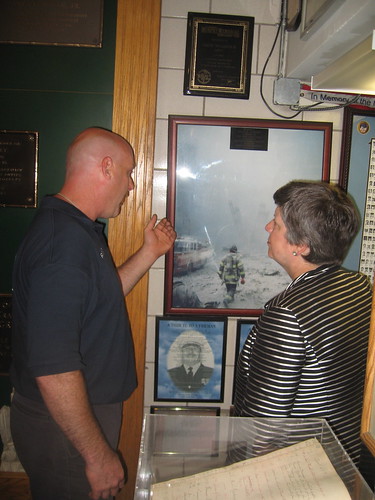
Afterwards, the Secretary went next door to the adjoining Engine 39/Ladder 16 fire house. Again, she thanked them for their service. She spoke at length with firefighter Richie Rattazzi about his experiences during September 11th in front of a framed photo honoring two members of the fire house, Ray Murphy and Rob Curatolo, who died at the World Trade Center on 9/11.
NYFD firefighter Richie Rattazzi and Napolitano.
Napolitano finished the day in New York with a taping for the “Charlie Rose Show” (which can be found here)Â before leaving for Washington. (At that link, you will also find the video of the last time Napolitano was on the show in October of 2007. The other guest was the then relatively little known Governor of Alaska, Sarah Palin. It’s interesting to watch.)
A good local television story on Napolitano’s full day in New York City is here. As the Secretary had highlighted the value of the CERT program for involving citizens in her Council speech earlier in the day, I think she would be happy that I went from the fire house to join a group of about 100 fellow NYC-CERT members in an midtown office building conference room for a two-and-a-half-hour advanced training with Con Edison emergency response experts on the topic of electrical safety.
These icons link to social bookmarking sites where readers can share and discover new web pages.
In a major speech this morning here in New York City that focused a great deal of attention on the role of the American citizen in homeland security, Secretary Janet Napolitano said that “for too long, we’ve treated the public as a liability to be protected rather than an asset in our nation’s collective security” and promised that there would be increased focus on “creating a culture of awareness and preparation” where “every individual understands their role.”
The speech was delivered at the Council on Foreign Relations in Manhattan. A transcript as well as the video and audio can be found on the Council’s website here.
Janet Napolitano speaks to the Council on Foreign Relations this morning (Photo by Chris Hondros/Getty Images North America)
Below are some excerpts from the speech that I thought were particularly notable on the public’s role and responsibilities in homeland security. I have excerpted a lot because I think it signals a significant commitment from the Secretary to inform, involve and engage the citizenry going forward:
“I will speak candidly about the urgent need to refocus our counterterror approach, to make it a shared endeavor, to make it more layered, networked and resilient, to make it smarter and more adaptive and to make sure that as a country, as a nation, we are at the point where we are in a constant state of preparedness and not a state of fear.
The challenge is not just using federal power to protect the country, but also enlisting a much broader societal response to the threats that terrorism poses.
Now, a wise approach to keeping America secure should be rooted in the values that define our nation, values like resilience, shared responsibility, standing up for what is right. These are the values that led us to fight and win two world wars, that were on display in the dark days after the September 11th attacks. We must embrace them again now.
So how do we secure our homeland and stay true to our values? We do it with four levels of collective response. It starts with the American people. From there, it extends to local law enforcement, and from there up to the federal government, and then finally out beyond our shores, where America’s international allies can serve and do serve as partners in a collective fight against terrorism…
So what is the right response, and what are we doing? As I mentioned earlier, there are four layers, and the place we start is the work of engaging the American people in our collective effort. I’m often asked if complacency is a threat in the United States, and I believe the short answer is yes. But I think a better question is this: Has the United States government done everything it can to educate and engage the American people? The answer there is no. For too long we’ve treated the public as a liability to be protected rather than an asset in our nation’s collective security. And this approach, unfortunately, has allowed confusion, anxiety and fear to linger. [Read more →]
These icons link to social bookmarking sites where readers can share and discover new web pages.
In prepared testimony yesterday for a House subcommittee, FEMA Administrator Craig Fugate reiterated his concern about the lack of U.S. citizen preparedness in some pretty strong language. He told legislators that “personal disaster preparedness is and must be a national priority” and it “needs considerable national attention,” recommending that “every elected and appointed official at every level of government must make it a priority.”
Fugate has made citizen preparedness a priority in his own public statements during the first several months in the FEMA job (for example, here, here and here). But this is the most striking statement I’ve seen yet of his belief that the public as well as officials at all levels of government need to put civilian preparedness more front and center. Fugate delivered the remarks at a hearing, titled “Post Katrina: What it Takes to Cut the Bureaucracy and Assure a More Rapid Response After A Catastrophic Disaster” held by the House Subcommittee on Economic Development, Public Buildings, and Emergency Management.
As you might expect, I think it is terrific that Fugate is highlighting citizen preparedness and urging the nation to give more attention to it. The challenge, as Fugate knows as well as anybody, is to develop a more focused, creative, and sustained approach to the issue that can work on a national, state and community level. (This is my initial stab at it is here.)
I haven’t been able to paste longer excerpts of Fugate’s speech due to format problems but will do so when I can. The full text of the testimony is here. I also will also add some of the suggestions for improving citizen preparedness suggested at the hearing by former FEMA official Jane Bullock and Red Cross executive Joe Becker.
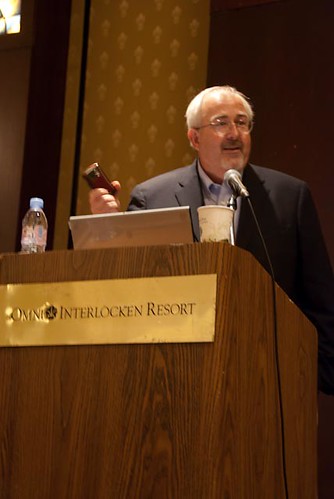
FEMA Administrator Craig Fugate shows off his emergency ‘Tricorder’ (a.k.a. smart phone) during his keynote address to the Natural Hazards & Applications Workshop in Broomfield, Colorado earlier this month. (photo: Samantha Capps, University of Colorado’s Natural Hazards Center)
UPDATE 7/30: I received the the prepared statements from the Subcommittee hearings, which I can now excerpt. First Fugate:
“While FEMA can and is making improvements to how we plan, organize, and respond in a catastrophic disaster, there remains one area of improvement that still needs considerable national attention: personal preparedness. Studies continue to indicate that far too many households do not have personal disaster plans that include provisions for assuring the self-sufficiency of their households for up to 72 hours following a disaster. A family should also think through personal preparedness plans in case of a catastrophic event that devastates their city.
In fact, a recent survey found that only half of Americans have put together an emergency kit, and less than half – only 40 percent – have created a family emergency plan.  I cannot emphasize enough just how problematic this could prove in a catastrophic environment, not only to the households, but to the efficacy of the overall incident management effort. Every family that fails to take even the most basic preparedness actions, such as having sufficient water and non-perishable food to support the family for at least 72, is a family that will pull responders and critical resources away from those who truly need such assistance, both the casualties of the disaster, and our most vulnerable populations, such as persons with disabilities and children.
I’ve said it time and time again, and I will continue to say it: personal disaster preparedness is and must be a national priority, and every elected and appointed official at every level of government must make it a priority. Nothing will contribute more to saving and sustaining lives than a citizenry prepared and provisioned to live in a reduced-services environment in the days immediately following a catastrophic disaster. When basic infrastructure at the community level halts, as should be anticipated in a catastrophic event, the value of personal preparedness cannot be overestimated. Neighbors are almost always the most effective and most immediate first responders – never more so than when local first response assets have been impacted by the same catastrophic event.
Having a family disaster plan, keeping supplies for basic survival needs, and staying informed are the responsibility of every American. By being prepared, you can help your family and your community weather the initial hours and days following a catastrophic event and free up our first responders to help those who cannot help themselves. [Read more →]
These icons link to social bookmarking sites where readers can share and discover new web pages.
After returning to New York from the H1N1 Summit, I was listening to the “Homeland Security Inside & Out “radio show on my iPod riding the subway (ironically to a meeting at the City’s Office of Emergency Management’s headquarters in downtown Brooklyn).
In my Flu Summit summary post, I had mentioned how struck I was by the continuing challenge of integrating the efforts and communications of the various emergency agencies/subjects — such as public health, emergency management, homeland security, law enforcement, infrastructure, etc. — in dealing with the public on H1N1 preparedness. That’s because each discipline has different languages, objectives, culture and perspectives. At the Summit, New York City Health Department official Marcie Layton said that integrating different agencies and functions was one of the biggest challenges in the effort to deal with H1N1.
So, it was interesting to hear Dave McIntyre, the co-host of the “Inside & Out” show, use his “Perspectives” segment to address a similar point — the continuing difference in outlook between people in emergency management and homeland security, which he had observed at the recent World Disaster Management Conference in Toronto. As Dave recounted to his co-host Randy Larsen:
“I was struck again by something I see over and over here in the United States and that is the enormous difference in perception, the difference in viewpoint between people who are emergency managers, disaster managers and those who work on national security or homeland security level questions.
The emergency manager and the disaster manager are focused on the preservation of life and property. They see the loss of a single life as an enormous tragedy and their goal is to prevent that from happening at all costs. Those people who work national security issues frequently assume, especially if you’re dealing with the military, that in this business there will be some loss of life — that what we are after, our goal is to protect the nation as a whole not individuals.
And this difference in goals — between protecting individuals versus the nation as a whole — still runs through as a theme in every discussion I have with emergency responders and then those who work at the national level. It’s just a fascinating perspective on how people view this subject entirely differently.”
McIntyre has as good a view as anyone on this topic. He runs a University homeland security center and hosts the leading radio show on the subject. And the integration challenge he points out will get even more challenging now that the fields of technology, including new communications and cyber security, also play an increasingly key role in emergencies. I think there is no question that interagency cooperation has improved since 9/11 (including during the H1N1 response in the Fall). But as Layton and McIntyre report — and I’ve observed as a layperson — there is still a long way to go.
Knocking down stove pipes and increasing governmental teamwork is obviously operationally crucial for preparing and responding to emergencies. But it is similarly important for governments to take into consideration how the multi-pronged/agencies approach impacts the public when it comes to preparedness. Though it is subtle, there can be differences in messaging, risk communication and emphasis. One objective of this blog to help integrate those different worlds together when it comes to dealing and communicating with the public.
I think one of the challenges for government is to tie their various citizen preparedness initiatives (ie. H1N1 and natural disaster/terror readiness) more closely together to make them clearer and easier for citizens to consume and act on. It would be also be useful to spread some of the terrific non-governmental preparedness resources to the followers of one emergency ‘world’ to others. For example, the citizen created and managed Flu Wiki is a model for all-hazards.
These icons link to social bookmarking sites where readers can share and discover new web pages.
A New York Times article Saturday, “Cut Back on Tamiflu, U.S. Official Says”, by Donald G. McNeil, Jr. reports that the Centers For Disease Control (CDC) is asking kids’ summer camps to stop distributing Tamiflu prophylactically, because the agency worries that “giving the drug to healthy people wastes the world’s limited supplies of Tamiflu and increases the chances of drug-resistant strains developing.”
To me, this is particularly interesting, because it reveals a tension between what may be the best preparedness decision for the individual (and the specific community — ie. a camp), and what is likely the best preparedness decision for the nation (and society). It is a conflict that can occur in disaster preparedness and response and presents a challenging public education point for authorities to deal with.
As I mentioned in a post earlier this week, “H1N1 Hits Home, I’m On Tamiflu,” I (along with my oncologist) had to decide a course of action after someone in my family was diagnosed with H1N1. Because I am recovering from Leukemia and have just finished chemotherapy, she recommended that I take Tamiflu (which follows the CDC’s guidance for people with underlying illnesses). But giving the antiviral to healthy kids this summer raises a more difficult issue, particularly since the camps have found it to be a successful way of stopping the flu’s spread. In his article, which covers the press briefing given yesterday by Dr. Anne Schuchat, director of the National Center on Immunization and Respiratory Diseases, McNeil writes:
Giving the drug to healthy people wastes the world’s limited supplies of Tamiflu and increases the chances of drug-resistant strains developing, Dr. Schuchat said, and the disease centers are working with camp associations and local health departments to discourage the practice. Dozens of camps have had swine flu outbreaks this summer. Some closed, others set up infirmaries, and some have had camp doctors write Tamiflu prescriptions or asked parents to send children with the drug.
The practice is controversial because public health authorities consider it selfish and dangerous. Although there is a national stockpile of 50 million courses of Tamiflu, it will not last into the coming flu season if many healthy Americans start taking the drug.
The director of Camp Modin, one of the Maine sleep-away camps that offered prophylactic Tamiflu, disagreed with Dr. Schuchat’s recommendation. ”The evidence speaks for itself,” said the director, Howard Salzberg. “I have no children with swine flu at this moment, and we are confident that the Tamiflu helped us remedy the situation.”
The full transcript of the briefing by Dr. Schuchat (who I had the chance to interview on video at the H1N1 Preparedness Summit earlier this month) can be found here. In her answer yesterday, she further explained the agency’s position and actions on the summer camps and Tamiflu.
I don’t think that’s a good idea, the prophylactics to all campers. What I can say is we have guidance about anti-viral medicines and the best ways for them to be used. We’ve been working closely with the camp associations and with the health departments who work locally with their camps, and we really want the public to know that anti-viral medicines are important. They’re part of our armamentarium. I think another important thing to say is we have the resistance to Tamiflu in the new virus.
I believe now there are about five cases that have been reported that are Tamiflu resistant. That’s a very small number compared to the very large number of cases we’re seeing around the world. But we have seen with other influenza viruses them taking off with a low level of resistance to virtually all strains being resistant. We think it’s important to be careful about how the medicines are used but there are circumstances where preventive use of anti-virals is still important in people who have severe medical problems, who have been in very close contact with someone with influenza. So I think our efforts are really trying to make sure people know the right way to use the medicines, the role that they play and the risk of resistance that’s out there that we don’t want to get any worse.
An argument can be made, of course, that what might actually be in the short-term interest of the campers is not really in their long-term interest if somehow the widespread prophylactic distribution leads in some way to a worse outbreak in the Fall. But in the short-term it’s a tough case to make to the kids, their families and camp administrators who feel that the Tamiflu cut down on a lot of illness this summer.
I am not an expert (or even a novice) at the medical questions involved. But I think it’s important to highlight the ‘personal vs. societal interest’ issue not only for H1N1 but also because it is something that has and will come up in other major emergency situations. In fact, it might be helpful for officials to actually say explicitly that they may be making recommendations that might seem (or may actually be) contrary to an individual’s best interest in order to achieve broader national public health goals. And, the Tamiflu prophylactic decision is one of those instances.
These icons link to social bookmarking sites where readers can share and discover new web pages.
This past weekend, my family and I had a great opportunity to explore New York Harbor on the retired fireboat, the “John J. Harvey”. The trip was part of City of Water Day, an event sponsored by the Metropolitan Waterfront Alliance (MWA), a non-profit organization I am involved with. More than 10,000 people participated in the Day, held on Governor’s Island, which was an attendance record for the island located in the middle of the Harbor.
The piece does a very nice job of illustrating the almost ‘no-win’ communications dilemma governmental entities have on H1N1 (and potential emergencies in general): officials want to warn people and get them to prepare, but will be criticized for ’scaring’ Americans if the end result turns out not to be as serious as the warnings (even if some of the upfront preparations contributed to the better outcome!).
It’s a good news/bad news scenario that is part of the emergency business. However, I think it is valuable to highlight that communications predicament in advance for the public and the media (and for the latter to integrate it into their coverage). This post lays out the dilemma as well as I’ve seen, and I recommend it. I’ve excerpted a good portion:
“There are obviously a lot of people who believe that some of us are making too much of this pandemic. You see editorialists, pundits, and commenters to websites opining that public health officials are scaremongering, that the media is sensationalizing, and that `swine flu’ is mild and nothing to worry about. I’ll grant that in some cases, particularly in the tabloid press, the media is sensationalizing this flu.
As to the other points . . .Public health officials don’t have the luxury of assuming that this flu will be a `non-event’. Not only do their jobs hinge on being prepared to deal with a pandemic, so do the lives of a great many people. Editorialists and commenters that blithely disparage those preparations do so because they risk absolutely nothing by being wrong. It is not their posterior on the line. There is no penalty if they convince the public that there is no danger, and it turns out there really is.
Imagine the Senate and House subcommittee hearings that would ensue if public health officials ignored this pandemic threat, failed to prepare, and even a small number of people died. The media would have a field day with live coverage, heads would roll in every state and federal agency, and the political, social, and economic fallout could be incredible. That’s the price of underestimating the threat…
…The way I’ve got it figured, if you are an emergency planner, or work in public health, there is absolutely no way to come out of this pandemic without being roundly criticized. There are basically 3 ways this pandemic could turn out.
1. The pandemic is mild. Very few people die. Disruptions to society are minor. This is the best case scenario, and one that just about everyone is hoping for. Of course, if that happens, public health officials will take in on the chin for `for scaring us all to death’ and spending billions of taxpayer dollars over `nothing’.
2. The pandemic is moderate or even severe. But through the hard work and dedication of millions of healthcare workers, emergency planners, and first-responders we are able to largely mitigate the damage, and greatly lower the death toll. Since society did not collapse, once again critics will claim that public health overstated the threat, and overreacted. Ironically, the better job they do, the more likely that Public Health Officials will be castigated for their trouble.
3. The Pandemic is moderate or even severe. There are excess deaths, society or the economy is disrupted, and public health mitigation, or the vaccine, is perceived by the public and the media as having been less than `ideal’. Which is a pretty good bet during a severe crisis.
There is plenty of room for things to go wrong, no matter how hard people work to prevent it. Once again, the blame will fall squarely on public health officials. But of course this time, they will be blamed for under-reacting, under-preparing, or incompetence. If this sounds like a no-win situation, you’d be right. Public health officials will likely get the same level of public appreciation that millions of computer programmers got in the year 2000 after working like dogs for several years to prevent a (very real) Y2K disaster.
These icons link to social bookmarking sites where readers can share and discover new web pages.
The “Worst-Case Scenario” series is celebrating its 10th anniversary, and the publisher, Chronicle Books, has given me three copies to give away. So, here’s the contest: email me (jsolomon@incaseofemergencyblog.com) a ‘worst-case scenario’ you have been in and how you dealt with it. The first three next two* people who do so will receive a “Worst Case Scenario” series book.)
*First Submission/Winner — Lesley Fan, New York, NY — “The worst-case scenario that I’ve been in happened when I was in another country with my then-boyfriend (now-husband). He got seriously ill with food poisoning and needed to see a doctor immediately, but neither of us spoke the language at all–and our baggage, with our phrase books, had been delayed. My hand gestures (and more than a little persistence) saved the day; it’s amazing how creative you can get in a pinch!
Clearly I’ve lead a pretty charmed life, free of rampaging bears and the like, but I really did feel more panicked than I’ve ever felt in that situation, and everything came out already, thankfully.”
Two more books left.
More information on the entire series can be found on Chronicle’s Worst-Case Scenario 10th Anniversary Blog here.
These icons link to social bookmarking sites where readers can share and discover new web pages.
“I have been a Community Emergency Response Team (CERT) member in Cobb County, Georgia since 2004. It all started with my desire to help my family and neighbors to survive a disaster. I started searching on the internet to find out if any volunteer opportunities were being offered in my community, and that’s how I found CERT through Citizen Corps and ultimately Cobb County.
I participated in exercises, drills, training and recruitment opportunities. I took numerous FEMA independent courses in emergency management until I decided to enroll in a formal study program in emergency management. That is when I started the graduate certificate program in emergency management at Georgia State University.
Today that knowledge has allowed me to create a ministry in my church focusing on awareness of emergency management including conducting drills, exercises and training. Through that ministry, I have created vital documents such as emergency operations procedures for church and faith-based schools, continuity of operations plans, and evacuation plans–documents that I am happy to share with my neighbors.
In addition to the purpose of sharing those documents, and in the spirit of cooperation, I have established communication between the church and the Public Safety authorities including, the sheriff, police, fire and emergency management departments in the county. After all how good is a plan if it not shared with those who are there to help you?”
This blog often covers my own first-person experiences. The most recent was a bit of a surprise. After covering the H1N1 flu from a distance as a blogger, the virus has hit home. This week, one of my family members was diagnosed with H1N1. She’s already feeling better, and the rest of the family is not sick. Though it was not a clear cut decision, my doctor suggested I should go on Tamiflu (in large part because I recently finished chemotherapy).
Today’s New York Times had a colorful article on H1N1 at kids’ summer camps in Maine which illustrated a debate about the use of Tamiflu as a prophylactic. It seems to have worked at the camps, however, some officials worry that the large-scale distribution of Tamiflu may be, in the words of Maine’s Public Health Director, “start breeding resistance.” It raises the prickly issue that can come up in other emergency preparedness and response contexts as well: that sometimes what is best for the individual is not necessarily best for the society as a whole.
A couple of other interesting H1N1 articles I wanted to highlight: an interview with author John Barry (The Great Influenza) about the lessons of the 1918 pandemic for the present situation in the current issue of “Biosecurity and Bioterrorism: Biodefense Strategy, Practice, and Science”, and a helpful piece today in WebMD.com offering a likely time-line for implementation of a H1N1 vaccine during the rest of the year.
UPDATE (7/25):The New York Times reports that a top CDC official is asking summer camps to stop handing out Tamiflu to healthy campers to stop camp flu outbreaks.
The official, Dr. Anne Schuchat, director of the National Center on Immunization and Respiratory Diseases, said she “strongly recommended” giving the drug only to people already seriously ill, or to their family members who are pregnant, have asthma or have other conditions that could be life-threatening if they caught the flu.
Giving the drug to healthy people wastes the world’s limited supplies of Tamiflu and increases the chances of drug-resistant strains developing, Dr. Schuchat said, and the disease centers are working with camp associations and local health departments to discourage the practice…The practice is controversial because public health authorities consider it selfish and dangerous. Although there is a national stockpile of 50 million courses of Tamiflu, it will not last into the coming flu season if many healthy Americans start taking the drug.
What’s particular interesting is how this illustrates a potential conflict between what is best for the greater society and what is best for an individual or a particular community, such as a camp.
These icons link to social bookmarking sites where readers can share and discover new web pages.