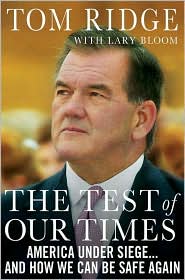
So, when I got to Chertoff’s office I showed him the initial story by Paul Bedard at USNews.com. He had not seen the news nor has read the Ridge book yet. I had planned to ask him about how he would recommend changing the color alert system and what he told the task force looking into that question. But of course now I had to inquire whether he had received any political pressure on the alerts. He said he “never” was. During Chertoff’s tenure, DHS raised the alert twice: in 2005, after the transit bombings in London, and again in 2007, after the announcement of a plot to bomb airliners going from England to the U.S.
I will be writing up my interview with Chertoff next week when his book is released. I also expect to speak to Ridge about his book as well.
These icons link to social bookmarking sites where readers can share and discover new web pages.
Future CrisisCamps are now being organized in other cities, and I wanted to bring those plans to your attention — in case you wanted to get involved in the organizing and/or were interested in attending them. The Camps are totally volunteer-driven so they could use whatever help you can provide.
San Francisco: The next CrisisCamp is scheduled for San Francisco on November 3-4. For more information on helping out and/or participating, send a tweet to @CrisisCampWest or email me at jsolomon@incaseofemergencyblog.com and I will forward it.
New York: There will be an initial organizing meeting for the NYC CrisisCamp on Saturday, September 12th. If you are interested in being involved in the planning as I will be, tweet @CrisisCamp or email me. There is a NYC Ning site email me. There is a NYC Ning site here.
London: There are also plans for a CrisisCampUK at some point in the future. Its Ning site is here.
Washington: This Saturday, there will be a CrisisCampDC Meetup at 11am at Whitlows on Wilson in Arlington, Virginia.
I found the initial CrisisCamp to be a great experience. I learned a great deal and met a lot of people doing some fascinating things. I encourage anyone interested in the intersection between disaster/crisis management and technology to get involved in some way.
These icons link to social bookmarking sites where readers can share and discover new web pages.
In a speech at the Heritage Foundation on Tuesday, the current President of the National Emergency Management Association (NEMA) Nancy Dragani said that the nation has a “culture of entitlement” when it comes to disaster preparedness and response. According to an article by Daniel Fowler of CQ Homeland Security, Dragani, the Executive Director of the Ohio Department of Emergency Management, said that:
…there has been a shift from personal responsibility to personal expectation, a course she suggested needs to be reversed. ”I have seen a shift from . . . ‘when the hurricane winds begin to blow, clean out your bathtub and fill it with water so you have drinking water’ to ‘when the hurricane threatens and the winds begin to blow, find out where [the Federal Emergency Management Agency's] going to deliver ice, food and water,’ ” she said. “And we can’t survive that…”We’ve become a culture of entitlement,” she said. “Within hours of an event the question is where’s FEMA, where’s my check, where’s my water, food and ice.”…
“I think we need to change that culture,” she said. “I think we need to go back to a message of personal preparedness and an expectation that to the extent possible people take the time, the energy, the money to prepare themselves and their family so that they don’t have to wait on FEMA to come in on their white charger and fix the day.”
In a subsequent post titled, “Nancy ’s Courage,” Security Debrief’s Rich Cooper wrote: Â ”I find her remarks, as reported, as very commendable and even courageous…Dragani’s voice is one more that echoes the reality check about what the public expectations from FEMA and emergency management at all levels should be.” I agree. A video of the Heritage speech can be found here.
These icons link to social bookmarking sites where readers can share and discover new web pages.
*Allow sick workers to stay home without fear of losing their jobs;
*Develop other flexible leave policies to allow workers to stay home to care for sick family members or for children if schools dismiss students or child care programs close;
*Share your influenza pandemic plan with employees and explain what human resources policies, workplace and leave flexibilities, and pay and benefits will be available to them;
There are no laws or mandates to back this up except in some limited areas (the New York City Council may act to mandate paid sick days in time for the Fall along the lines of laws in San Francisco and Washington D.C.) and getting widespread voluntary private sector compliance is a challenge (ie. unlike schools there is no local managerial authority; it has to be done firm by firm).
Further, while many large corporations have contingency plans already, it will be more difficult for smaller companies and their employees to comply. In the joint interdepartmental press release, Secretary of Commerce Gary Locke emphasized the need for  leadership for business and government:
Secretary Locke suggested businesses set the right tone in the workplace. That means implementing common sense measures to reduce the risk of spreading the flu and encouraging workers who are sick to stay home.
“The President has mobilized the federal government to get America prepared,” DOC Secretary Locke said. “But government can’t do it alone. For this effort to be successful, we need the business community to do its part.” Making the right decisions will not only improve public health, it also has the potential to protect economic productivity: Employees who are sick and stay home will not spread the flu in the workplace.
At the news conference, DHS’ Secretary Janet Napolitano added:Â ”Be responsible and understanding for the absenteeism that needs to occur with this strain of the flu.”
In order to help set that “tone” in businesses around the U.S., I would suggest that national leaders (including President Obama) as well as those in states and localities should begin to do high profile media events highlighting businesses of all sizes that are taking the actions being recommended by the government. That use of the bully pulpit would show how seriously the government views this, help other businesses figure out how to do it and make it seem like the norm not the exception.
I still am unclear whether there will be some need for stronger government action and/or assistance regarding business, employees and H1N1. But in the meantime, showing how some companies are already planning to handle it would seem to be helpful. (n.b. There will be a webcast on Flu.Gov Thursday at 1:00pm (ET) focusing the new federal business and employer guidance.)
Health and Human Services Secretary Kathleen Sebelius talks to reporters as Commerce Secretary Gary Locke and Homeland Security Secretary Janet Napolitano look on during a joint news conference today. (Photo: Karen Bleier / AFP/Getty Images)
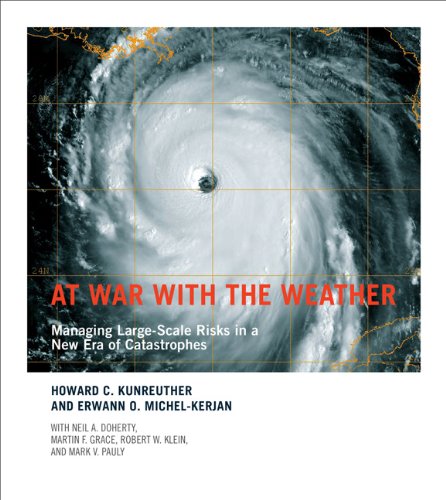
With Hurricane Bill gathering steam in the Atlantic, I wanted to highlight a new book, At War With The Weather: Managing Large-Scale Risks in a New Era of Catastrophies (MIT Press) by Howard C. Kanreuther and Erwann O. Michel-Kerjan. The authors, professors at the Wharton School of Business at the University of Pennsylvania, look at how the nation does (and doesn’t) mitigate, insure against, and finance recovery from natural disasters. Then, the book offers some interesting ideas on reducing losses and providing financial support for disaster victims to help recover from future large-scale events.
In 2005, Kanreuther and Michel-Kerjan point out, three major hurricanes — Katrina, Rita, and Wilma — hit the U.S. Gulf Coast within an eight-week period resulting in insurance reimbursements and federal disaster relief of more than $180 billion. Today, the book notes, we are more vulnerable to catastrophic losses because of the increasing concentration of population and activities in high-risk coastal regions of the country. It is a point frequently made by emergency officials, including FEMA Administrator Craig Fugate who, noting the proliferation of golf course developments in his native state, remarked recently that “you can tee off in Tallahassee and play through to Pensacola”.
But how should the nation (and states and localities) deal with this issue? In the book, the authors offer two overall principles that ”provide guidelines for the development of new catastrophe insurance programs”:
Principle 1: Premiums reflecting risk are designed to provide signals to individuals regarding the hazards they face and encourage the adoption of cost-effective mitigation measures. Principle 2: Dealing with equity and affordability issues addresses ways to provide special treatment to homeowners currently residing in hazard-prone areas (e.g. low-income uninsured or inadequately insured homeowners).
Then, based on the above principles the authors offer two proposals to provide protection for homeowners in hazard-prone areas:
1) Long-term homeowners’ insurance could be tied to a mortgage, thus stabilizing a homeowner’s premiums over time. Home improvements loans can encourage the adoption of cost-effective loss-reduction measures. 2) A program of insurance vouchers, similar in concept to food stamps, could assist low-income residents in disaster-prone areas so they can purchase adequate insurance.
Anyone interested in the issues around hurricane/disaster preparedness and response will find At War With The Weather definitely worth reading.
These icons link to social bookmarking sites where readers can share and discover new web pages.
“You have learned from the news media and City officials that there has been a widespread airborne anthrax release across the city that may affect large numbers of the City’s residents. [Anthrax exposure may cause fever, coughing, malaise, fatigue, myalgias, profound sweats, and chest discomfort. If anthrax is inhaled and not treated, death is very likely for the victim. However, antibiotics can protect against the deadly effects of anthrax exposure, particularly if they are taken as quickly as possible.]
You have been informed by the news media and City officials that the New York City Department of Health and Mental Hygiene (DOHMH) is opening Points of Dispensing (PODs) across the City to rapidly distribute antibiotics to the public…You have been informed that “your” POD at Marte Valle (School) will open in approximately 12 hours, and that to receive medication, each individual will be required to complete a POD Screening Form. [In an actual response, the opening time of the PODs will likely vary, and "your" POD would be located in your neighborhood.]
You have been informed that the Screening Form is available both electronically (that you may fill out on your computer and print out; or print from your computer and fill out by hand), or as printed forms available at various outlets (including the POD itself) which may be filled out by hand before coming to the POD. You have been encouraged to fill out the forms electronically whenever possible and to help others do the same, as it will speed progress through the POD.
You have been informed that a designated adult may pick up medications for themselves and up to 5 other individuals if they bring completed POD Screening Forms for each person to the POD site. You have been encouraged to pick up medications for individuals that may experience difficulties in accessing PODs due to mobility, age, transportation or other constraints…”
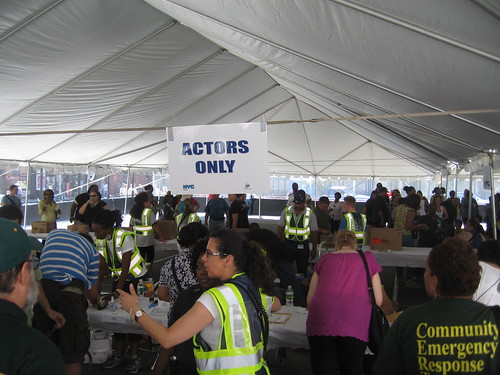
This was the role written for 300 or so New Yorkers (including myself) who played “patient actors” at a City of New York Point of Dispensing (POD) drill held at a school on Manhattan’s Lower East Side Saturday afternoon.
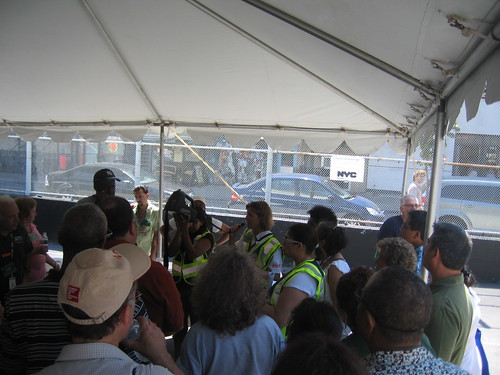
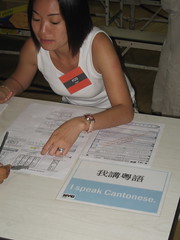
CITIZEN “ACTORS” REGISTER FOR THEIR ROLES AS “PATIENTS” BEFORE THE POD DRILL
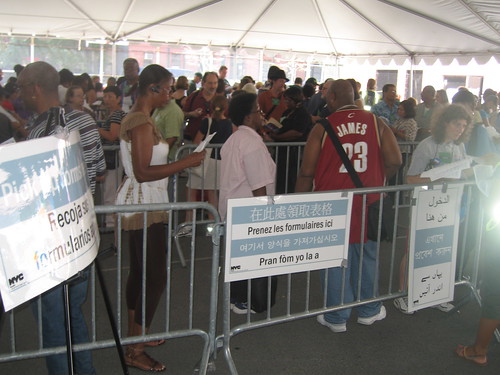
We arrived at 1:oopm and registered for the drill underneath a large tent set up in the courtyard of the school. The “cast” for the day was comprised mostly of New York City Community Emergency Response Team (CERT), Medical Reserve Corps and other Citizen Corps members, government employees, and some New Yorkers who had responded to DOHMH’s request for volunteers.(Though the exercise was developed to test medicine distribution in response to an anthrax event it will undoubtedly help public health officials if a widespread vaccination program is required for the H1N1 flu in the Fall.)
After registering, we were all briefed about the day by a drill organizer and placed on line. We each filled out a one-page “POD Screening Form” with questions about any underlying health issues that would make taking the antibiotic problematic (ie. particular allergies, specific regular medications or pregnancy). The form also required we give consent for ourselves and anyone we were picking up meds for, such as family members or neighbors.
A HEALTH DEPARTMENT OFFICIAL BRIEFS US BEFORE WE LINE UP FOR ANTIBIOTICS.
DOHMH staffers also distributed a survey to find out how we as individuals would handle a medicine distribution in a real-life situation (ie. Would you be picking up doses for others? How would you get to the POD?), which I imagine will provide complementary data to the Department.
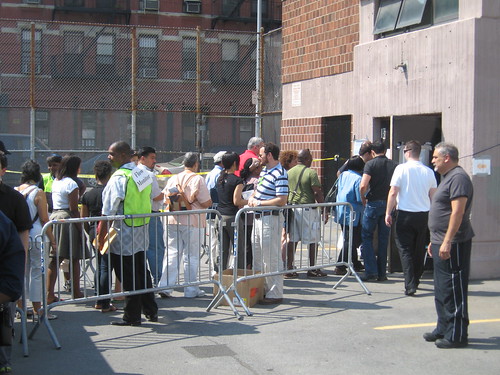
As the exercise was being set up inside the school, we ended up having to wait more than an hour on line (giving new meaning to the term “patient actors”!). However, the organizers did their best to help us deal with the summer heat by frequently bringing around refreshments and snacks as well as keeping us under the tent. And, most of us knew from experience that waiting is an expected part of the drill in these drills. The time did offer us a chance to catch up with fellow CERT team members (I was with my teammate, Will Sanchez, with whom I had also spent time waiting for an emergency exercise to start underneath the Hudson River in a train tunnel this Spring) as well as to meet some new folks, including members of the Coast Guard Reserve, the Coney Island CERT and a DOHMH staffer/volunteer on a ‘busman’s holiday’.
Once the drill began, the “patients” started filing into the school building and were led to the gym.
THE DRILL STARTS Â AND “PATIENTS ” STREAM INTO SCHOOL/POD.
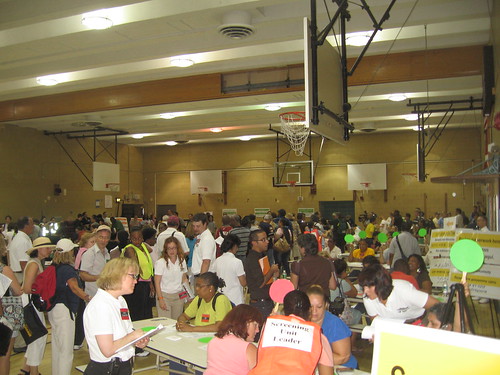
Rows of tables were set up with staffers waiting to look at our forms, correct our mistakes (I had checked all the circles not filled them out ‘SAT’-style as requested) and direct us to the next step. If you had indicated on your form you had any potential problems with the antibiotics being distributed, you were sent to the Medical Evaluation table to determine whether you needed an alternate antibiotic. Otherwise, you were directed to a medicine distribution table.
INSIDE THE GYM/POD
At the medicine distribution table, we were given a container with the antibiotics as well as the directions on how and when to use them. Once finished, we were guided back outside. It took about 10/15 minutes to finish the whole process in the gym. In addition to those working on the drill, there were also a number of “observers” in the gym monitoring the event from relevant government agencies. This NY1 television report video offers a good sense of the activity inside.
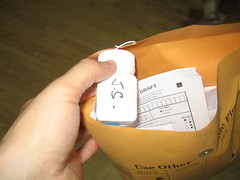
A POD WORKER GOES THROUGH MY SCREENING FORM BEFORE PROVIDING ME WITH ANTIBIOTICS; THE WORKER WROTE MY INITIALS ON THE CASE.
We were asked to go through the process again so DOHMH could get more practice. (In fact, we were all requested to do three trips through.) Officials told us that in an actual emergency the City would likely set up 200 or so of these PODs to distribute medicine.
As a “patient actor”, you go through the drill watching all the activity around you without knowing exactly who is doing what. And. therefore it is impossible from our vantage point to have any idea of the successes or failures of the drill. So earlier today, I checked with DOHMH to get its initial evaluation. A Department spokesperson sent me this helpful response by email this afternoon:
“This exercise allowed DOHMH to test our plans set up a POD and to distribute medication to large numbers of New Yorkers in a very short period of time. It also highlighted, as all good exercises do, successes and areas for improvement. The new screening form, which was being tested for the first time, was very successful and therefore we need to address the pressure this high throughput placed on other aspects of the POD. We plan to also consider options for making mental health staff more identifiable within the POD and designate quiet areas within the building where individuals can be spoken with. We also plan to consider adding more staff to assist the trained POD core team with setting up the POD.”
I also asked for an evaluation of the role of the volunteers: “The citizen patient actors were great. It is very helpful to have the public engaged in these exercises as it serves as a way to educate as well as an opportunity for DOHMH to receive feedback on our plans.” The two-way value of these exercises — not only as practice for the responders but also as education for the citizens involved — is instructive. It is why I (and many emergency officials I have spoken to) believe that as a nation we should be increasing the number of emergency drilling opportunities for the public.
Like all of the CERT drilling activities, participating in the POD exercises was interesting and largely enjoyable. No SAG/AFTRA cards were distributed afterwards and our next acting jobs will still be limited to emergency drills. However, at the beginning of the day, a DOHMH official told us: “Thanks for participating and making New York City a happier and safer place.” To most of the volunteers, that type of recognition and satisfaction is compensation enough.
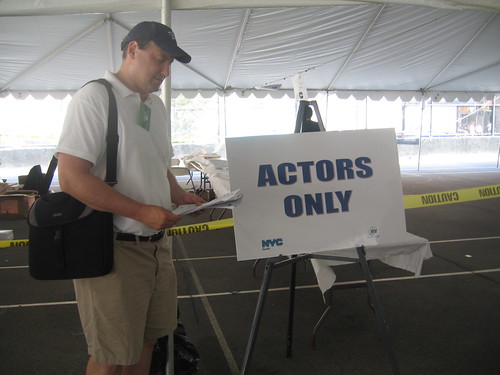
THIS “ACTOR” STUDYING HIS ROLE
These icons link to social bookmarking sites where readers can share and discover new web pages.
With the hurricane season now picking up in earnest, I wanted to highlight the daily FEMA “National Situation Update”. Every morning, it offers a quick snapshot of FEMA’s activities with information and graphics gathered from a variety of sources including other federal agencies and departments, state and local governments, and the news media. Earlier this month, I visited FEMA’s Situation Room at its Washington headquarters (where the information is collected), which reminded me that I had wanted to highlight this resource on the blog. This morning’s Update reports on the Lockheed Fire, Tropical Storm Claudette as well as the newly-named Hurricane Bill:
As of 5:00 a.m. EDT, August 17, 2009, the center of Hurricane Bill was located approximately 1,160 miles east of the Lesser Antilles.
Hurricane Bill is moving quickly toward the west-northwest near 22 mph; this general motion is expected to continue for the next 24-to-48-hours. Maximum sustained winds have increased to near 75 mph. Strengthening is forecast during the next day-or-two, and Hurricane Bill could become a Major Hurricane by Wednesday. Hurricane force winds extend outward up to 30 miles from the center and Tropical Storm force winds extend outward up to 145 miles. Estimated minimum central pressure is 987 mb (29.15 inches).
To get the daily Update (which complements other FEMA web-based resources), you can go to the Emergency Managers section of the FEMA website here. The agency’s FEMAinFocus Twitter feed also sends it out every morning. Thanks to Dennis Hanlon’s NetControl Twitter feed for originally bringing this to my attention.
These icons link to social bookmarking sites where readers can share and discover new web pages.
I was very unhappy to hear on my iPod this week that the public radio show, “Homeland Security Inside & Out” is ending production after three-and-a-half years. I was a podcast subscriber and a big fan of the weekly program hosted by Dave McIntyre and Randy Larsen.
“Homeland Security Inside & Out” was not only a well-produced, enjoyable hour of radio, but it was a very valuable homeland security resource that will really be missed. It covered the broad and evolving homeland security field in a comprehensive, even-handed manner. During the show’s run, Dave and Randy interviewed 900 guests (I was honored to be one of them last year). I have written a number of times on the blog about ideas, events and perspectives I first heard on the program.
Two of the guests on the final episode offered their own tributes to the show: CNN’s Jeanne Meserve said: “it’s really a loss that you’re going off the air.” And the Heritage Foundation’s James Carafano added that the show provided “a great public service for bringing [homeland security] issues out”. Unfortunately, “Homeland Security Inside & Out” is now out as well.
The 64% figure was striking to me, because it points out an interest of many Americans to become more knowledgeable in emergency preparedness/response (and it is a question that isn’t often polled). Twenty hours is the standard amount of training to become qualified as a member of a Community Emergency Response Team (CERT). That’s not to say that two-thirds of the population want to join the CERT program, but it does seem to indicate that a lot of Americans would be amenable to some sort of disaster education/training — maybe held in their workplace, house of worship, social club, etc.
Another interesting finding in the study is that a major impediment for people getting prepared is that they believe emergency responders will take care of them in a disaster (despite the warnings of the responders themselves that they can’t handle everyone, particularly in the first 72 hours). According to the survey:
From a list of possible reasons why individuals had not prepared, 30 percent of individuals indicated that a primary reason they had not prepared was because they believed that emergency personnel would help them in the event of a disaster. Further, 61 percent of participants indicated they expected to rely on emergency responders in the first 72 hours following a disaster.
The Citizen Corps, which is part of the FEMA’s Community Preparedness Division, has been measuring the public’s knowledge, attitudes, and behaviors on preparedness since 2003. I previously wrote about the 2007 survey which was released earlier this year. This updated report includes surveying fielded in the Spring; some of the initial results were released at the Conference. The rest of the data and further analysis will be presented at a later date. (n.b. the “training” question and  64% result is not in the report issued this week but was part of the presentation at the conference)
The survey is comprehensive and worth looking through for those interested in citizen preparedness research. Below are the “Summary And Recommendations”:
* Individuals’ high expectations of assistance from emergency responders may inhibit individual preparedness. Communicating more realistic expectations and personal responsibilities is critical.
* Too few people had stocked disaster supplies, and most supplies were incomplete. More emphasis is needed on the importance of stocking disaster supplies in multiple locations, and more specificity is needed on critical items to include, such as flashlights, radios, batteries, first aid kits, and personal documents.
* Greater appreciation for the importance of household plans and knowledge of local community emergency procedures and response resources is needed. Individuals who reported being prepared lacked critical plans and information.
* Practicing response protocols is critical for effective execution. Greater emphasis on drills and exercises is needed.
* An awareness of vulnerabilities to natural disasters motivates individuals to prepare. Most individuals, however, did not believe their communities will ever be affected by any type of disaster.
* Perceptions of the utility of preparedness and confidence in ability to respond varied significantly by type of hazard. Because all-hazards messaging may dilute critical differences in preparedness and response protocols, preparedness and response education should include a focus on hazard-specific actions appropriate for each community.
* Social networks, such as households, neighborhoods, the workplace, schools, and faith-based communities, and the concepts of mutual support should be emphasized
* Focusing on individuals in the contemplation and preparation stages for personal preparedness may yield greater results. Messaging and community outreach efforts should be designed to support those already considering taking action. Individuals’ strong interest in attending training courses and volunteering should be harnessed through social networks. Training and volunteer service should be linked with a responsibility for educating and encouraging others to prepare.
* Specific sociodemographic characteristics correlated with attitudes toward and actions for preparedness. Insights into these differences offer the ability to tailor outreach efforts to targeted audiences.
* Individuals believed they had a personal responsibility to report suspicious behavior but greater collaboration between citizens and law enforcement is needed.
The survey  was conducted by ICF Macro’s Carol S. Freeman who has done the previous Citizen Corps research and is a (if not the) leading opinion researcher in the area of citizen preparedness.
At the Citizens Corps conference, I had an opportunity to talk to some local emergency officials about the 64% finding. Below is a brief interview I did with San Francisco Fire Department Lt. Erica Arteseros, who coordinates the city’s Neighborhood Emergency Response Team program (CERT is called NERT in SF). In the video, she says government need to capitalize on the interest expressed in the poll.
San Francisco NERT coordinator Lt. Erica Arteseros talks about the Citizen Corps survey.
These icons link to social bookmarking sites where readers can share and discover new web pages.
The City of New York is looking for at least a few hundred more good men (and women) to be “Fake Patients” in a “Point of Dispensing (POD) Emergency Response Exercise” on Saturday afternoon. Officials say the drill will help in the planning for both a possible anthrax attack as well as the possible return of H1N1 in the Fall. This is also a rare opportunity for average citizens to take part in this type of emergency exercise and be part of the government’s preparedness effort for both the pandemic flu or a future terror incident.
The City has currently signed up 500 “patients” so far, according to Anne Rinchiuso from the Health Department’s Bureau of Emergency Management, but she says they could use up to 2000 volunteers. “The more people in the drill the more practice and data we get.” During the drill, the volunteer patients will go through a POD, a mass dispensing site opened for the distribution of antibiotics or other medications in response to a public health emergency or outbreak.
Rinchiuso says the exercise was designed a year ago specifically for an anthrax response. However, it will also provide lessons for officials in case there is a need for a mass H1N1 vaccination program this Fall.
If you are interested in participating on Saturday, go to the Health Department’s Exercise website at www.nyc.gov/health/podexercise to fill out the short registration form. The drill will take place at a school on Manhattan’s Lower East Side and will run from approximately 1-5 pm. It is open to New Yorkers over 18 years old. More information will be provided once you register.
Although CERT team members are often asked to participate in emergency responder drills (and are doing so again on Saturday), this exercise is open to all New Yorkers. Rinchiuso notes that this an opportunity for individual members of the public to play a very helpful role in the City’s emergency preparedness planning. (On a personal note, I have participated in a number of these drills. I — and I think most of the other participants — have found them interesting, community-building and even fun events. You really do feel as if you are helping out your city in an unusual but important way. And maybe you’ll even make some new friends on the line for ‘medicine’.)
These icons link to social bookmarking sites where readers can share and discover new web pages.