An editorial in Friday’s USA Today summarizes some of the lessons learned and not learned from Hurricane Katrina’s aftermath. Among the positives, according to “Four years after Katrina, a mix of progress and inertia,” are the rebuilding of FEMA as well as that:
–The New Orleans levees so easily breached in 2005 are in better shape. The Army Corps of Engineers is about one-third done with a $15 billion upgrade to the region’s flood control systems. The Mississippi River Gulf Outlet, a poorly conceived canal that was at least as effective at funneling water into New Orleans as aiding ship-borne commerce, has been closed. And authorities are beginning to restore wetlands that give the region a natural buffer.
–In Mississippi, casinos have been rebuilt on solid ground after the state abandoned the fiction that its gambling was somehow less objectionable if its casinos were on floating structures. Rising prices for real estate and insurance, meanwhile, have caused a shift in new building toward more durable high-rise structures. A number of other states along both the Atlantic and Gulf coasts have imposed stricter building codes…
However, the editorial goes on to say that the impact of those positive developments:
has been greatly diluted by the ongoing taxpayer subsidization of building in hurricane-prone areas. Homeowners in flood zones, including coasts vulnerable to hurricanes, can get federal flood insurance at rates that don’t come close to approximating the actual risks, thus subsidizing risky development. That insurance program is $19 billion in the hole because of its low premiums and massive payouts.
Efforts to limit the program, or hike premiums to put it on sound footing, are stuck in Congress. In all likelihood, the existing debt will be formally forgiven by Washington, enabling the insurance program to start racking up fresh debts. The unrealistically low rates encourage people to build, or rebuild, in areas that probably should be left alone or developed with steel-reinforced concrete structures.
To some extent, private homeowners’ insurance, which protects against wind (but not water) damage from tropical storms, is helping to discourage unwise building. Rates for this coverage have surged in recent years as insurers have concluded that an extended period of benign storm activity might have ended. Many took massive losses with Katrina and are determined not to let that happen again.
But lawmakers from coastal regions have responded to this message with a kill-the-messenger approach. They are pushing to have federal taxpayers take over liability for wind damage as well.
Florida might have even come up with a way to put federal taxpayers on the hook without getting legislation through Congress. Its state government has taken over much of the property insurance business, now insuring about half of the structures in the state.When a major storm hits and wipes out its catastrophe fund, the smart money is on Florida officials running to Washington for a bailout. In the wake of bailouts for car companies and banks, among others, the pleas would be hard to resist.
Four years after Katrina, and 40 years after Hurricane Camille slammed the Gulf Coast, this unwillingness to reassess risks and to pay the requisite premiums threatens to undermine the work of public officials trying to make coastal communities safer. Good intentions are important, but they are no replacement for steely eyed realism.
These icons link to social bookmarking sites where readers can share and discover new web pages.
Four years after Hurricane Katrina, the United States is “dangerously unprepared” for another major disaster with many key functions of disaster preparedness, response, relief, and recovery continuing to lack capacity to deliver core services and programs before and after a major disaster, due to the ineffectiveness of FEMA to sufficiently coordinate over 20 agencies and organizations under the National Response Framework. That’s the conclusion of the Disaster Accountability Project (DAP), which was founded after Hurricane Katrina to improve FEMA, American Red Cross, and the other government agencies and nonprofit organizations responsible for disaster preparedness, response, relief, and recovery.
“FEMA’s leadership is very capable, yet Americans are unnecessarily vulnerable until post-disaster housing, mass care, and disability policy deficiencies are resolved,” said Ben Smilowitz, Executive Director, Disaster Accountability Project in a statement which outlined the group’s recommendations:
Disaster Housing: Interagency Dispute. The President must provide guidance to FEMA and HUD as there is a loud silent debate between the agencies about who is responsible for short-term and long-term housing. While FEMA continues to further develop the National Housing Strategy, progress is snail-paced and FEMA’s own National Advisory Council is calling for the pace to pick up.
Mass Care/American Red Cross: Role Confusion/Capacity Problems. The GAO made it very clear that existing structures responsible for providing Mass Care services after a major disaster do not have the capacity to provide necessary services. While the American Red Cross is no longer the lead agency for Mass Care in the National Response Framework, the organization maintains a lead role in practice.
In the last year alone, the American Red Cross has laid off a significant percentage of staff across the country, significantly widening the ratio of “paid staff” to “unpaid staff,” commonly known as the volunteer. After last hurricane season, the American Red Cross received nearly $100 million from the federal government to cover many of its costs from the last hurricane season and other major disasters. With public and donated funds should also come accountability, transparency, and oversight. There ought to be a national-level conversation about the role of volunteers in disaster response and relief, their strengths and limitations, and viable alternatives or ways professionals can help by augmenting volunteer efforts.
The critical role of local organizations and their ability to reach community members in need cannot be ignored. While these small nonprofits and faith-based organizations do not have the resources for national public service announcements and billion dollar fundraising campaigns, they need access to some of the donated dollars that flow into the coffers of larger organizations able to broadcast commercials across the country. FEMA might consider exploring ways that donated dollars can be split proportionally or that even a small percentage (5-10%) can be used to support the important work of local organizations.
Disability Policy: Not in compliance with Post-Katrina Act. The Disaster Accountability Project strongly urges FEMA to comply with the directives of Section 513 of the Post-Katrina Emergency Reform Management Act and create an Office of Disability within the Office of the Administrator and provide this Office with sufficient staff at the national level. The National Disability Coordinator position is now completely unsupported, buried in the employment-oriented Office of Equal Rights, and arguably ineffective for that and many other reasons.
The Disaster Accountability Project echoes the repeated recommendations of FEMA’s National Advisory Council and disability rights groups such as the National Council on Disability, that FEMA create Regional Disability Coordinator positions in each FEMA Region. These recommendations are not only critical for the 54 million-plus individuals with disabilities in the United States, but also to help implement Administrator Fugate and Chief of Staff McNamara’s goal of fully integrating disability and accessibility considerations into mainstream standard operating procedures.
Communications: Hurricane Ike revealed problems. In the immediate aftermath of Hurricane Ike, the Disaster Accountability Project’s hotline received numerous calls from survivors reporting they did not know where to find Mass Care Services, despite the fact most callers found out about the hotline from Houston-area radio. The public was not receiving steady, detailed county-by-county information about the location of services. It appears that despite post-Katrina federal guidance documents for Disaster Communications including the National Response Framework’s Emergency Support Function 15, Emergency Alert System, and HazCollect updates, there may have been an oversight. The Disaster Accountability Project hopes to begin a conversation about a solution.
DAP recommends that “the FEMA Administrator should be included in Cabinet meetings to cut down on bureaucratic ‘games of telephone’ and so that the President can be the final arbiter of interagency disputes.”
For more information on the Disaster Accountability Project go to its website here or Twitter feed here. The group also maintains a toll-free “tip” line for citizens to report any gaps in disaster preparedness and response at 866-9-TIP-DAP.
These icons link to social bookmarking sites where readers can share and discover new web pages.
As Tropical Storm Danny moves up the East Coast and the nation marks the 4th anniversary of Hurricane Katrina, it is a good time to mention a robust volunteer program called SkyWarn. I have wanted to highlight this citizen preparedness opportunity since being reminded of the program by the new (and helpful) Citizen Corps Twitter feed earlier in the month.
SkyWarn, which is run by the National Oceanic & Atmospheric Administration (NOAA), is comprised of 260,000 citizen Storm Spotters trained by their local National Weather Service (NWS) office to assist in identifying and reporting extreme conditions.
Classes are free and typically are about two hours long. To find out when a Skywarn class will be conducted in local your area, contact your local NWS office (map here.)
These icons link to social bookmarking sites where readers can share and discover new web pages.
At one of the opening panels of the recent Citizen Corps’ National Conference On Community Preparedness, I heard a terrific presentation on San Francisco’s new preparedness initiative, “Prep SF Because It Rocks!”, given by Rob Dudgeon, the Deputy Director of  the City’s Department of Emergency Management (SFDEM), and Kristin Hogan from the consultancy CirclePoint who helped develop it. (The slides for their presentation, “The Preparedness Movement: How Social Media Supports A Culture of Preparedness,” can be found here.) Afterwards, I shot an interview with them about “Prep SF” and about citizen preparedness in general. The video is at the bottom of the post.
To Dudgeon and Hogan, the public preparedness challenge calls for new content and distribution approaches. That means less top down instructing of citizens and more sharing knowledge among members of the community using social media. An underpinning of the new initiative is that existing official or “branded” citizen preparedness efforts have hit a ceiling. ”We got who we’re going to get,” says Dudgeon.
“Prep SF Because It Rocks!” is being rolled out in stages beginning with an “unbranded” Facebook page which is not web linked with the SFDEM official sites including www.72 hours.org. This is not viewed by organizers as a one-time “campaign” but instead as an effort to create a “preparedness movement” which will become part of San Franciscans’ everyday lives.
I was particularly impressed with their strategic approach to the issue laid out in the presentation, which began with a thoughtful analysis of other preparedness efforts and academic social science. Though the initiative is very localized to reflect the City of San Francisco, there are many elements in “Prep SF” that are transferable (and localizable) to any area in the U.S. I recommend becoming a Facebook “Fan” of “Prep SF” not only if you are in Bay Area but also if you are interested in creative preparedness/public education efforts.
INTERVIEW WITH ROB DUDGEON AND KRISTIN HOGAN ON “PREP SF BECAUSE IT ROCKS!” (ABOVE)
These icons link to social bookmarking sites where readers can share and discover new web pages.
He’s back! The much anticipated return of @Disastersrus (a.k.a. Florida Emergency Management Director Craig Fugate) to Twitter with a new identity and under a new management occurred yesterday as now Federal Emergency Management Administrator Fugate launched his new feed @CraigatFEMA.
While only 1 in 10 of Americans surveyed by the American Red Cross claimed to be very worried about H1N1 flu, 93 percent say they are are taking or planning to take at least one action to guard against the H1n1 flu. The poll was released earlier today.
“Even though most Americans aren’t extremely worried about the virus, they seem interested in taking steps to protect themselves and their families,” said Scott Conner, Red Cross senior vice president of preparedness and health and safety services. “Taking those basic steps-such as washing your hands more frequently and remaining at home if you are sick become even more important as the new flu season approaches.”
According to the results, women are more likely to take protective actions, with 84 percent making an extra effort to cover coughs and sneezes (versus 71 percent for men), and 81 percent washing their hands more carefully and more often (compared to 71 percent for men).
The survey also found that 62 percent plan on being vaccinated against this new flu virus if one is offered. Nearly half of those surveyed (46%) plan on assembling a two-week supply of food, water and medicine that they might need in the event they or someone in their family becomes sick and need to stay home for extended periods of time.
The survey results seem to indicate that Americans are in a relatively good mental posture for the Fall — not getting too scared but taking some actions and beginning to think about contingencies in the event of a widespread health emergency. (Of course one would want both personal and societal preparedness to be a higher for such a potential pandemic but the best should not be the enemy of the better here.)
As far as the gender findings, come on men get with it!
These icons link to social bookmarking sites where readers can share and discover new web pages.
U.S. Department of Homeland Security (DHS) Secretary Janet Napolitano and more than 25 senior DHS officials  received CPR and first aid training from American Red Cross trainers at the Department’s headquarters in Northwest Washington, D.C. on Friday. During the two-hour session, Secretary Napolitano and her staff received hands-on training from Red Cross instructors in cardiopulmonary resuscitation (CPR), basic first aid and use of automated external defibrillators (AEDs). This marks the first year the Red Cross has provided this type of training to federal officials in Washington, D.C.
SECRETARY JANET NAPOLITANO DURING CPR TRAINING
Secretary Napolitano’s decision to undertake this training at DHS was constructive in a number of ways. First of all, of course, it added her and more than 25 new people to the ranks of those are better prepared to help their fellow citizens in a medical emergency. It also brings some high-level attention to one of the concrete — and relatively easy — things that individuals and institutions can do to become more prepared.
Making the workplace a location for citizen/employee preparedness training and planning is such a crucial element in making substantive steps towards becoming a more prepared nation. And getting the commitment and involvement from the top of an organization is always a key. Napolitano was sending the message that this was worth two hours of her time and that of her employees.
When I took CPR at the Red Cross’s Greater New York Chapter two years ago, I was struck by how many in the class were taking the course because they had to for work (many were physical trainers and CPR is part of the certification process). I too was there in large part because it was clearly an aspect of my work. While maybe in the ideal world everyone would volunteer to take these courses on their own time, the reality is that if we expect people to take CPR/First Aid — as well as other preparedness tasks — we have to make it easier for them to do it.
Let me make a small suggestion to DHS based on my own CPR experience: put a renewal training on the schedule 365 days for now since the certification only lasts for a year. I will admit here that my certification has lapsed. And, I am not alone: in the last few weeks, I have happened to speak to several people in the preparedness field who sheepishly admitted to me that they too needed to get re-certified. (Empathetically, I will not disclose their identities.) If a follow-up re-certification is not scheduled a year from now, I know from experience that there will be a lot of folks walking around DHS headquarters in September of 2010 with expired cards.
By the way, Red Cross personnel train and certify approximately six million people each year through CPR, AED, and first aid courses available daily at 700 Red Cross chapters across the nation. If you’re interested yourself, get in touch with your local Red Cross chapter or visit www.redcross.org.
These icons link to social bookmarking sites where readers can share and discover new web pages.
U.S. officials are reevaluating the government’s original post-9/11 Ready.Gov citizen preparedness recommendations and in public statements are already reprioritizing what they are urging Americans to do to prepare for disasters.
It means that Ready.Gov’s “Get A Kit, Make A Plan, Be Informed” framework — which has been used by many federal, state and local preparedness sites since its launch six years ago — will likely get an overhaul. “We are taking a look at the website content,” Ready’s Acting Director Rebecca Marquis said last week.
Though changes have yet to be made on the Ready.Gov site, FEMA Administrator Craig Fugate has already been altering the Ready citizen preparedness message in a number of recent appearances. He has been urging people to “make a plan”, but has been omitting mention of a getting a (supply) kit. An example is the video (below) shot in the new Los Angeles Emergency Operations Center from FEMA’s website earlier this month in which he urges Americans to “get a plan, get trained.”
FEMA HEAD CRAIG FUGATE TALKS ABOUT PREPAREDNESS IN LOS ANGELES EOC EARLIER THIS MONTH (ABOVE)
The changes come as many in the preparedness community have expressed concern that asking Americans to create a full 72-hour supply kit may be too difficult financially and logistically. (In addition, people may already have some elements of the recommended kit, and it is more a matter of taking stock and/or updating them.) Making a family communications plan, Fugate has said, doesn’t cost anything. The emphasis on the “get trained” message was underscored last week when Secretary Janet Napolitano and more than 25 Homeland Security staffers took a CPR/AED/First Aid course.
The current “Get A Kit, Make A Plan, Be Informed” approach came out of an effort in the years after 9/11 to standardize and simplify the preparedness message to the public. While the Ready.Gov messaging has definitely made some awareness inroads with the public, I have found a general consensus in the preparedness field area that revising and augmenting the approach would be helpful. FEMA will be working with the Red Cross and other partners in developing the changes.
I think it is a great idea to take a new look at Ready.Gov and other preparedness messaging. My major suggestion, as I have written on the blog, is that any communications overhaul be done as part of an overall strengthening of the government’s citizen preparedness effort, because there is a limit to what even the most effective information campaign alone can do in changing public behavior.
These icons link to social bookmarking sites where readers can share and discover new web pages.
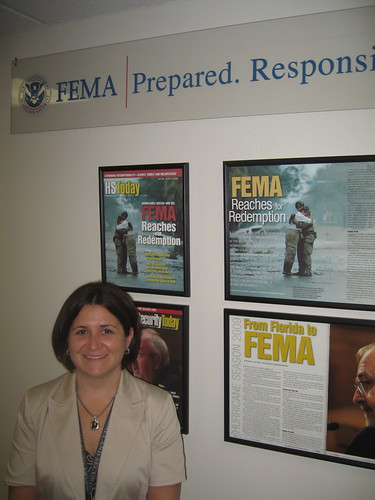
With “National Preparedness Month” (NPM) a little more than a week away, the H1N1 flu could make September a real-life ‘teaching moment’ on the importance of emergency preparedness, according to Ready.Gov’s acting director Becky Marquis. I spoke to Marquis at FEMA headquarters on Thursday to preview some of Ready’s plans for the Month.
The NPM’s kickoff event will take place September 2nd in New York’s Times Square featuring Homeland Security Secretary Janet Napolitano and local Citizen Corps Council members who will be passing out preparedness and volunteering information as well as hand sanitizer. It will also be the launch of a new series of national public service announcements being produced by the Advertising Council, which will be localized in some cities.
Ready will be producing and distributing a NPM multimedia web package on preparedness along the lines of the new social media content now being created by FEMA and DHS. It will include videos from Napolitano and FEMA Administrator Craig Fugate on the subject of preparedness emphasizing the “shared responsibility” and the public as “an asset” themes they have discussing publicly in recent weeks. Updates will be sent through the ReadyDotGov Twitter feed throughout the Month.
One point of emphasis for this year’s NPM will be on citizen disaster volunteer programs such as the Community Emergency Response Team (CERT) program as part of the Obama Administration’s Serve.Gov program, according to Marquis (who herself is a CERT member in Northern Virginia.)
Another focus will likely be H1N1 preparedness and response, said Marquis noting that “National Preparedness Month could become H1N1 Preparedness Month.” She said that Ready.Gov (and NPM) would likely be a significant part of the government’s public information response.
I also asked Marquis about the little-noticed congressionally-legislated organizational and geographical move of Ready.Gov from DHS (and its upper Northwest Washington campus) to FEMA (and its offices near the Mall) late last year. She said that the transfer has turned out to be a positive development for a couple reasons: first, there are more public preparedness resources and activities at FEMA which she can draw from for Ready. And second, there are more external relations staff to help provide support for the program — that’s particularly important around this busy time since Marquis is Ready.Gov’s only full-time employee.
For more information on National Preparedness Month go to www.ready.gov/america/npm09/index.html. There is a state-by-state event calendar on the site here. If you would like to be part of the NPM Coalition (which currently has 2,225 private and non-profit members), you can sign up here.
READY.GOV’S ACTING DIRECTOR REBECCA MARQUIS AT FEMA’S HEADQUARTERS
These icons link to social bookmarking sites where readers can share and discover new web pages.
Many of the methods will be familiar to readers who follow social media and disasters, but Callari offers some new ideas and resources for preparing and responding to hurricanes and other emergencies. His list underscores that sometimes social media has unique attributes for dealing with disasters, and often it is a complementary or alternative method of doing so.
Thanks to the CrisisCamp Twitter feed for bringing this to my attention.
These icons link to social bookmarking sites where readers can share and discover new web pages.