The 10 finalists for the U.S. Health and Human Services (HHS)Â YouTube Flu Prevention PSA contest have been announced and posted on Flu.Gov. You can now vote here through September 16th for the winner who will receive a $2500 prize (and whose PSA will be featured on national television).
The finalists are all good and their entries are better produced than I would have thought. Each makes useful H1N1 points in creative ways. And, the idea of asking the public to create PSA’s allows for more pushing of boundaries than if a government agency produced them. It is unlikely that the government would be able to show a man wielding a chainsaw through the streets to illustrate a version of  ’social distancing’ as one of the finalists does.
According to the rules set out in HHS Secretary Kathleen Sebelius’ own video on YouTube, contestants were asked to: “Create a 15, 30, or 60 second video Public Service Announcement (PSA) that will inform and motivate people to take steps that will help prevent the spread of the flu. Make your video fun, smart, and entertaining.”
Though I thought all the finalists were effective, only one video can win. So, in consultation with my two young daughters (my YouTube consultants), this blog picks “H1N1 Rap By Dr. Clarke” (see his entry below). In his video, Dr. Jon Clarke, in shades, raps about H1N1 prevention before concluding a little more soberly and without the sunglasses. We thought the combination was effective. If he is chosen, Clarke could be the breakout video star of the Fall.
“H1N1 RAP BY DR. CLARKE” (ABOVE). A FINALIST IN THE FLU.GOV H1N1 PSA CONTEST
To watch all the finalists and vote go to the entry site here.
You can also view the entire group of 242 judged entries here. Most of these provide a more homemade video feel and are filled with kids, superheroes, and pigs. Some are also pretty effective. This one (below) called “Barnyard Conference” was a favorite among my kids, and it’s pretty funny (though it may not help efforts to replace the term “swine flu” with H1N1!).
ONE OF THE FLU CONTEST ENTRIES, “BARNYARD CONFERENCE” (ABOVE)
In all, I think that soliciting, unleashing and highlighting creativity from Americans with a desire to help on flu prevention — and from of a variety of ages, backgrounds, and points of view — was a terrific idea. It is fun, citizen-driven/focused, and most importantly should be effective in raising flu preparedness among the public. By the way, if you disagree with my selection please tell me why you picked one of the other finalists (or preferred one of the other 232 entries) instead.
These icons link to social bookmarking sites where readers can share and discover new web pages.
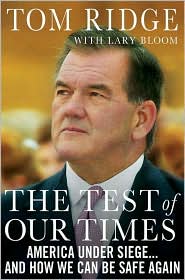
Former U.S. Homeland Security Secretary Tom Ridge’s new book has garnered headlines over questions whether some in the Bush Administration wanted him to raise the terror color alert for political reasons.
But a bigger theme (and, I would argue, a bigger deal) throughout the book is his frustration with the inability to have a frank and sustained dialogue with the American public about post-9/11 homeland security. The good news is that many of the objectives envisioned but not attained by Ridge when he was in charge and detailed in the book can — and may well — be taken up by the current Secretary Napolitano.
Ridge says he wrote his book in large part because “I’ve seen a sense of public complacency creep in.” Chertoff also writes in his about his similar concern about “complacency” and a return “to a September 10th mindset”. Further, Chertoff told me in an interview last month that he “wishes he could have done more” on citizen preparedness. Though Ridge doesn’t explicitly say so in his book, it comes through pretty clearly that he has some of the same regrets.
Ridge acknowledges the confusion that  Americans have had about their role in the nation’s homeland security since 9/11. In fact, he characterizes it memorably as “homeland helplessness”. And though I think he would agree that he did not address it nearly as well he would have hoped, Ridge does nicely lay out some useful ways that current leaders can try (ie. candid discussions with the public on topics like risk management and ‘dirty bombs’). The same significant challenges about the task — the novelty, complexity and sensitivity of the subjects in a highly-charged media and political environment — are still there as is the huge opportunity to capitalize on the largely untapped asset that is the American public. (Something that Napolitano has indicated an intention of doing.)
In the book, Ridge writes that when he came to Washington after 9/11 as presidential homeland security adviser and then as head of the new cabinet department he wanted to “create a culture of sharing” both among agencies and the public and move from a “need to know” to “need to share” philosophy. He believed that communities and citizens “deserved more information about the conduct of our business and the rest of the administration as it effected them.”
Ridge describes how he and his chief public affairs aide, Susan Neely, envisioned their citizen communications approach:
“We needed to create a government office with a public information policy that would be groundbreaking. We would find a way to interpret frightening reports in a way that would motivate a sense of readiness and security without sounding like a horror movie. We would attempt to share as much information as possible, certainly more than government agencies were used to doing. The goal was unprecedented, and the task would prove more difficult than we realized.”
“An informed public is an engaged public and a good investment in the security of the community and the country. And informing the public required a new way of thinking and communicating and, I believed, now was the time to take up the task…Americans had a role to play, and to do so effectively, they needed to know more not less.”
But, Ridge writes, others in the Bush Administration did not share that same idea when it came to the public. He says some in the White House opposed the citizen awareness campaign, Ready.Gov, because it would have “little value or merit, but grudgingly let us proceed”. (He does note getting some satisfaction later on that Ready did gain some traction with the public and ultimately even First Lady Laura Bush did PSA’s on emergency preparedness.)
Ridge, like Chertoff, believes that there needs to be far more public understanding about the role of risk in homeland security. In the book, he uses the example of the ‘dirty bomb’ — a traditional explosive laced with radiation — which “though it will cause some deaths in the area of the explosion, is primarily a psychological weapon and a means to contaminate a large area.” Ridge raises a key question — that most experts I’ve spoken to believe the nation will face at some point in the future — how will we decide to deal with that contaminated area? (e.g. would we abandon all of downtown Manhattan?) He writes:
“If the measured level of contamination should turn out to be moderately higher than the existing federal health and environmental standard, but at a risk level that people were prepared to accept, would the government force them to leave? What level of additional health risk would citizens and communities be prepared to accept in order to maintain their communities?…If decontamination of the affected area could not reduce the danger of cancer death to one in ten-thousand, which means in a city of five hundred thousand an additional fifty deaths would occur, should we or would we abandon the city? And how could the government arrange for a trustworthy response devoid of panic and politics, with a clearly scared (and rightly so) population.”
Statistically, this is minimal. But it is not hard to imagine the media frenzy whipping the population into a panic…In the post -9/11 world, we need to be informed and realistic about the level of contamination we will accept. In such an attack, most of the casualties come well after the initial explosion. The difficulty is determining the subsequent level of contamination and its long-term physical and psychological effects on the population. We believed we could address these problems, but we were also left with major policy issues at various levels.”
Ridge lays this out in a clear, straightforward and provocative manner in the book. It leads to the obvious question — shouldn’t he have presented it this way to the public during his tenure? (I will ask Ridge when I interview him; I’m guessing he would answer ‘yes’ but cite some of the major obstacles he faced in doing so.) Again, the good news is that we haven’t been struck by that ‘dirty bomb’ (which Ridge would seem to deserve some credit for) so the fact is that the public still can and should get that type of briefing.
“The high-altitude nuclear weapon-generated electromagnetic pulse (EMP) is one of a small number of threats that has the potential to hold our society seriously at risk and might result in defeat of our military forces. The damage level could be sufficient to be catastrophic to the Nation, and our current vulnerability invites attack.
Briefly, a single nuclear weapon exploded at high altitude above the United States will interact with the Earth’s atmosphere, ionosphere, and magnetic field to produce an electromagnetic pulse (EMP) radiating down to the Earth and additionally create electrical currents in the Earth. EMP effects are both direct and indirect. The former are due to electromagnetic “shocking” of electronics and stressing of electrical systems, and the latter arise from the damage that “shocked”-upset, damaged, and destroyed-electronics controls then inflict on the systems in which they are embedded. The indirect effects can be even more severe than the direct effects.”
At a U.S. House Homeland Security Subcommittee hearing earlier this Summer, “Securing The Modern Electric Grid From Physical And Cyber Attacks,” Chair Yvette Clarke (D-NY) noted in her opening statement: “Though we may no longer fear a nuclear attack from Soviet Russia, rogue adversaries (including North Korea and Iran) possess and test high altitude missiles that could potentially cause a catastrophic pulse across the grid.”
The EMP threat has also received more attention as a result of a best-selling novel about an electrical shutdown by William Forstchen, One Second After. Forstchen has a web site with information on EMP preparedness here.
There is some debate over the seriousness of the threat and how significant the nation’s response should be to it. Michael Crowley wrote a skeptical article on the subject for The New Republic earlier this summer:
“‘EMP is real,’” agrees Joe Cirincione, a nuclear weapons expert who now runs a pro-disarmament think tank, the Ploughshares Fund. But, as Cirincione notes, few analysts take the threat very seriously. The odds that Iran or North Korea would prefer a technologically untested Rube Goldberg scheme to merely nuking us seem slim. And any terrorist group able to execute such a plan was probably capable enough to get us one way or another anyhow.”
“On Twitter [@RedCrossPDX], tell us just one thing that you’re doing to get prepared this September (aka National Preparedness Month). To get you started, here are some quick ideas:
–Buying enough water for my family
–Setting aside extra pet food
–Picking up a crank radio
–Taking the free online Be Red Cross Ready training
–Practicing the “sleeve sneeze”
–Putting games for the kids in my kit
–Picking a disaster meet-up place
You get the point. It doesn’t have to be complicated or expensive or hard. And if you tweet us with just one thing, we’ll enter you to win — not one, but three — prizes that will get you started on being prepared for anything:
*A Safety Starter preparedness kit
*A vintage first aid kit
*A “Be Prepared For Anything” t-shirt
You have until September 30 to send us your tweet (please use the hashtag #just1thing for tracking purposes) to be entered. If you win, we’ll send you your prizes via snail mail.”
Though there are many actions that citizens can do to prepare for emergencies, the idea of asking people to do just 1 thing is smart — making it seem far more manageable. And, though they won’t say it explicitly, the sneaky Cross Bloggers know that often when someone does one thing to prepare they ended doing many more. I look forward to seeing and posting their long list of ‘things done’ by the end of the month. So, do #Just1Thing and give them a tweet.
A VINTAGE FIRST AID KIT, ONE OF THE CONTEST PRIZES
These icons link to social bookmarking sites where readers can share and discover new web pages.
Due to dangerous wildfire conditions, please do not travel to the areas affected by the fires without explicit instructions from a qualified emergency response organization. In the days and months to come, longer-term recovery efforts may be under way and in need of support. These services are best provided through coordinated efforts, and it is critical that potential volunteers do not self-deploy. Please see the Web site links below for the most up-to-date information regarding the wildfires, potential volunteer opportunities, and donation opportunities.
It then offers links to the most updated information, places to provide financial/in-kind assistance, and possible volunteer opportunities through LAWorks. The site also shows how Californians can sign up to train for future disasters through CERT, the Red Cross or the Salvation Army.
(photo: Associated Press)
These icons link to social bookmarking sites where readers can share and discover new web pages.
U.S. Department of Homeland Security Secretary Janet Napolitano today joined with Federal Emergency Management Agency Administrator Craig Fugate and the Ad Council to launch a new series of Ready Campaign public service advertisements (PSAs) designed to encourage all Americans to take steps to prepare for emergencies, kicking off September’s National Preparedness Month.
“Preparedness is a shared responsibility that begins with the American people,” said Secretary Napolitano. “These public service advertisements highlight the simple steps everyone can take to prepare for disasters, enhancing the safety and security of our country.”
The theme of the PSAs is “World Upside Down” underscoring that a disaster can turn one’s life upside down. The PSA urges audiences to get a kit, make a plan and be informed. Below is one of the spots from the Ad Council’s YouTube site:
A READY.GOV/AD COUNCIL “WORLD UPSIDE DOWN” PSA
Produced pro bono by advertising agency Cramer-Krasselt in conjunction with the Ad Council, the new Ready PSAs-produced for television, radio, print, outdoor and the Web-direct audiences to visit www.ready.gov to find national and local preparedness information and resources. The Ready Campaign encourages Americans to take three simple steps to prepare for emergencies: (1) Put together an emergency supply kit; (2) Make a family emergency plan; and (3) Get informed about the types of emergencies that could take place in their communities and appropriate responses.
In the video, shot at FEMA headquarters, Marquis says National Preparedness Month is the “perfect time to think about preparedness”, and she outlines some steps every American should take to become prepared.
The first Dialogue took place in early August. The current one runs through September 6th [Update: The deadline has been extended to September 9th]. (The third will take place September 28th through October 4th). To participate, you can go to www.homelandsecuritydialogue.org to weigh in on six topic areas – Counterterrorism and Domestic Security Management; Securing Our Borders; Smart and Tough Enforcement of Immigration Laws; Preparing for, Responding to, and Recovering from Disasters; Homeland Security National Risk Assessment; and Homeland Security Planning and Capabilities. The public input through the Dialogues complements the work of the Department’s QHSR study groups in each of the areas.
In a Blogger Roundtable teleconference yesterday to promote the launch of the second Dialogue, DHS Deputy Assistant Secretary Alan Cohn said that the Department had been “very happy” with the first round. He said that there had been 8200 participants (who posted more than 200 individual proposals) with 20,000 individuals visiting the site in total.  (DHS Assistant Secretary David Heyman held a similar Roundtable when the Dialogue process began earlier last month.)
Cohn said the Department had learned a good deal from public input during the first Dialogue on the process (how to make the site more user friendly and have less overlap among areas), on the lexicon (no more use of “man made disasters” and language is more consistent throughout) as well as on the content (participants requested more emphasis on mitigation and resilience; and in fact, resilience has a much higher profile in the second Dialogue). The challenge of course is defining the concept of resilience better and showing how it impacts the various areas of the review — which Cohn hopes will be discussed by Dialogue participants going forward.
In the second Dialogue, participants are asked to use a point system to prioritize various objectives in each area and then will hopefully provide recommendations on how those objectives should be achieved. The discussion will continue through the week and the ideas with the most support rising to the top” (though most of mine did not rise all that high in the first Dialogue so the system is not perfect!).
There are definitely limitations to the online format for soliciting comments and facilitating discussion on often complex and subtle homeland security goals and objectives. But, as is true in much of what this blog covers, we shouldn’t let the best be the enemy of the better. The Dialogues do give citizens the rare opportunity to talk directly to DHS (and, yes, Cohn says every comment is read and given to the study groups for consideration) on pretty much all homeland security issues. In fact, Cohn said repeatedly during the Roundtable that the Department was really depending on that involvement.
“We’re very happy [with the input so far], but we’d like to get a whole lot more comments…Everyone has something to contribute,” Cohn said, adding “The more people who participate the more valuable this tool is going to be.”
These icons link to social bookmarking sites where readers can share and discover new web pages.
The American Red Cross is launching a new campaign, “Do More Than Cross Your Fingers,” today hoping to make it easier for Americans to prepare for emergencies. The campaign’s spokeswoman is Jamie Lee Curtis, a long-time Red Cross volunteer and advocate for personal preparedness in her home state of California.
The campaign will encourage Americans to take simple actions like building an emergency kit, creating a communication and evacuation plan and being informed about disasters common in their communities. It includes an interactive online game, Prepare4, which not only quizzes you on what preparedness supplies to store in case of an emergency but will also offer to email you a list customized for family size, age of kids, pets, etc.
Corporate sponsor FedEx will promote the campaign in its stores and NASCAR races, including those held in Richmond, Indianapolis and Philadelphia. Clorox will be distributing educational materials online and via retail stores. For more information on the campaign as well as the Red Cross’ emergency preparedness recommendations for the public, you can go to http://www.redcross.org/domore.
These icons link to social bookmarking sites where readers can share and discover new web pages.
In an interview just before the release of his new book, former U.S. Homeland Security Secretary Michael Chertoff urges that the terror color codes should be condensed to three levels, calls for the development of a new preparedness course (including first aid, CPR, basic mechanics, and firearms training) for schools across the U.S., acknowledges “he would have liked to have done more” on citizen readiness during his tenure, and says that his successor Janet Napolitano is doing “a very good job”.
We spoke a couple weeks ago at the Washington, D.C. office of the Chertoff Group, a security and risk management advisory firm, he opened earlier this year. (Not surprisingly, the former Secretary looks more tanned and rested than when I last interviewed him almost exactly a year ago at DHS headquarters before he left for the Gulf Coast to supervise Hurricane Gustav preparations.)
Yet, Chertoff does believe there need to be some changes made to the current alert system, most notably that the colors should be condensed from five to three levels —  because he says “we’re not going to get below yellow.†He recommended in testimony to the new DHS alert task force that there be “a steady state, a heightened alert and then Red”. Though he believes Red may have to be delineated with a little more specificity (ie. if an incident has happened, but there is no intelligence about another attack vs. when the government believes another strike is imminent).
As far as citizen preparedness, Chertoff says that a key to creating a long-term prepared nation is to focus on schools and kids. In the interview, he sketched out two suggestions  – a “minimum” and a “maximum” approach. The “minimum” would be “to get the fire management and emergency management people to come together to create a program to be exported to the schools on basic preparation.”
Chertoff’s “maximum” option is that there be a more substantive course developed for U.S. schools on planning and preparation which would include teaching “basic skills,” such as first aid, CPR, swimming, driving, basic mechanics and operating a firearm.
“If you’re not going to have a national service then as part of graduation from high school there should be a course over a period of time that teaches you the kind of basic things you might need in an emergency,” Chertoff says, adding “It’s going to do two things. It’s going to create a cadre of more capable people, but it is also going to demystify the process of preparation. Most people are intimidated that they don’t know how to do it. They’re afraid of being embarrassed.”
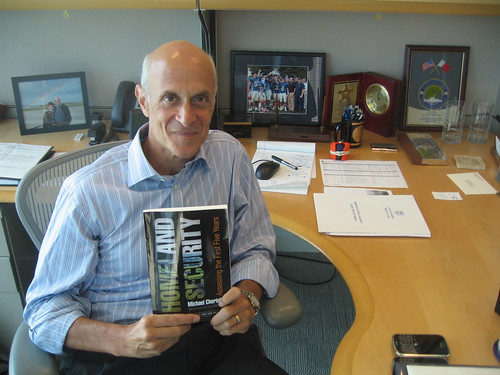
MICHAEL CHERTOFF IN HIS OFFICE WITH HIS NEW BOOK, HOMELAND SECURITY: ASSESSING THE FIRST FIVE YEARS
Chertoff, who during his tenure at DHS would often urge Americans to be “vigilant” about terrorism, says Americans need to be aware but not paranoid. As a model, he suggests the ways most people deal with crime: “We all teach our kids not to be afraid to go outside but not to walk down a dark alley at 3am.”
In his new book, Chertoff suggests the government share more information with the public about the threats facing the nation. But he says it is not necessarily a matter of declassifying more things but of doing a better job of “packaging and presenting” the facts at a time when there are so many other issues competing for the public’s attention. His concern — eight years after 9/11 — is that citizens become complacent, and he urges the public to continue to support government investments in preventing and responding threats, particularly in the biological and nuclear area.
Chertoff says he “would have liked to have done more” on citizen preparedness during his tenure. He believes some things were accomplished with the Ready.Gov program, but that it was difficult to communicate with the public on these issues:Â ”It was hard under our Administration because it got freighted with a lot of political stuff. There were people who viewed counter terrorism, homeland security as a Bush thing and therefore anything you did in that area those people automatically objected to because they were opposed to Bush. In the new Administration, there will be a little less resistance. Sometimes the person who starts something isn’t the person to finish it.”
Chertoff believes his successor Janet Napolitano is “doing a very good job”. He is particularly happy that she has continued the “non-political” and “non-partisan” approach to homeland security which is how he says he tried to run the Department and believes the nation is best served.
As I wrote in my initial writeup, I would recommend the new book to anyone interested in homeland security (and for that matter public policy). Chertoff’s perspective is unique — not only was he of one of three Homeland Security Secretaries in the nation’s history, but he also headed U.S. Justice Department’s Criminal Division post-9/11 and served as a federal judge. It can be purchased here.
These icons link to social bookmarking sites where readers can share and discover new web pages.