September 15th, 2009 · No Comments
Pegged to National Preparedness Month, the U.S. Citizen Corps just announced it has added some new social media tools to its website, including widgets, web banners, and RSS feeds. They complement the Corps’ existing Twitter, E-mail lists and Facebook web presence. According to a news release:
“Widgets: Widgets are web tools that can be put on your webpage, blog, and social media sites. Citizen Corps’ widgets are free and display information provided by FEMA’s Community Preparedness Division through continually updated data feeds. Citizen Corps widgets are easily placed on your web page by copying the code of the widget and placing it within the html code of your web site’s editor…
Citizen Corps Web Banners: Web banners are graphic files that can be used by individuals to link from their website to CitizenCorps.gov. These banners are free and are available in several styles and sizes…
Citizen Corps RSS Feeds: RSS feeds provide subscribers with automated updated information through user-defined applications without having to continually visit CitizenCorps.gov. These RSS feeds can be imported into self-made widgets and many other social media sites.”
You can find all the tools at www.citizencorps.gov.

These icons link to social bookmarking sites where readers can share and discover new web pages.
Email Entry
Tags: Preparedness 2.0
September 15th, 2009 · No Comments
Mike Tolson from the Houston Chronicle offers an interesting list of “5 lessons we could learn from Hurricane Ike” on the storm’s first anniversary. As I think that Tolson’s lessons are useful for all communities, I’ve reprinted it below in its entirety:
Our success weathering the storm depended on how prepared we were and how much we were willing to come together. Here, five lessons to remember for next time:
Numbers often deceive
Galveston natives or longtime residents of the island are accustomed to storms and storm warnings. Coming two years after Hurricane Rita, the evacuation from which proved difficult and unnecessary, Ike brought skepticism. Those who figured the storm would lose its punch and come ashore as a middling and survivable Category 2 hurricane were proved right, sort of. The winds topped out at about 100 mph over land. But the size of the storm, with its broad wind field of hundreds of miles, pushed more water ashore than many expected – a storm surge of 15-20 feet that swamped the island and destroyed many homes on Bolivar Peninsula. That prompted an official change from the Saffir-Simpson Hurricane Scale to S-S Wind Scale to emphasize that the velocity of the wind and the size of the surge may not be directly connected. Ike’s winds caused plenty of damage, but it was the surge that proved so devastating to coastal areas, in some cases up to 30 miles inland.
No power to the people
A direct hit from a hurricane will surely take down the power grid. The only question is for how long. In the case of Ike, the lengthy power outages afterward affected an estimated 2.6 million people and hindered the ability of municipalities to provide normal power and sewer service because of poor backup power sources at pump stations. The limited evacuation also meant a lot of people living for days or weeks without electricity. A Rice University study reported that more than 50 percent of those surveyed lost power for five days and a third for more than 10 days. Putting utilities underground might be smart – areas such as Clear Lake or the Galleria with underground lines were not without power for long – but the cost makes it a nonstarter for a large-scale retrofit, and if the lines do go down sometimes they can take longer to fix. Better to take matters into your own hands. If you want a working fridge and maybe a little AC, you need to invest in a standby power generator that runs on natural gas or propane and puts out 7 kw or more of power. They are expensive, from $2,000 up to $15,000 for the most powerful units, but a great amenity if you have the means. A gasoline-powered generator is cheap, portable and a big help, but the juice it puts out is not likely to run the average home. And you better stockpile lots of fuel.
Prepare, and then prepare some more
A few things are certain in the aftermath of a hurricane strike: Death, destruction, discomfort and inconvenience. The only variable is how much. Coping has a lot to do with preparation. Ike showed again that people rarely have enough nonperishable food, water, gasoline, batteries and devices that make life easier in the absence of electricity, including battery-powered lanterns and fans. It’s not as if people don’t have plenty of warning for a hurricane, but there is a general expectation of normality returning within a few days. That did not happen this time because of power problems. Municipalities prepared better for Ike than ever before – more targeted evacuation zones, planning for people with special needs, the arrangement of transportation and shelters, and cleanup crews that started work quickly after the storm passed. One disturbing point made by the Rice study is that those evacuating from mandatory zones still did not leave early enough, meaning the gridlock seen in advance of Hurricane Rita would have occurred again if more people from other areas had left. Given the headaches caused by lengthy power outages, that’s a possibility next time.
[Read more →]
These icons link to social bookmarking sites where readers can share and discover new web pages.
Email Entry
Tags: Hurricane Preparedness · Preparedness Lessons
September 15th, 2009 · No Comments
The National Federation of Community Broadcasters (NFCB), National Public Radio (NPR), and the Corporation for Public Broadcasting (CPB) in collaboration with three public television stations, and the Integrated Media Association are developing the Station Action for Emergency Readiness (SAFER) project, a plan to help public broadcasters serve their communities when disaster strikes.
SAFER will develop customizable plans to help stations stay on-the-air, online and in touch with their audiences through mobile devices during crises. An online manual will guide stations in developing or improving their business continuity plans. A companion crisis communications plan will show stations how to reliably deliver critical life-saving information to listeners in emergency situations.
The project will also distribute online tools and widgets that stations can embed into their own websites so the public can get emergency information on their mobile devices as well as online and on-air. Webinars and workshops will be offered featuring experts who can assist stations with implementation of a response program.
“Our member stations are a vital source of information in their communities and we’re eager to work with NFCB and CPB on equipping them with tools they need to best serve their audience, especially in times of disaster,” said NPR’s Joyce MacDonald.
“Public and community radio stations are frequently the only local broadcasters serving their communities,” said NFCB’s Ginny Z. Berson, adding, “When a local emergency arises or disaster strikes, these stations are critical to getting life-saving information to listeners.”
SAFER will build on the experiences and lessons learned by public broadcasters in emergency situations such as Hurricane Katrina, floods in the Midwest, and wildfires in California. The three public television stations involved in the project are KQED in San Francisco, Public Broadcasting Atlanta, and Mississippi Public Broadcasting.
These icons link to social bookmarking sites where readers can share and discover new web pages.
Email Entry
Tags: Media · Preparedness 2.0
September 14th, 2009 · 4 Comments
As the nation marks the anniversary of 9/11, one of the significant homeland security challenges the government still faces eight years later is figuring out how best to communicate the terrorist threat to the public and then engage the citizenry to help in its anti-terror efforts.
Both parts of that challenge involve a difficult balance. On the first, many homeland security officials worry about citizen complacency and would like do a better job of conveying that there is still a significant terrorist threat to the nation. However, in doing so they do not want to unnecessarily scare the public or give away intelligence sources and methods.
As for the second part, officials believe that civilians are a significant information resource that they would like to do a better job utilizing. And, in fact, better utilizing the public in the homeland security enterprise has been an early theme of DHS Secretary Janet Napolitano. Last month, Napolitano told the Council for Foreign Relations in New York City “for too long we’ve treated the public as a liability to be protected rather than an asset in our nation’s collective security,” adding:
“we’re taking a much closer look at how we can support and inform our greatest asset, individual citizens, and with them the private sector. You are the ones who know if something is not right in your communities, such as a suspicious package or unusual activity…
...With basic training, every one of us can become better first preventers as well as first responders…You know, I think there’s actually an important role that we can play in educating even our very young about watching for and knowing what to do if – if you’re in an airport and you see a package left with no one around; you know, that sort of thing. I also think we could do a much better job at educating young people about how to — how to prepare how to handle themselves so that they can protect themselves also if something untoward were to happen…”
But she acknowledged that work needed to be done in figuring out how to do so:
“…So do we have a plan in that – in that way, or have we actually worked that angle of this? Not yet. But I think you’re getting the gist of what I’m saying, which is to say we need a culture of collective responsibility, a culture where every individual understands his or her role…”
Interestingly, the difficulty developing such a plan was underscored in the post-speech audience questions, a number of which expressed concerns that any new effort  on making Americans better “first preventers” might impinge on civil liberties.

JANET NAPOLITANO (ABOVE) SPEAKS TO THE COUNCIL ON FOREIGN RELATIONS IN AUGUST (Photo by Chris Hondros/Getty Images North America)
Napolitano’s task is made more difficult because the country has not been attacked since 9/11, and the public may not perceive a continued threat. In an interview in the Washington Post last week, the Secretary was asked “if the American people could see what you see — if they were privy to intelligence reports and they saw the whole spectrum of what was out there, do you think they would have a different view of preparedness?”
Her reply: “Oh, yes, perhaps. But on the other hand, I think what is important for them to recognize is that we have hundreds of thousands of people working on this every day.” Even as she would like to get the public’s attention, the Secretary understandably does not want to unnecessarily stoke concern. Finding that balance is key. Yet, if they want to address “complacency,” officials will have to find ways to better illustrate what is “out there,” to narrow the gap between what they see and what the public does.
Clearly, there is a limit to what can be disclosed without comprising intelligence activities, but many in law enforcement that I spoken to believe more can and should be told to the public. In fact, many have told me that they would like to offer more information so Americans understand the threat situation better. It makes their jobs easier, establishes more credibility, and may better innoculate the nation when/if something does happen. A goal of that education should also be showing how citizen involvement actually helps and more precisely what citizens should (and should not) be doing to help.
In her Council for Foreign Relations speech, Napolitano noted some examples of citizen involvement:
“Three years ago, it was an attentive store clerk who told authorities about men trying to duplicate extremist DVDs. This led federal agents to eventually round up a plot to kill American soldiers at the Fort Dix army base here in New Jersey, in New Jersey. Just last month, a passenger saw two employees exchange a bag at the Philadelphia airport that had not been properly screened. That passenger’s vigilance ultimately stopped a gun from getting onto the plane.”
More recently, Napolitano thanked a commuter who took a photo of a sleeping guard at the George Washington Bridge over the Hudson River, telling CNN, “Catching those lapses is an important reminder that none of us can be asleep on the job,” Napolitano said. “Security … safety is something that we all have a responsibility for.”
Highlighting those examples are helpful. But more detail is necessary to get the public’s attention. One thing I might suggest is to make more use of security videos of people caught (or at least suspected of) surveilling infrastructure. Again, that would be done in a careful, sober manner, not to stir panic or fear but to better illustrate the threat and what is being asked of the public. Along those lines, former Secretary Chertoff — who expressed a similar concern about public complacency in his recent book – told me that government has to do a better job of “packaging and presenting” the threat.
There is also a need to provide the public with more context for their role. Earlier this summer, Napolitano appointed a task force to look at the future of the Homeland Security Advisory System. And, I think any type of new system should include more information for the public about why an alert is being raised and lowered along with guidance on what to do when it changes.
A PHOTO (ABOVE) OF A GUARD AT THE GEORGE WASHINGTON BRIDGE SLEEPING WHICH WAS TAKEN BY A COMMUTER, JOEY LEPORE
[Read more →]
These icons link to social bookmarking sites where readers can share and discover new web pages.
Email Entry
Tags: Preparedness Ideas · See Something/Terrorism Tips
September 14th, 2009 · 3 Comments
I just read an interesting report “Civil Defense and Homeland Security: A Short History of National Preparedness Efforts” which was originally issued by the Department of Homeland Security in September, 2006. I had not seen the study which offers a good, compact 35-page summary of previous public preparedness initiatives. As the Obama Administration starts revamping current citizen readiness programs, this historical context is particularly useful in highlighting things that tripped up other efforts. The report’s introduction summarizes:
“An analysis of the history of civil defense and homeland security programs in the United States clearly indicates that to be considered successful, national preparedness programs must be long in their reach yet cost effective. They must also be appropriately tailored to the Nation’s diverse communities, be carefully planned, capable of quickly providing pertinent information to the populace about imminent threats, and able to convey risk without creating unnecessary alarm.”
The report doesn’t explicitly say so, but by those criteria it clearly indicates the nation has never had really had a fully “successful” national preparedness program. It does underscore a point often discussed on this blog that designing and executing a “successful” one is not an easy undertaking.

The study recounts that other Administrations dealt with many of the same challenges/balances that officials now face when it comes to civilian preparedness, including the need to: back up good words/intentions with serious governmental/societal commitment;Â think through whether the public can actually do logistically and financially what is being recommended;Â communicate scary subjects without unnecessarily scaring people; ; figure out how best the federal government can support and complement local leadership; and settle philosophical differences among policymakers before presenting anything to the citizenry.
In its conclusion, the report notes: “The history of civil defense and homeland security in the United States has been one of frequent policy and organizational change.” I would argue that to get it right there will need to be some more policy and organizational changes (though I believe it is more a matter of focus than anything else). Nevertheless, given the history described in the study, any new initiatives must be carefully considered and implemented.
Correction: When I originally posted this, I called the study a “FEMA report”. As Bill Cumming has pointed out to me (see Comment below), it actually was produced in 2006 by the Department of Homeland Security’s Preparedness Directorate.
These icons link to social bookmarking sites where readers can share and discover new web pages.
Email Entry
Tags: Preparedness Reports
September 13th, 2009 · No Comments
CERT members don’t volunteer for the fringe benefits. But nonetheless it was great that the USS Intrepid Museum offered free admission today to CERT’s as part as their “Safety Preparedness Weekend”. So, I took one of my daughters to the newly refurbished carrier which is docked on the Hudson River in midtown Manhattan. It’s always nice for non-profit organizers (in this case NYC-OEM which manages the CERT program) to find and offer small incentives/benefits to their volunteers.
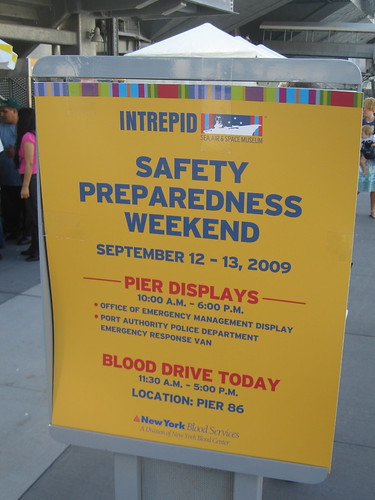
As part of the “Preparedness Weekend,” NYC-OEM handed out readiness information to the the public and the New York Blood Center Van was there to take donations. By the way, I definitely recommend you visit the ship if you’re sightseeing in New York City.
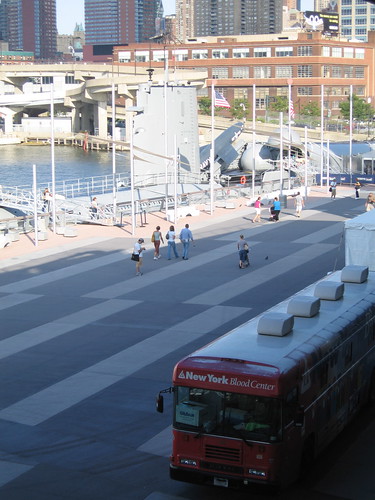
NEW YORK BLOOD CENTER VAN UNDERNEATH THE USS INTREPID; USS GROWLER SUBMARINE IS IN BACKGROUND
These icons link to social bookmarking sites where readers can share and discover new web pages.
Email Entry
Tags: CERT · Preparedness Events · Volunteering
September 13th, 2009 · No Comments
A book with the title The Chaos Scenario seems perfect for this blog. The cataclysm described, however, has not happened to a place or a people but instead to an industry. It does though give me a great segue to recommend the new book — whose subhead is Amid the Ruins of Mass Media, The Choice for Business is Stark: Listen or Perish — written by friend and colleague Bob Garfield.
Beyond the title and our relationship, a more important reason for highlighting the book is that many of the readers of this blog are very interested in the changing media landscape and the future of communications. And, there are few people better situated to write about this chaos than Garfield, host of National Public Radio’s “On The Media” show and a columnist for Advertising Age magazine. He is one of the most incisive and funniest commentators I know, and he brings both tools to The Chaos Scenario. I think you’ll learn a lot and laugh some as well.
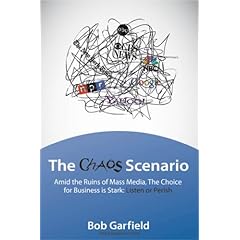
In the area of emergency communications, he discusses how citizen-generated media has (and will continue to) provide the earliest reports on incidents including the terror bombings in London and Mumbai. And his new concept of ‘listenomics’ has significant implications and lessons for emergency preparedness and response communications for and with the public. (He also has significant interest in public preparedness and has been an interview subject for my book.)
Garfield has also been an inspiration to me in my radio work. He kindly allowed me to make fun of him in a story I did about how the radio is made at NPR. He also did one of my favorite radio pieces ever about his effort to get his country/western song “Nashville Bob” recorded.
You can download the book’s first three chapters for free at the TheChaosScenario.net website to see if you want to purchase The Chaos Scenario — which then you can do here.
These icons link to social bookmarking sites where readers can share and discover new web pages.
Email Entry
Tags: Media
September 12th, 2009 · 1 Comment
There is an article in the October issue of Popular Mechanics, “How Self Reliance Can Get You Through Any Disaster” by Glenn Reynolds. According to Reynolds, who often writes about citizen preparedness on his blog, Instapundit,
“Here’s a simple truth: It’s better to bend than to break, and it’s best to be prepared for the worst. This age-old wisdom is going by a new name in slide-rule circles: “Resilience engineering” starts with the insight that it’s smart to design and maintain systems so they have some give. That means building technologies that offer extra capacity to handle sudden loads, plenty of warning when normal operations are beginning to break down, backup systems in case things do go wrong, diverse digital architectures so that a single bug doesn’t produce widespread failure, and decentralization so that when (not “if”) communication breaks down things don’t grind to a halt…
…When it comes to large-scale emergencies, the country has a hidden weapon-and we can do more with this resource. I’m talking about a populace filled with self-reliant, community-minded individuals. During a major crisis, on the order of Katrina or a serious California earthquake, relief services can be overwhelmed. When individuals are prepared to look after themselves for a while, with food, water and medicine on hand, and alternative sources of heat or power, it makes a big difference. The government can’t take care of everybody at once. If disaster-relief staffs don’t have to worry about you, they can take care of others-which means that being self-reliant can actually help your community.
Often, government officials worry about the public panicking in a widespread disaster. But they have that backwards. In studies of more than 500 emergencies, the University of Delaware’s Disaster Research Center found that panic rarely occurred. In fact, people consistently jump in to help themselves and their neighbors. Research by scholars like Kathleen Tierney, who directs the Natural Hazards Center at the University of Colorado at Boulder, shows that the true first responders are often the people on the scene when a disaster strikes. They save lives by administering first aid, getting people out of hazardous areas and spreading warnings. Volunteers improvised the water-based evacuation of lower Manhattan on Sept. 11, called an American Dunkirk by some, that moved masses of people out of the danger zone.
A self-reliant attitude is good, but skills help mightily, too. Citizen training is available through the Red Cross, Community Emergency Response Teams and Neighborhood Emergency Response Teams. One underappreciated resource is the amateur radio community. Acquire a ham radio license (American Radio Relay League, ) and you can become a major resource if a disaster strikes. It’s fun, too.”
Thanks to the National Hazards Center’s Twitter feed for bringing this to my attention.

(Illustration by Paul Blow, Popular Mechanics)
These icons link to social bookmarking sites where readers can share and discover new web pages.
Email Entry
Tags: Preparedness Tips
September 12th, 2009 · 1 Comment
Via the Twitter feeds of FEMA Region 8 and the Citizen Corps, below are some of the tips from READYColorado’s “Top 10 List For Preparedness On A Budget”:
* Create your own personalized list. You may not need everything included in “ready made” kits and there may be additional items you need based on your personal situation.
* Budget emergency preparedness items as a “normal” expense. Even $20.00 a month can go a long way to helping you be ready. Buy one preparedness item each time you go to the grocery store.
* Request preparedness items as gifts. We all receive gifts we don’t need or use. What if  your friends and family members gave you gifts that could save your life? Don’t forget to protect them by sending preparedness gifts their way, too.
* If you are prepared, you may be able to help friends and neighbors who need assistance. By sharing preparedness supplies, you can help each other.
* Trade one night out to fund your 72-hour kit. Taking a family of four to the movies can cost upwards of $80-$100. Just one night of sacrifice could fund a 72-hour ready kit.
The full “Top 10″ list is here.

These icons link to social bookmarking sites where readers can share and discover new web pages.
Email Entry
Tags: Preparedness Tips
September 11th, 2009 · 1 Comment

In September 1609, the beach near the tip of the island was surrounded by thickly wooded hills. Passenger pigeons flew overhead; porpoises hunted in the harbor. Around 600 Native Americans lived on the island. And they were the ones who, on Sept. 12, must have watched as a European, Henry Hudson, guided his small wooden ship into the Muhheakantuck (later Hudson’s) River, cleaving the waters with the narrow prow of history that would one day create New York City in its wake.
To the native Lenape people, whom Hudson met and traded with, Mannahatta meant “island of many hills.” Modern ecological research has shown that Mannahatta was an island of remarkable biological diversity. Its 55 ecosystems encompassed stately forests, rich wetlands, sandy beaches and rocky shores, eel grass meadows and deep marine waters. This 25-square-mile island had 66 miles of streams and more ecosystems per acre than Yellowstone; more plant species than Yosemite; and more birds than the Great Smoky Mountains National Park does today.
There is a process in ecology called succession – the orderly advance of ecosystems from one state to another. There are moments of terror and unfathomable destruction, and then stability returns and life takes hold again, often with a firmer grip. This applies, of course, both to nature and to human society. As Jane Jacobs wrote, “Lively, diverse, intense cities contain the seeds of their own regeneration.” Resilience is a hallmark of any successful system, whether for a forest, a wetland or a city.
Today, we honor the memory of all that was lost and sacrificed on 9/11. But in thinking back 400 years, in imagining the Lower Manhattan of the distant past, we can join that memory to another realization: that we, and the world we live in, have a remarkable capacity to recover and renew.
These icons link to social bookmarking sites where readers can share and discover new web pages.
Email Entry
Tags: Preparedness Ideas