U.S. Housing and Urban Development Secretary Shaun Donovan and Homeland Security Secretary Janet Napolitano today announced the launch of DisasterRecoveryWorkingGroup.gov—a new interagency website that will allow federal disaster recovery officials to solicit comments from state, local and tribal partners and the public. According to the press release:
The new website will be used by the federal government’s newly-formed Long Term Disaster Recovery Working Group—co-chaired by Secretary Donovan and Secretary Napolitano—to allow stakeholders to submit ideas for disaster recovery; articulate objectives for recovery assistance going forward; identify examples of best practices; raise challenges and obstacles to success; and share thoughts, experiences and lessons learned.
The two-minute video (below) and resources are available at www.FasterVaccines.org. It is part of the Commission’s effort to engage citizens on issues of bioterrorism and weapons of mass destruction.
“WHY WEREN’T H1N1 VACCINES AVAILABLE FOR CHILDREN BEFORE SCHOOL STARTED?” VIDEO (ABOVE)
“Whether the threat is from naturally occurring disease or bioterrorism, the United States needs to be able to produce vaccines and other medicines faster and less expensively. We had six months of advance warning for the H1N1 pandemic. A bioterrorism attack will have no advance warning,†said former senator Graham, chairman of the Commission. “Creating the infrastructure for rapid development of large quantities of safe vaccines and medicine is a win-win for public health and national security.â€
According to Graham, the United States—unlike the European Union and China—continues to use a 60-year old production method, using chicken eggs, to make H1N1 and other important vaccines. Modern methods will shave months off the typical six-to-nine months that current processes require. These newer methods can produce more vaccine and be quickly scaled-up, on demand.
“We want the public to know there are better options,” said Commission vice chairman Talent, “and encourage policymakers to have the foresight to invest in them.â€
These icons link to social bookmarking sites where readers can share and discover new web pages.
In the Spring, when federal officials requested that the media to use the term “H1N1″ instead  of “Swine Flu” to describe the pandemic, I — being the obedient oldest child that I am — followed their instructions and have been careful not to write “Swine Flu” in any of subsequent blog posts.
However, I continue to see that many in the major media are still using “Swine Flu” interchangeably with “H1N1″: an editorial in today’s New York Times is titled, “Swine Flu and You,” there’s a video feature on CNN.com called “Swine Flu Latest,” and NPR has dubbed its recent special series, “Swine Flu: The Second Wave.”
As someone who writes about the topic a lot, I understand why: first, it’s easier to have another way of writing or headlining the same term, second “Swine Flu” is not only more colorful than H1N1 but it’s also more familiar to viewers and readers, and third the media doesn’t always follow government guidance. (And, in fairness, even the U.S. Health of Human Services’ @Flu.Gov Twitter tweets are still being tagged #swineflu, because it helps reach more people.)
Yet, last month, U.S. Secretary of Agriculture Tom Vilsack reiterated his plea to the media that “Swine Flu” be dropped from use, saying in a statement:
“Each time the term is used it unfairly hurts America’s farmers who are suffering severe economic losses during these challenging economic times. And each time the media uses the phrase “swine flu” a hog farmer, their workers and their families suffer. It is simply not fair or correct to associate the 2009 pandemic H1N1 influenza with hogs, an animal that does not play a role in the ongoing transmission of the pandemic strain.”
In a post on CNN.com’s own “Paging Dr. Gupta” blog, Medical News Editor Miriam Falco explains that using the term is not only a matter of the economic fortunes of the pork industry, but also of factual accuracy:
“Back in the spring, when we first heard about ’swine’ flu, it was given that name because initial tests showed it resembled some known viruses that have circulated in pigs. However, the CDC explains on its Web site, ‘…further study has shown that this new virus is very different from what normally circulates in North American pigs.’ The agency explains that this new H1N1 virus has genetic material from viruses found in European and Asian pigs, as well as genes from birds and humans.
Plus, USDA officials point out that this is a human virus because it was first detected in humans. They say there are no reports of H1N1 circulating in any swine herds here in the United States. They acknowledge that Canada, Australia and Argentina have found H1N1 in a few pigs. And Deputy Agriculture Secretary Dr. Kathleen Merrigan says she wouldn’t be surprised if the H1N1 virus does eventually surface in U.S. pig herds. But she stresses that pigs infected with the virus would not be sent to market.
Of course, unless you are a hog farmer, naming the pandemic is obviously much less important than dealing with it (or in the media’s case, covering it). But as someone who has been dutifully following the terminology ‘rules’, I’d like to see other media do the same or else just let this obedient older child go back to using both terms.
[UPDATE: Jim Garrow helpfully points out in a comment (below) that some of the confusion may result from the Associated Press stylebook which instructs using "swine flu on first reference, then specifies H1N1 virus on follow-up reference.†David Stephenson in a follow-up comment says he's "astonished" by the AP policy "formally mandating inaccurate reporting."]
These icons link to social bookmarking sites where readers can share and discover new web pages.
With news on H1N1 coming in fast and furious — and from all corners of the world — Mike Coston at Avian Flu Diary highlights the volunteer citizens who are helping to gather and analyze it for their fellow members of the public. In his post “Drinking From The Fire Hose,” Coston writes:
“With flu season in the northern hemisphere upon us, and cooler weather bringing the likelihood of new H5N1 bird flu reports as well, the newshounds that work the flu forums are looking at six very busy months ahead.
Newshounds are volunteers who spend hours each day searching in the hundreds of online English and Foreign language news sources for information pertaining to pandemic influenza, avian flu, and other emerging infectious diseases…Their work thankfully is archived on the flu forums, where it is discussed, analyzed, and becomes part of the historical record. The flu forums have essentially become repositories of flu and infectious disease information, that function like real-time libraries.”
Coston notes that the newshounds’ good work appears on flu forums like Flu Wiki and FluTrackers as well as on blogs like his (and mine) — and is ultimately used by public health practioners, policymakers and average citizens:
“Much of what I do in this blog is dependent upon their labors. While I still do a fair amount of news hounding myself, at least half of the stories I blog about come by way of these hardworking news analysts…
Both FluTrackers and the Flu Wiki produce a daily summary of news items, which helps make it easier to pluck out individual news stories from the onslaught of posts.
The Flu Wiki summary is updated in real time, during the day, at the top of each day’s news thread. Each item has a corresponding link to take you to the original source material (news article, journal article, etc.)…FluTrackers takes a slightly different approach, posting a summary at slightly irregular intervals, but generally every 24 to 36 hours.”
“All of this, as you might imagine, takes an incredible amount of work and dedication. Scores of these folks work on the forums without pay, and far too often without recognition. Their work, by the way, is freely shared between forums and with the world.
The expertise of many of these newshounds is remarkable, with some becoming quite adept at translating articles, and knowledgeable about local customs and idioms in places like Indonesia and China.”
If you have not already, I recommend you checking out these forums both for the flu information available on them as well as a model of what can be done by knowledgeable, committed and public spirited citizens in the area of emergency preparedness and response.
These icons link to social bookmarking sites where readers can share and discover new web pages.
This “What Should We Tell The Public?” video features Ben Smilowitz, founder and executive director of the Disaster Accountability Project (DAP). After serving as a volunteer in Mississippi in the weeks following Hurricane Katrina, Ben decided there was a need to provide citizen oversight for government and non-profit agencies esponsible for disaster preparedness, response, relief, and recovery. So, he established the Disaster Accountability Project to empower the public.
In the video, Ben urges the public to “ask questions” because “the more questions you ask, the more information you’ll get about local preparedness”. One way you can “ask questions” about local preparedness is as a volunteer Disaster Accountability monitor helping verify gaps in disaster relief services so they can be addressed. You can learn more about DAP’s work on its website. The video was shot at the Natural Hazards Workshop this summer.
BEN SMILOWITZ, EXECUTIVE DIRECTOR, DISASTER ACCOUNTABILITY PROJECT (ABOVE)
These icons link to social bookmarking sites where readers can share and discover new web pages.
President Obama has signed a proclamation declaring the H1N1 flu a “national emergency,” according to Reuters:
The proclamation, which Obama signed Friday night, will make it easier for U.S. medical facilities to handle a surge in flu patients by allowing the waiver of some requirements of Medicare, Medicaid and other federal health insurance programs as needed, the White House said in a statement.
The U.S. Centers for Disease Control and Prevention said on Friday that H1N1 swine flu has become widespread in 46 of the 50 U.S. states, a level comparable to the peak of ordinary flu seasons but far earlier and with more waves of infection expected.
The White House statement said the declaration was intended to prepare the country in case of “a rapid increase in illness that may overburden health care resources” and was similar to disaster declarations issued before hurricanes hit coastal areas.
These icons link to social bookmarking sites where readers can share and discover new web pages.
“The site is focused on individuals and families in multi-hazard disasters. It includes information on what to do before (preparedness), during (response) and after (recovery and mitigation) disasters…
The new design features a simple format with main topics divided in blocks of three for easy access. The first block includes information like disaster information, preparedness, and mitigation. The second block includes action items such as recent news, major warnings and relevant information just one click away, i.e. hurricane preparedness, National Preparedness Month and H1N1.
The third block includes general information like current disasters, types of disasters and what to do before, during and after different types of natural or man-made emergencies as well as links to other government agencies active in disasters.”
Preparados. Receptivos. Comprometidos.
These icons link to social bookmarking sites where readers can share and discover new web pages.
This edition of the blog’s “What Should We Tell The Public?” video series features Allison Cardona, the Director of Disaster Services for the ASPCA. It was shot at a pets’ emergency preparedness event held by the ASPCA and New York’s Office of Emergency Management.
In the short video, Allison explains the steps every pet owner should do to prepare their animals for emergencies. In the background there is a Golden Retriever, Hunter, who stopped by (with his owner) to be microchipped and have a ‘go bag’  photo taken. I have found that pet owners tend to be among the most prepared groups, but I’m sure Allison’s recommendations will be helpful.
ALLISON CARDONA, ASPCA DISASTER RESPONSE DIRECTOR (ABOVE)
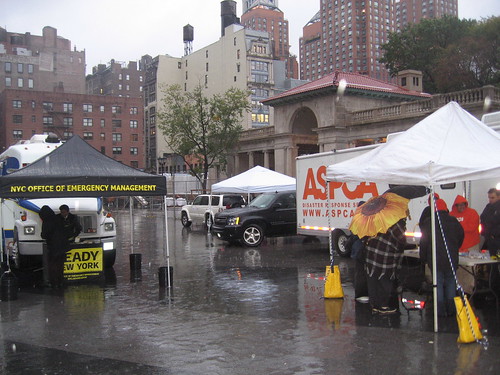
Unfortunately, the event was held during a rain storm (see photo below) so we did the interview inside the organization’s trailer located in the middle of Manhattan’s Union Square. For more information about emergency preparedness for pets, go to the ASPCA’s website here.
THE ASPCA/NYC OEM PET PREPAREDNESS EVENT IN NEW YORK’S UNION SQUARE; THE ASPCA TRAILER IS BEHIND THE TENT
These icons link to social bookmarking sites where readers can share and discover new web pages.
A new American Red Cross survey has found that women seem to to be making more of an effort on H1N1 prevention than men, but that most Americans are preparing for a new flu outbreak. The poll also revealed that one in five households includes a member of has gone to work or school when they were sick.
According to the survey, 83% of women surveyed responded that they made an extra effort to cover coughs and sneezes with a tissue, compared to 67% of men; 35% of women surveyed have gotten their seasonal flu shots this year, compared to 26% of men.
Though overall the poll found that roughly 7 in 10 Americans are confident they could take time off from work, have the right supplies at home and know what flu symptoms signal a need to go to the hospital.
The poll also indicated that in the past two months, one in five households has someone who has gone to work or school when they were sick. The latter statistic would seem to be troublesome in part because it appears to underscore the fact that some people fear they need to go to work or risk losing pay or their jobs.
More information on the survey can be found on the Red Cross’ blog here.
These icons link to social bookmarking sites where readers can share and discover new web pages.
“Just as with our nation’s preparedness for natural disasters or terrorist attacks, our nation’s cybersecurity is a shared responsibility. And it’s an opportunity for you, as an individual, to personally contribute to our national security. Securing your home computer helps you and your family. And it also helps your nation in some very important ways. It helps by reducing the risk to our financial system from theft; and to our nation from having your computer infected and then used as a tool to attack other computers.
As individuals, the steps you need to take are clear, and they will make a big difference:
* Install and activate firewalls for your computer and internet connection
* Make sure your anti-virus and anti-spyware software is installed and up-to-date
* Check your computer settings to make sure your operating system and applications are automatically patched
* Practice good online habits by not visiting suspect sites, downloading suspicious documents or attachments, or opening email from people you don’t know
* Back up your files regularly and use strong and secure passwords; and
* Begin educating your children early about staying safe online.”
The full transcript and the web video can be found on the DHS website here.
These icons link to social bookmarking sites where readers can share and discover new web pages.