November 4th, 2009 · 1 Comment
New York City’s Office of Emergency Management is taking advantage of Yankee-mania here as an angle in its most recent “Tip of the Week” sent out earlier this week:
“With a 3-1 lead over the Phillies, the [UPDATE: World Champion] Yankees have been focused on driving runs home this World Series. But when the catcher is blocking the plate, a runner needs to change his plan.
Some emergencies may make it difficult or even impossible to return home. OEM recommends New Yorkers identify two meeting points— one close to home and another outside of the neighborhood— where loved ones can reunite in case an emergency blocks the way home.”

These icons link to social bookmarking sites where readers can share and discover new web pages.
Email Entry
Tags: City Preparedness · Humor · Preparedness Tips
As has been discussed on the blog a couple of times this summer, the H1N1 pandemic contingency plans for workplaces, particularly small businesses, continue to be a significant issue. Unlike schools, there is no central managerial authority to make and implement policies; guidelines have to be created and implemented on a firm by firm basis. It will also have to be done on a volunteer basis as there are no laws or mandates (ie. compulsory sick leave) in most of the country.
Health officials concern about the workplace and H1N1 is the subject of an article by Stephen Greenhouse in today’s New York Times, “Lack Of Sick Days May Worsen Flu Pandemic”:
Public health experts worried about the spread of the H1N1 flu are raising concerns that workers who deal with the public, like waiters and child care employees, are jeopardizing others by reporting to work sick because they do not get paid for days they miss for illness.
Tens of millions of people, or about 40 percent of all private-sector workers, do not receive paid sick days, and as a result many of them cannot afford to stay home when they are ill. Even some companies that provide paid sick days have policies that make it difficult to call in sick, like giving demerits each time someone misses a day.
Public health experts say policies like these encourage many people with H1N1, commonly called swine flu, to report to work despite official warnings from the government and most companies that they should stay home.
“For people who are really caught on a weekly income, if they can’t make a go of it, they might say, ‘I’m desperate. I’m going to do what I have to do, and I’m going into work even though I’m sick,’†said Robert Blendon, a professor of health policy at Harvard.
He warned that this might spread disease, and that these financially squeezed workers might send their flu-stricken children to school, infecting others.
Well before President Obama declared H1N1 a national emergency, the federal Centers for Disease Control and Prevention was emphasizing that businesses should adopt “flexible leave policies†to allow workers with the flu to stay home. In one advisory, the C.D.C. encouraged employers “to develop non-punitive leave policies.â€Â Despite such recommendations, some employees say they have no choice but to go to work sick.
As has been suggested previously on the blog, one way officials at local, state and federal levels — including President Obama — could be helpful is by highlighting businesses of all sizes who are already making plans for their workforce. This attention would provide guidance, encouragement (and, in some cases, pressure) for other organizations.
Using the bully pulpit in that way would underscore how seriously the government takes this and make special planning/policies for H1N1 seem like the norm not the exception. The media can also play a constructive role here by examining what is and is not being planned by organizations in their areas.
These icons link to social bookmarking sites where readers can share and discover new web pages.
Email Entry
Tags: Business Preparedness · Pandemic Flu · President Obama
November 2nd, 2009 · 1 Comment
In a post on his Atlantic.com blog, David Shenk makes the point that “vaccines have become something of a civic responsibility: they work best when everyone takes them.”
Media reports have continued to highlight the skepticism of many Americans about the H1N1 vaccine. More than half of Utah residents surveyed in a KSL-TV/Deseret News poll said they were planning to skip the vaccination. And the New York Times reported that as of last week, “…fewer than half of New York City parents with children in elementary school have given permission for their children to receive the vaccine at school, reflecting some ambivalence about the need for the vaccine or concern about its effects.”
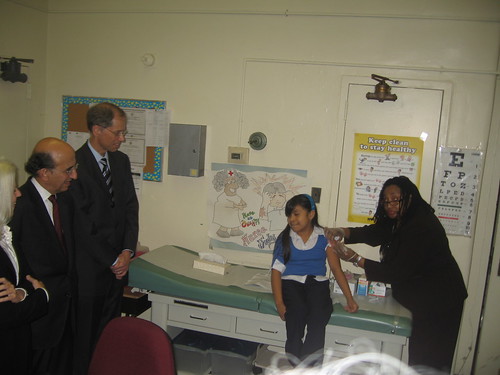
FOURTH-GRADER LESLIE CRUZ GETS HER H1N1 FLU VACCINE WITH NYC DEPUTY MAYOR LINDA GIBBS, HEALTH COMMISSIONER THOMAS FARLEY, AND SCHOOL CHANCELLOR JOEL KLEIN AT BROOKLYN’S P.S. 157.
Every citizen/parent will have to make their own choice on the vaccine. However, as Shenk argues, we all have a stake in each other’s decisions, because the numbers vaccinated will likely have an impact on the flu’s spread. The Times article, written by Jennifer Medina, explains the role of “herd immunity” in dealing with H1N1:
Experts debate exactly what level of flu vaccination is ideal, but a computer model developed several years ago by epidemiologists at Emory University, based on experiences with mandatory flu shots for Japanese schoolchildren, suggested that when 50 percent of children are vaccinated, a community’s risk of a seasonal flu epidemic falls by two thirds, and when 70 percent are vaccinated, the risk drops to 4 percent.
U.S. Homeland Secretary Janet Napolitano has spoken often about the “shared responsibility” of each stakeholder, including the public, when it comes to emergency preparedness and response. However, to date officials have not emphasized that messaging approach yet on the H1N1 vaccinations. Of course, as there is not enough available vaccine it may be premature to make that communications push right now. And, ultimately you want people to get the vaccine, because they believe it is in their own interest. Nevertheless, to help move some Americans off the vaccine fence, I think using the shared or civic responsibility approach might be helpful.
These icons link to social bookmarking sites where readers can share and discover new web pages.
Email Entry
Tags: Pandemic Flu · School Preparedness
A new post, “The Best Notification,” by Rick Wimberly on EmergencyMgmt.com’s Alerts and Notifications blog summarizes an interesting report Wimberly issued this year, Notifications, Alerts, Warnings: The Next Generation.
As governments at all levels try to determine the optimal alert/warning systems, Wimberly, president of Galain Solutions, argues for a “system of systems” which encompasses myriad distribution methods:
Get five emergency management professionals together, and you’ll get five opinions on the best way to alert and notify the public. Opinions will range from sirens-to-telephones-to-broadcast-to-giant voice-to-flashing lights-to-instand messaging-to-social media to who knows what else. Walk the floor of the International Association of Emergency Managers (IAEM) conference vendor display area and you’ll see more companies hawking their notifying and alerting wares than any other product. And, guess what, they’ll all claim theirs is the best.
So, who’s really right? Well, none of them…and all of them. There is no single “best” way to notify and alert the public. There are lots of them! It all depends on three questions, each one as important as the other: (1) what are you trying to say, (2) who are you trying to say it to, and (3) what do you have available?
[Read more →]
These icons link to social bookmarking sites where readers can share and discover new web pages.
Email Entry
Tags: Preparedness Ideas · Preparedness Reports
I had the wonderful opportunity this morning to view the arrival of the U.S.S. New York — which was built in part with steel from the fallen World Trade Center towers — into the harbor which bears its name.

THE USS NEW YORK PASSES BY GROUND ZERO THIS MORNING (ABOVE)
The Navy ship was welcomed on the Hudson River by a flotilla of local boats ranging from Coast Guard vessels to Water Taxis to individual kayakers. I viewed the arrival on a retired police boat, the “Big G,” which is now owned by the Metropolitan Waterfront Alliance, a group I am involved in whose mission includes highlighting the role of the waterfront in emergency preparedness. The New York’s ‘return’ had a good deal of meaning for New Yorkers both on the ship itself and those watching it from the land and the water.
Being in a boat, I did not see the ceremonies in Lower Manhattan during the New York’s stop at the site of the World Trade Center. This is how the Associated Press described it:
First responders, families of Sept. 11 victims and the public gathered Monday at a waterfront viewing area, where they could see the crew standing at attention along the deck of the battleship gray vessel. The big ship paused. Then the shots were fired, with a cracking sound, in three bursts. The bow of the $1 billion ship, built in Louisiana, contains about 7.5 tons of steel from the fallen towers.
“It’s a transformation … from something really twisted and ugly,” said Rosaleen Tallon, who lost her firefighter brother, Sean, on 9/11. “I’m proud that our military is using that steel.”
…After the ground zero stop, the ship — escorted by about two dozen tugboats and other vessels — headed up the Hudson River toward the George Washington Bridge. After a U-turn there, it was to head south to Pier 88. An official commissioning ceremony is scheduled for Saturday.
The New York will remain in the city through Veteran’s Day and then head to Norfolk, Va., for about a year of crew training and exercises, Murphy said. The ship is 684 feet long and can carry as many as 800 Marines. Its flight deck that can handle helicopters and the MV-22 Osprey tilt-rotor aircraft. It was scheduled to be built before the terrorist attacks. About a year later, the announcement came that the ship would bear the name New York to honor the city, state, and those who died.

THE U.S.S. NEW YORK HEADS UP THE HUDSON RIVER SURROUNDED BY LOCAL BOATS . I WAS ON ONE OF THE SMALLER ONES. (Photo By ABC News)
These icons link to social bookmarking sites where readers can share and discover new web pages.
Email Entry
Tags: City Preparedness · Preparedness Events
Daylight Savings Time ended today. So, after you’ve changed your clocks, VCR’s, etc., (and checked the batteries on your smoke alarms) why don’t you also take a moment to review the supplies in your emergency kit and go-bag (or put some aside if you have not already done so). You now have another hour in the day to do so, and it shouldn’t take that long. As the American Public Health Association campaign urges, “Set Your Clocks, Check Your Stocks” (your supplies not your 401k).
Personally, I feel there should be a special day every year on which Americans would check their kits as well as their emergency plans and focus in general on the topic of preparedness (or even just a high profile moment, such as half-time of the Super Bowl suggested by the former top federal preparedness official.) But in the meantime, it makes sense to piggyback emergency preparedness onto a twice-a-year event that is already imbedded in the lives of all Americans as the fire safety folks have done with the idea to use this day to check smoke alarm batteries.

These icons link to social bookmarking sites where readers can share and discover new web pages.
Email Entry
Tags: Preparedness Ideas
I wanted to mention that two friends of the blog, Bill and Janet Liebsch from FedHealth, have just published the 5th edition of their book, It’s A Disaster…And What Are You Going To Do About It. The book can be customized for government agencies, businesses, volunteer groups, nonprofits and others. For more information about FedHealth and the book (as well as the CD and e-book), click here.

These icons link to social bookmarking sites where readers can share and discover new web pages.
Email Entry
Tags: Preparedness Resources
The White House Blog is recommending that kids sports teams have their players wash their hands before games and do not shake hands afterwards to help prevent the spread of the H1N1 flu.
In a post titled, ” Flu Prevention Tips on the Fields,” Katie Stanton, “Director of Citizen Participation and a Soccer Mom,” writes:
“If your kids are playing on sports teams this fall, here are a few more tips to help them stay healthy:
* Have coaches remind children to cover sneezes and coughs with their sleeve or a tissue. Dispose of any tissues in a separate bag.
* Coaches (and parents) should make sure players stay home if they have a cough, cold, or flu for 24 hours after their symptoms have cleared.
* Have players wash their hands or use hand sanitizers before starting the game.
* Make sure players bring in their own water bottles and do not share them.
* Instead of post-game handshakes or high-fives, cheer or clap for the opposing team.”
My kids have soccer games scheduled for this Sunday (I’ll be refereeing), and I have passed this information on to our coaches and the league administrators.

PRESIDENT OBAMA WATCHING HIS DAUGHTER, SASHA, PLAY SOCCER Â (ABOVE)
These icons link to social bookmarking sites where readers can share and discover new web pages.
Email Entry
Tags: Child Preparedness · Pandemic Flu · Preparedness Tips
October 30th, 2009 · 1 Comment
The always helpful and creative folks at the Cross Blog have offered some preparedness-related ideas for those still looking for costumes in a post titled, “Halloween Red Cross-Style”:
“If you’re also having a hard time figuring out a costume for this year, I’ve got some inspiration for you. How about showing off your Red Cross knowledge and support by dressing as:
* A Red Cross Pirate…?!
* A giant blood drop (our mascot’s name is “Buddy Blood Drop”)
* A Disaster Relief Volunteer
* “Disaster Dog” (another Red Cross mascot; see photo below)
* A blood donor (complete with a “Be nice to me, I gave blood today!” sticker, a bandaged arm, a fake bag of blood, and a doughnut in hand)
* A vintage Red Cross nurse
* A Vietnam “Donut Dolly”
* Dr. Charles Drew (the “father of blood banking”)
* American Red Cross founder Clara Barton
*Â CPR Annie (the dummy)
![[halloween+-+starlight+parade.jpg]](http://2.bp.blogspot.com/_8rLg69m7HKM/SuI4YmZ7W4I/AAAAAAAAAVA/OYrSGYa5UPE/s1600/halloween%2B-%2Bstarlight%2Bparade.jpg)
And once you are appropriately costumed, Sharon Stanley, the chief nurse of the American Red Cross offers some “tricks” to handle H1N1 hazards this Halloween:
* If your child is sick, keep them at home. This will be disappointing to your young one, but your neighbors and community are counting on you to hold the line on transmission of this virus.
* Remind kids to keep their hands away from their eyes, nose and mouth to keep germs away. Carry that hand sanitizer with you or have it near your candy dispensing area.
* If you are giving out candy, hand it out or scoop it. Instead of a bowl of candy, consider handing out small, individually wrapped bags of treats.
* Throw away any unwrapped candy and inspect the rest for choking hazards and tampering.
[UPDATE: ABC News correspondent Jake Tapper made a good point on his Twitter feed this morning: "Please note: if you plan on dressing up like a pig for Halloween and going as 'swine flu,' you are not being creative."]
These icons link to social bookmarking sites where readers can share and discover new web pages.
Email Entry
Tags: Humor · Red Cross
October 29th, 2009 · 1 Comment
Like most kids, I never liked getting shots when I was younger. Yesterday morning, I was recalling those days and thinking whether it would have been easier had they been given with the Health Commissioner, the School Chancellor and a room full of television cameras in the room.
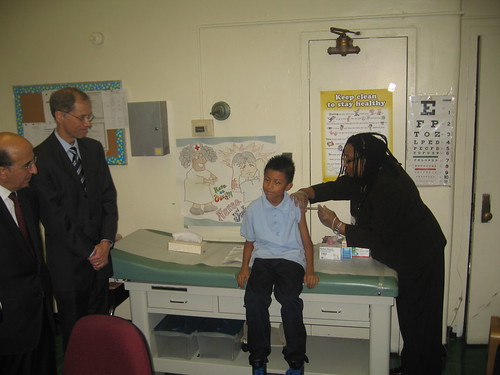
That’s exactly how students at P.S. 157 in Brooklyn got their H1N1 vaccinations delivered yesterday. They were among the first New York school children to be given the new vaccine as the City kicked off its campaign. The kids got their shots or nasal spray (the former for those with asthma or other respiratory issues) with Commissioner Thomas Farley and Chancellor Joel Klein and a passel of local media looking on.
NINE-YEAR-OLD FRANCISCO GOMEZ (ABOVE) GETS HIS H1N1 VACCINE AS NYC SCHOOL CHANCELLOR JOEL KLEIN AND HEALTH COMMISSIONER THOMAS FARLEY LOOK ON.
Though the vaccinations and media event seemed to go well, it did highlight one of the challenges for the program: getting parental permission slips in. At P.S. 157 as of yesterday morning, according to officials, 115 kids were cleared out of the student body of 369 (or 31%). Officials said that they expect that percentage to go up soon. And, Chancellor Klein said that many children in the school system will be going to their own doctors for the vaccination.
The City’s program, which aims to cover 300,00 children, will expand its rollout to middle and high schools early next month. Another issue for the New York school system is the diversity of the student body, and the Health Department’s web site offers information and consent forms in 10 languages
LESLIE CRUZ BEING INTERVIEWED BY THE MEDIA (ABOVE) AFTER GETTING HER H1N1 FLU SHOT.
At P.S. 157, the students seemed a bit overwhelmed by all the press (though it may have distracted them from any vaccine discomfort). But I think the coverage will have a positive impact on the H1N1 rollout here: most of the news stories included interviews with kids who said the vaccination wasn’t a big deal and parents who felt the risk of H1N1 outweighed any concerns about the vaccine. Typical was this article (accompanied by a video) on the website of the New York Times (which, continues. despite my blog post on Monday, to use the term Swine Flu interchangeably with H1N1):
Despite an extensive outreach campaign — including the distribution of screening and consent forms to all parents and guardians — doubts have lingered. The parents who streamed in and out of the rain at P.S. 157 expressed mixed views, but in most cases, they said their concerns about the safety and efficacy of the vaccine were outweighed by worry that that their children might contract the H1N1 virus.
“I have a lot of questions, but I think it’s a good thing,†said Reina Mendez, who was dropping off her 9-year-old grandson.
Jimmy Rivera, who has two sons, 7 and 5, at the school, said: “I wasn’t really convinced about it, but after I did a little research on the computer, I decided it was a good idea. Actually, I had a debate with my wife — my wife wanted it.â€
These icons link to social bookmarking sites where readers can share and discover new web pages.
Email Entry
Tags: Media · Pandemic Flu · Preparedness Events