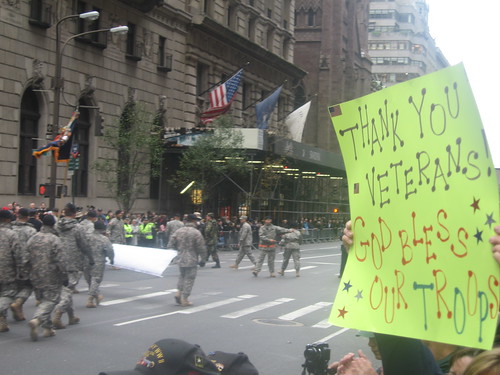
MARCHERS AT TODAY’S VETERANS DAY PARADE ON FIFTH AVENUE IN NEW YORK CITY
A relatively big (though not nearly big enough) and emotional crowd lined the parade route shouting “thank you” to the marching veterans, young and old. There were also a number of home-made “thank you” signs (below).
On this day, I wanted to mention a couple of initiatives by the Department of Homeland Security (DHS) and the American Red Cross. DHS yesterday launched a new website designed to provide a one-stop location for veterans and veterans organizations to learn about veteran hiring and contracting opportunities as well as how to get involved in community-based efforts such as Citizen Corps.
The site, at www.dhs.gov/veterans, features information for veterans about how to find employment opportunities at DHS, ways to get involved in community-based efforts like Citizen Corps (list here), and special veteran programs such as Operation Warfighter and Wounded Warrior, which provide employment opportunities for severely wounded or recovering service members to assist their transition back to the military or civilian workforce.
DHS’ civilian workforce includes approximately 47,000 veterans, comprising 25 percent of all employees in addition to the 42,000 active duty members of the U.S. Coast Guard.
Also, today the Red Cross launched their program, “Holiday Mail For Heroes,” which solicits cards for the military and their family. If you are interested in participating, send your cards to this address:
Holiday Mail for Heroes
P.O. Box 5456
Capitol Heights, MD 20791-5456
Once the cards arrive at the Red Cross chapters, they are sorted and reviewed by volunteers who then distribute them to service members, their families and veterans in communities across the country. For more information, go to www.redcross.org/holidaymail.
And again, thank you.
These icons link to social bookmarking sites where readers can share and discover new web pages.
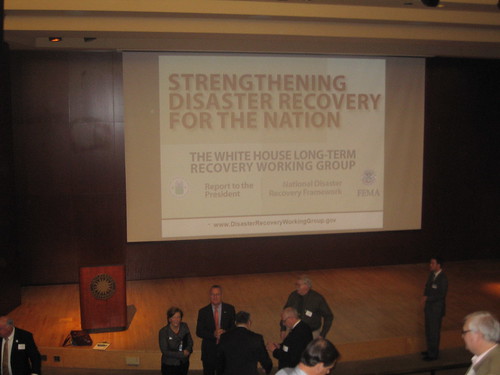
The White House Working Group — co-chaired by Department of Homeland Security Secretary Janet Napolitano and Department of Housing and Urban Development Secretary Shaun Donovan and composed of the Secretaries and Administrators of more than 20 departments, agencies and offices — will recommend future improvements as well as help inform and develop a National Disaster Recovery Framework to provide operational guidance for recovery organizations.
LONG-TERM DISASTER RECOVERY WORKING GROUP “STAKEHOLDER FORUM” HELD IN DOWNTOWN MANHATTAN
Today’s all-day forum, held in downtown Manhattan, was comprised mostly of stakeholders from the emergency management community from throughout the area. There were a number of breakout sessions in which participants discussed a series of questions on long term disaster recovery. Between sessions, I recorded a brief interview with FEMA Assistant Administrator Beth Zimmerman about the outreach effort:
BETH ZIMMERMAN, FEMA ASSISTANT ADMINISTRATOR TALKS ABOUT THE LONG-TERM DISASTER RECOVERY WORKING GROUP.
Officials hope that those stakeholders, including the public, who cannot attend these forums will offer input directly on the website. Acting FEMA Region Two Administrator  Michael Moriarty gives a terrific pitch for citizen involvement in the video below:
MICHAEL MORIARTY, ACTING REGIONAL ADMINISTRATOR, HIGHLIGHTS HOW THE PUBLIC CAN GET INVOLVED
If you are interested in contributing to the process online, go to disasterrecoveryworkinggroup.gov/questionnaire/. To find out more information about the initiative or the three remaining forums click here.
These icons link to social bookmarking sites where readers can share and discover new web pages.
In a speech at the London School Economics last week, DHS Secretary Janet Napolitano brought her theme of “shared responsibility” across the Atlantic. She told the audience — which included a number of American students — that as part of U.S. homeland security, ”individuals have responsibilities, families have responsibilities to be prepared…to have thought what they would do in the case of an emergency.”
Napolitano is right. If there’s one preparedness-related task Americans should do first it’s asking (and then trying to answer) that simple question — what would my family do in the event of an emergency? But I would suggest that simple question is not so simple for individuals to answer by themselves. Family emergency planning cannot totally be done in the family vacuum. To do it most effectively, citizens also need to know the plans of the institutions they are involved with — their workplace, kids’ school, elderly relative’s nursing home, governmental authorities, neighbors, etc.
I think that both of the questions Napolitano suggests Americans ask are closely tied and should be answered together. In fact, I don’t think you can really develop your own plan without knowing what the other places are doing. (And, I would further suggest that the lack of citizen compliance to date is that we don’t think that doing our own plan individually — without other stakeholders — will be all that useful in an emergency with family members spread all over.)
As part of that process it’s also up to governments, particularly at a local level, to tell the public more about their emergency plans to help us make ours. The idea is not that members of the public know every scenario but that they are at least familiar with what the possibilities are — that they are not hearing it for the first time after something happens. A survey released Friday by the National Homeland Defense Foundation and Colorado Technical University found that 94 percent of homeland security professionals don’t think Americans know the appropriate steps to take if a terrorist attack were to happen in their hometown.
DHS SECRETARY NAPOLITANO (ABOVE) GIVING A NATIONAL PREPAREDNESS MONTH SPEECH WITH FEMA ADMINISTRATOR CRAIG FUGATE AND AMERICAN RED CROSS PRESIDENT GAIL MCGOVERN LOOKING ON.
And, the planning process should not be a one-way and top-down. The public should have input on not only their own plans. In addition, to the knowledge they can impart, institutions should not be designing plans that may not be realistic for the people they are planning for.
Take the issue of pet preparedness and response. Animal protection groups made the point that it was not realistic to plan that pet owners would be willing to leave their animals in an emergency (a contention borne out during Katrina and something I have witnessed during CERT deployments on building collapses here in New York City). So, many governments altered their policies to allow pets in emergency shelters (though they would still prefer owners make out of area arrangements if possible on predicted disasters like hurricanes.) That change in policy only came when all stakeholders came together and thought through the planning and realized that the ideal was not the reality. The same kind of attention is now necessary for the entire public.
The fact that every family’s plan involves other parts of the community is why I strongly believe that there needs to be one day in the year dedicated to the emergency planning process. If we as a nation feel it is really important for the public to develop emergency plans, it would be far more effective if everyone was doing that at the same time — rather than asking individuals to do it on their own so the planning can be integrated. This ‘preparedness day’ would also be the time that we all asked the questions about planning then practiced and updated those plans. (One helpful model is Japan’s Disaster Prevention Day, held on the anniversary of the catastrophic 1923 Tokyo earthquake.)
Among the questions that will come out of that type of drilling day include:Â Where would you go? Would it depend on the type of emergency? Would you be able to get out of work? Would your kids’ school want you to come there? One, if not the most important, question to answer is how would you communicate with each other as well as how would the authorities communicate with you as information may be the most crucial element in determining the answers (one result I think would be more social media/networking preparedness/training in advance.)
The fact is that families will never be able to fully answer all these ‘what if’ questions in advance; it will always depend to some extent on circumstances (ie. evacuating vs. sheltering in place), but this day would at least begin the preparedness process. Â It would be the time to think through some scenarios and link together some of the institutions/people families would need to rely on in a disaster. Ultimately, if we want people to ask the right questions on emergency preparedness, we need to help them find the answers.
These icons link to social bookmarking sites where readers can share and discover new web pages.
Andy Carvin, who spearheaded creation of the innovative Hurricane Information Center during Gustav and Ike last summer, has announced on his Twitter feed that the site is looking for online volunteers to help with preparations for what is now Tropical Storm Ida. The Center serves as a comprehensive clearinghouse and aggregator of information/content in addition to helping solicit and coordinate volunteers both inside and outside the impacted areas. As Carvin writes on its main page:
“…Ida is expected to make landfall on the Gulf Coast near the Alabama/Florida border late Monday or early Tuesday. I’ve already started updating the feeds on the homepage to aggregate Ida-related information, but there are still some tasks to be done.
Most importantly, we need to update the wiki: http://hurricanewiki.org. We need volunteers to review the wiki section by section and make sure that there are resources collected for Florida, Alabama, Mississippi and Louisiana. Much of this was done last year but it can’t hurt to be sure it’s up to date. If you plan to work on a section of the wiki, please let us know which one.
Next, we need to identify useful Twitter accounts so I can begin aggregating them using the new Twitter Lists feature. If you come across any useful Twitter accounts related to Ida – local news accounts, weather spotters, volunteers, local orgs, etc – please add them to the wiki here:Â http://www.hurricanewiki.org/wiki/Twitter_Resources.
I’ll work on putting together a Twitter list with all the accounts we pull together. Lastly, if there are any other online volunteer duties you can tackle in the next 48 hours, please speak up now and spell out what you can do, and if you need other volunteers to accomplish it.”
For more information and to volunteer, go to the Center’s main page here.
These icons link to social bookmarking sites where readers can share and discover new web pages.
Andrew Ostrow of Mashable had an interesting post pointing out how the new Twitter Lists have already become excellent resources for the public during emergencies as was demonstrated last week during the Ft. Hood shootings.
The Lists allow Twitter users to organize the feeds they’re following into groups. And, Ostrow notes the work of several news organizations as part of their Ft. Hood coverage to provide a “real-time view of what multiple sources — both local and national — are reporting”:
“The New York Times:Their Fort Hood Shootings list has updates from news organizations throughout Texas, the US Army, as well as what look to be several citizen journalists on the ground…
Dallas Morning News: Reporter Scott Goldstein has taken it upon himself to setup a list of news sources…
CNN: The cable news network has created its own Fort Hood list with local and national sources. It’s the first list the network has created on its breaking news (@cnnbrk) account, which has more than 2.8 million followers.
What’s really interesting here from a media perspective is that we’re seeing news organizations that compete vigorously for breaking news turning to real-time curation to help tell the story. And the result is certainly a win for media consumers – rather than searching far and wide for local news from Fort Hood, it’s all being aggregated for us by news organizations we trust. It certainly might be a glimpse of what’s to come from the Twitter Lists feature.”
Though the major storm is a key event in the book (and, of course, offers a good angle for this blog), Cheerful Money focuses more on the sometimes stormy yet fascinating saga of Friend’s family, and how it relates to the story of the so-called WASPs (White Anglo Saxon Protestants) in America. I’ve known Tad since college, and there is a portrait of a particular campus administrator that is one of the finest profiles I’ve read. If you don’t believe my biased opinion, you can read a glowing review of the book in the Washington Post.
You can purchase Cheerful Money here. For hurricane safety tips, go here.
These icons link to social bookmarking sites where readers can share and discover new web pages.
In an effort to reach out to its stakeholders, including the public, FEMA has announced outreach initiatives on business preparedness and flood insurance.
First, the agency will be holding a series of public meetings throughout the U.S. on the Department of Homeland Security’s Voluntary Private Sector Preparedness Accreditation and Certification Program (PS-Prep). PS-Prep is a partnership between DHS and the private sector that will enable private entities — including businesses, non-profit organizations and universities — to receive emergency preparedness certification.
The purpose of these meetings is to offer the public an opportunity to participate in the development of this new program. The schedule can be found here. For more information on PS-Prep.
I recently read an interesting report, “A Strategy for Developing ‘A Culture of Preparedness,’” which summarizes the work of FEMA Region V’s “2009 “Preparedness Summit.” Held in Chicago in January, the Summit brought together 75 government and non-government experts from a number of fields “to generate ideas toward creating a culture of preparedness.”
James Opoka, Region V’s Deputy Federal Preparedness Coordinator, told me Wednesday that the idea for the Summit largely came out of officials’ “frustration” with lack of progress on citizen preparedness. The conference examined barriers, objectives and possible solutions for public and community readiness. Everything was on the table: in fact, ironically, one of the major themes of the “Preparedness Summit” discussions was the idea of replacing (or recharacterizing) the term “preparedness” itself. According to the first of the report’s “Guiding Principles”:
“Preparedness is really about personal safety: People cannot relate to the term “preparedness” but can relate to the concept of personal safety. We may need to connect the message of preparedness to other safety/preparedness messages and change the way we deliver it as a result.”
The Summit focused on four main elements of citizen preparedness: Message, Messengers, Methods and Collaboration. Some selected “findings”:
Message: Our preparedness messages must be tangible, achievable and relevant to individuals; Focus on creating behavioral change rather than awareness.
Messengers: Before finding the right messenger, we must identify the audiences; the messengers must be individuals and groups that generate acceptance and trust
Methods: Establish a uniform preparedness branding, similar to corporate branding; use a comprehensive array of disciplines for input into a marketing campaign.
Collaboration: Identify the local and community groups that have the greatest leverage to prepare everyone; Establish an advisory board composed of disaster survivors.
There was a “Creative Thinking Exercise” during the Summit, which resulted in a terrific list of citizen preparedness proposals, some which have been discussed on this blog). A sampling:
* “Have a National Preparedness Day (instead of Preparedness Month)”
* “Follow-up. “‘Ok, I’ve got all this duct tape, but I don’t know what do with it.’”
* Â ”Imitate a political field worker’s approach with leaders in each precinct getting neighbors involved.”
* Â ”Exercise disaster plans using the public.”
* “Advancement requirement for schools, 6th and 10th grade, must participate in community preparedness service.”
In the aftermath of the tragic shooting at Ft. Hood yesterday, the response of individuals at the base and the surrounding community displayed the value of first aid training and blood donation. First, soldiers at the scene used what they had been taught to treat the wounded. Then, hundreds of local residents responded to hospital and Red Cross urgent requests for blood
The base commander, Lt. Gen. Robert Cone said the tragedy might have been worse if not for the training and quick action of those nearby:
“People tell stories of soldiers ripping their uniforms apart and basically applying first aid. We put a great investment in soldiers’ first aid and taking care of each other. I’m sure this could have been much worse. As horrible as this was, I think it could have been much worse,” the general said.
The need for blood was significant but the response was quick and robust, according to an article in the Dallas Morning News:
Some North Texans spent Thursday evening doing what they thought could help the most after the shooting at Fort Hood – giving blood. Both the local Red Cross chapter and Carter BloodCare centers began accepting donations for shooting victims Thursday evening. Those efforts will continue today.
“I heard on TV that they needed blood, so I came down here,” said Matt Williams of Irving. He has two sons, one currently serving in Iraq and another who recently completed a tour of duty. ”If my son was hurt at a base, I hope someone close by would go and give blood,” Williams said. Bill Clements was donating platelets Thursday evening, something he started doing on a regular basis after the terrorist attacks on Sept. 11, 2001.
PHLEBOTOMIST MELISSA VILLARUEL, DONOR BILL CLEMENTS AT RED CROSS BLOOD CENTER (Photo: Dallas Morning News)
These icons link to social bookmarking sites where readers can share and discover new web pages.
As I have mentioned on the blog my CPR-AED accreditation has expired, and I have to renew it — not only because I need the official paperwork, but I also feel like I could use the skills refresher. Though the fact I haven’t gotten around to it typifies the difficulty that a lot people have in putting aside time to take CPR. So, I thought I’d mention a couple of creative CPR-AED options — one more convenient, one more romantic.
The more convenient alternative allows for completing some of the course online. Many local Red Cross chapters offer this “Blended Learning” approach, which combines both web-based and on-site training. It cuts class time by half from 4 hours to sometime between 90 and 12o minutes depending where you take it. The online component allows you do the course at your own pace, though you do have to pass the online test (getting 80% or better).
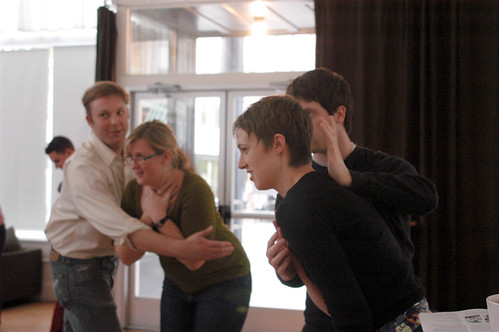
The more romantic option, “Singles CPR” comes, not surprisingly, from the innovative folks at the Oregon Trail Red Cross Chapter. The idea of “Singles CPR” is to add a fun and alluring twist to emergency training with the hope that the dummy’s heart is not the only one that starts fluttering during the session. And, “Singles CPR” has already resulted in at least one love match. This is the kind of unusual approach to CPR and preparedness in general that is so helpful in encouraging people to make the extra effort (though, of course, as a happily married lapsed resuscitator it’s not for me.)
OREGON TRAIL RED CROSS “SINGLES CPR” PARTICIPANTS MOVE IN CLOSE ON THEIR “FIRST DATE”
These icons link to social bookmarking sites where readers can share and discover new web pages.