The report, written by Civic Enterprises, indicated that 91% of veteran respondents would like to address the issue of “disaster relief” as a volunteer (second only to “helping wounded veterans”) and 88% of veterans said that disaster relief was “important” to them.
The report was commissioned as part of Service Nation’s Mission Serve initiative which aims to more closely bond the U.S.’s service and military communities and better use the skills and talents of veterans to address the nation’s problems at home.
“…that a new generation of veterans is returning home from Iraq and Afghanistan without sufficient connections to communities, is enthusiastic to serve again, and points the way forward for how our nation can better integrate them into civilian life. Although the 1.8 million veterans are from every corner of our nation, they are strongly united in their perspectives regarding civic responsibilities and opportunities as they return home.
What’s more, the findings show that OIF/OEF [Operation Iraqi Freedom/Operation Enduring Freedom] veterans are underutilized assets in our communities, and their continued service is likely to improve their transition home. We believe there is significant potential to increase volunteering and civic engagement among this generation of veterans.”
These icons link to social bookmarking sites where readers can share and discover new web pages.
Taking a little time away from their work dealing with the H1N1 flu among other issues for a bit of fun, the staff of the National Association of County & City Health Officials (NACCHO) has assembled their Top 10 list of favorite public health books. As the group explains on their website:
In an effort to develop a new resource for members, NACCHO recently asked its staff, “What are your favorite public health-related books, movies, articles, and novels?†With over 100 avid readers and film watchers on staff, we came up with a long list of favorites to recommend to members—from the seminal 1988 Institute of Medicine (IOM) Report to the recent bestseller The Great Influenza. The top ten titles are listed below.
A list of NACCHO members’ top picks is coming soon. To suggest your favorite title please e-mail Ashley Bowen (abowen@naccho.org).
I have read five of the books on the list including the three pictured below and can attest that they are not only fascinating but also good reads.Â
The only book I might add to the NACCHO list is Richard Preston’s novel, Cobra Event, which describes a biological terror attack on the U.S., but it may be that that fiction will have its own Top 10. By the way, when you purchase a title (new or used) from the Top 10 list from Powell’s Books, an independent book store based in Portland, Oregon, NACCHO receives a portion of the sale.
These icons link to social bookmarking sites where readers can share and discover new web pages.
I was just sent an interesting new book, Safeguarding Homeland Security: Governors And Mayors Speak Out (Springer), edited by Simon Hakim and Erwin A. Blackstone. The book is comprised of individual chapters written, as the title indicates, primarily by state and local officials about their own experiences with some aspect of homeland security.
Several of the contributions focus on citizen and community preparedness, including Houston Mayor Bill White on  his city’s response effort in the Katrina aftermath and Boston Mayor Thomas Menino on the creation of his town’s Medical Reserve Corps.
The chapter that I found most thought provoking (especially from a citizen/community preparedness angle) was by Alan Kirschenbaum from the Israel Institute of Technology who has written frequently on his nation’s public readiness efforts. In his contribution, “Disaster Management: Privatization as a Viable Alternative,” Kirschenbaum looks at the use of the “private market to prepare for and respond to disasters” particularly in the area of citizen preparedness (The role of the private sector in homeland security is a theme that runs through much of the book.)
Kirschenbaum reports on a public survey that was conducted by Israel’s Home Front Command earlier in the decade to determine how many households were “Ready to Pay for Disaster-Related Services Provided by Private Organizations.”
The results indicated that almost a third of Israelis were willing to pony up to pay the private sector for products/services, including: “supply food and water,” “prepare children in schools in emergency,” “have electric supply if stoppage” “evacuate to safe place if necessary.” The survey also found that interest in purchasing these services was driven less by economic status by age and family situation (ie. the respondents most interested were young families.)
So, what’s the takeaway from that study for U.S. citizen preparedness? (And, there is a lot that Israel can teach us on this subject.) Clearly, Israelis face a more prevalent threat than Americans, particularly in regard to terrorism, but they also enjoy a more robust citizen preparedness system. The survey results did indicate that at least a third of Israelis would like more than what the government was providing in the area of civil defense. I would venture that the number is at least as high here in the U.S.. The question is how do you (if you do) fill the gap between what the public wants/needs and what government can provide.
One way, as has been discussed on this blog, is to bring the private sector into citizen preparedness in the same way they have been involved in disaster response. There is a need to develop integrated marketing/awareness campaigns on national/state/local level with major consumer brands who are in the preparedness-related product and services business (e.g. personal tech, water, big box stores) to make preparing far easier and far less expensive for the public.Â
You can purchase Safeguarding Homeland Securityhere (n.b. the cost is $139.oo).
These icons link to social bookmarking sites where readers can share and discover new web pages.
As I had mentioned last week, the first-ever Random Hacks of Kindness took place this weekend in Mountain View, California. The event — which came out of discussions at the inaugural Crisis Camp held in May of 2009 in Washington, D.C. — was aimed at identifying key challenges and developing technological solutions to ‘real world’ problems related to emergency management and response here in the U.S. and around the world.
Google, Microsoft, and Yahoo may be tough competitors when it comes to Internet software and services, but they are putting their differences aside to build a developer community to tackle bigger picture problems like saving lives in emergencies.
The companies have joined with NASA, the World Bank, and PR agency SecondMuse to organize the first-ever Random Hacks of Kindness event, which was held at a warehouse space-cum community center called Hacker Dojo this weekend. For two days, coders worked on ways to use technology to help solve real-world problems, such as how people can get information and find each other during disasters.
The event came about after representatives from Google, Microsoft, and Yahoo attended a Crisis Camp conference for emergency and disaster relief groups in Washington, D.C. in May. The technologists decided that they would join forces to create a community of developers to build tools to help emergency workers.
“We’re trying to seed the community,” said Jeffery Martin, business product manager for Google Crisis Response. “We’re saying, partner with the private sector and we can push technology forward and innovate.”
Developers worked on a dozen or so tools that could help disaster and emergency workers in times of crisis. Several tools took advantage of social media sites, like Twitter, and SMS for information sharing. One project envisioned using laptops, routers, mobile devices, USB keys and Wi-Fi to create a mesh network for times when normal networks are down.
Several projects explored the use of maps, including one group that built a widget that allows a user to click on a point in a map to have the coordinates automatically inserted into a message that can then be posted to multiple social networks at once via the HelloTXT service.
In his keynote address, FEMA Administrator Craig Fugate challenged the programmers in attendance “to produce a solution that would allow individuals to create a dynamic, cross platform family emergency communications plan.” Fugate even put his some of his budget where his mouth was by offering to fly the team that best tackled the challenge to Washington in February to speak to a gathering of state emergency management heads.
The winner (of what was dubbed the “FEMA Prize”) was a group called Break Glass which, according to the list of winners on the website, offers an “extremely simple method to build and retrieve your family communication plan. Provides a cached family plan on phones for easy access in the event of no connectivity. One button activation from your phone. Allows the broadcast of emergency message to your family circle and the update of social networks when connectivity is turned on.” One of the judges, Jaan Orvet, offered some more perspective on the event in a blog post yesterday.
The next Random Hacks of Kindness is tentatively scheduled to take place in Washington, D.C. early next year. For more information on the initiative , you can go to its website www.rhok.org.
DEVELOPERS GIVING PRESENTATIONS ON THEIR DISASTER-RELATED PROJECTS AT THE RANDOM HACKS OF KINDNESS EVENT (Photo: Elinor Mills/CNET)
These icons link to social bookmarking sites where readers can share and discover new web pages.
I recently had the opportunity to speak with James Featherstone, the General Manager of Los Angeles’ Emergency Management Department, about the City’s citizen outreach efforts, particularly the relaunch of the Department’s website Ready LA.
When it comes to public preparedness, Featherstone has a bad news/good news situation. On the negative side, the Department must prepare and respond to the greatest range of threats of any major city, including wildfires, earthquakes, terrorism, and pandemics. Featherstone notes that Los Angeles faces 13 out of the 16 types of “Major Emergency” as defined in the Stafford Act. (Adding to his challenge is the sheer size of the area as well as the diversity of cultures and languages spoken.)
On the positive, all these potentialities may make it a little easier for him to convince residents that preparedness and planning may be worth their while.
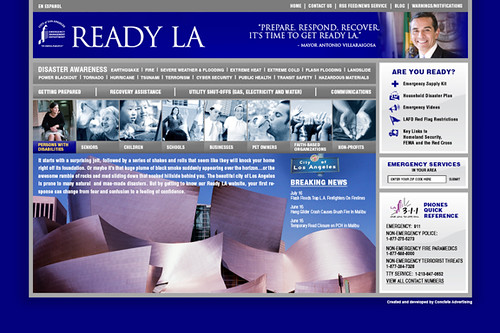
When you go to the Ready LA website, you are immediately struck by the rotating scenic photos of City of Angels landmarks. including the Frank Gehry-designed Walt Disney Concert Hall, Chinatown Gateway, Santa Monica Pier and Griffith Observatory. The aim is to draw people into the website by making the “unfriendly subject more friendly.” I think that approach — emergency management department with a little touch of convention and tourism bureau — may be smart, making the subject of preparedness seem more like a quotidian part of living in a big city, not something that is particularly extraordinary. The website’s introduction tries to set the tone:
“The beautiful city of Los Angeles is prone to many natural and man-made disasters. But our Ready LA website can soothe your fears, with important facts, valuable tips and critical reminders for developing plans of action to help you, your family and pets survive every type of conceivable emergency. Most of the time, life goes on here in L.A. without incident. But when calamity strikes… don’t panic! Please take a few minutes to review all of our helpful advice.”
FRONT PAGE OF READY LA WEBSITE WITH PHOTO OF THE WALT DISNEY CONCERT HALL IN LOS ANGELES
The new website is only one of the communications distribution methods, including its Facebook and Twitter pages, that the Department is using to complement traditional media outreach. There is also Spanish language site (and plans to have versions in Chinese, Japanese, Korean, Vietnamese and Tagalog.) In 2010, the City will developing a new preparedness website for the disabled to meet the needs of the hearing and visually impaired, according to Mark J. Carreno of Concrete Advertising which oversaw the ReadyLA update.
Featherstone says that it is crucial for emergency managers to offer many approaches and choices to reflect the expanding media environment and the diverse makeup of the population. As he explains, “”we have to fish where the fish are.””
These icons link to social bookmarking sites where readers can share and discover new web pages.
Michael Chertoff makes a second appearance in the “What Should We Tell The Public?” video series. The first was last year when Chertoff was U.S. Homeland Security Secretary; now he heads the Chertoff Group. In this video, Chertoff urges that all Americans think through their plans in the event of a personal or community emergency in advance. His successor, Janet Napolitano, recently made a similar point in a speech at the London School of Economics.
There are few positives about contracting Leukemia, but I got one perk  – a H1N1 vaccine. Because of my illness,  I am a member of the ‘underlying condition’ priority group, and therefore just received the vaccination shot.
Around the nation, authorities are now distributing the limited supplies to priority groups. Here in New York, the low turnout last weekend at clinics set up specifically for young people prompted officials to open access to other ’special’ populations. The City Department of Health’s new vaccine distribution widget is below:
These icons link to social bookmarking sites where readers can share and discover new web pages.
According to the “Flu Fighters”/NYC Service web page, “Flu Fighters will mobilize hundreds of volunteers to conduct outreach and awareness activities at community events, schools, senior centers, and houses of worship in New York City to raise awareness about influenza and the importance of getting vaccinated.” The Health Department’s flu page underscores the appeal: “Become a Flu Fighter and Help Save Lives!” So, of course, I signed up.Â
The “Flu Fighters” campaign has not yet received a lot of attention or been highly promoted by City officials. That may be largely because of delays in the delivery of the vaccine. In fact, though many areas around the country have begun to solicit citizen volunteer help for the massive H1N1 vaccine rollout, there has not been a major public deployment to date. That may change as more supplies become available and the weather turns colder.
The webpage further explains the various “Flu Fighter” responsibilities:
Community Outreach Volunteers: As a community outreach volunteer, you will promote influenza vaccination and prevention in your neighborhood. You will receive a Flu Fighter Action kit with posters and brochures to distribute at work, places of worship, local senior centers, pharmacies, local stores, or at other community hubs. You can distribute these materials at times and in places that are convenient for you.
Once you sign up, NYC Service will contact you about influenza vaccination centers or awareness events that may be taking place in your neighborhood throughout the influenza season. You can help promote these events by handing out flyers, posting signs, or bringing a friend or family member to get vaccinated.
Vaccination Pledge Volunteers:Â Protect your family and friends from influenza! As a vaccination pledge volunteer, you will pledge to remind people you know to get vaccinated. You will receive information on which people are mostly likely to get ill from seasonal or H1N1 influenza so that you can encourage them to get vaccinated. You will also receive information on where people can get vaccinated in their neighborhood.
Parent Outreach Volunteers: If you are the parent or guardian of a child in elementary, middle, or high school, you can help your child’s school as a parent outreach volunteer. This year, the City will be offering influenza vaccinations at elementary schools and at large weekend vaccination centers. Every child must have a consent form signed by their parent/guardian in order to receive the vaccine. Parent outreach volunteers will assist the vaccination consent process by attending school events to provide materials to other parents about the importance of vaccination and to remind them of the consent form due date.
Parents whose child’s school has a call tree can also volunteer to contact other parents to remind them of the consent form due date. You will receive all of the materials that you need to carry out these activities and can choose which activity is best for you.
Vaccination Center Volunteers:Â As a vaccination center volunteer, you will help out at one of the weekend vaccination centers (also known as Points of Dispensing, or PODs) that will take place across the city. You can help to distribute screening forms or manage the flow of people in and out of the vaccination center. If you are bilingual, you can translate in order to help people who do not speak English understand the signs and instructions.
For more information on “Flu Fighters” click here.
These icons link to social bookmarking sites where readers can share and discover new web pages.
As part of the inaugural “Random Hacks Of Kindness: Disaster Relief Codejam” (RHoK), a group of more than 150 leading crisis and technology experts are coming together for the next several days to work on identifying key challenges and developing solutions to ‘real world’ problems related to emergency management and response here in the U.S. and around the world.
This so-called “Give Camp” came out of discussions at the inaugural Crisis Camp held in May of 2009 in Washington, D.C. According to the RHoK website, “During one of the opening sessions an industry panel including representatives from Microsoft, Google and Yahoo! agreed that some matters supersede competitive concerns. We agreed to cooperate to mobilize our developer communities to create interoperable solutions/code that will have real impact in the field.”
During the RHoK, being held at the Hacker Dojo in Mountain View, California, programmers will partner with subject matter experts with the aim of building “a global community dedicated to solving disaster relief challenges through technology.” The software created will be openly shared with the international community. Microsoft, Google, Yahoo, NASA and the World Bank are the founding sponsors.
As of this writing, there were still a few spots left. If you are interested in attending or for more information, go to the RHoK EventBrite page here. I attended the Washington Crisis Camp, and wish I could get to this one. But I will be following it through its Twitter tag, #rhok.
We will be organizing a Crisis Camp in New York City in early 2010. If you would like to help on that event, please get in touch with me at jsolomon@incaseofemergencyblog.com
These icons link to social bookmarking sites where readers can share and discover new web pages.
In the end, Ida ended up weakening and did not have as serious impact on the U.S. as originally feared. Nonetheless, Jeannette’s post offers some nice insight on the increasingly central role that social media will play in disaster response:
The Hurricane Information Center was established during the heydays of the Democratic National Convention in August 2008. As the Convention was winding down, a Ning network was established to facilitate a distributed network of volunteers who could bring together disparate sources of information into a single online platform of technology mashups.
More than 500 people participated in this effort. They identified relevant Twitter feeds; annotated maps with evacuation routes, shelters, and available resources; linked to updated news stories; and edited a hurricane Wiki in real time. In true crowdsourced fashion, this network organized itself, invited newcomers with various levels of expertise to participate, and requested assistance with identified tasks.
The value of the information available through the Hurricane Information Center existed in its resources available to those looking for real-time information. The wisdom of the crowd, its collective intelligence, and self-monitoring behavior led to an example of a real-time, online, collective action taking that rivals examples of on the ground convergence routinely seen in disasters and crisis events.
Now, as Ida ramps up, the Hurricane Information Center has re-activated itself. Today, network founder Andy Carvin of NPR, sent out a call for help through an email blast which was repeated across various network participants’ personal blogs and through Twitter networks. It’s as if the horn has been sounded for the cavalry to assemble and they are preparing to mount their horses for the long ride into a potential disaster.
The second group to sound the alarm is Emicus.com. This website, launched by a Seattle start-up company, brings together newsfeeds from government, news, and the public and adds a number of sign-on features such as the “I’m OK†notification system. Here users can use the Emicus website to send text messages to their predetermined network, relaying the message that they are OK.
This hurricane season may be the first proving ground for Emicus, which was developed in response to Hurricanes Katrina and Wilma (2005), and Gustav and Ike (2008). The Emicus professional staff, which works out of offices in Florida, Seattle, and San Francisco, will serve as the dedicated team to monitor and relay information posted on the website.
Two dedicated groups – one comprised of volunteers across the country in a crowdsourced effort, the other developed on an enterprise model – are both preparing to deliver safety-critical information in this impending hurricane. Observations of the efforts and output should not go un-noticed by those who are interested in learning more about the wisdom of the crowd and the uses of social media to prepare, respond, and manage disasters and crisis events.
As Jeannette points out, the Hurricane Information Center and Emicus are innovators in the use of social media in disasters. One challenge going forward is to spread awareness among the public of social media’s capabilities during disasters in advance so when the bugle is blown next time more citizens know how and where to assemble.
These icons link to social bookmarking sites where readers can share and discover new web pages.