I wanted to highlight two exciting disaster preparedness/response events in Washington, D.C. this weekend, which are open to any interested member of the public –Â CrisisCampDC and RHoK (Random Hacks of Kindness) 1.0.
CrisisCampDC is a project of CrisisCommons, which according to its website, “is a volunteer technology community dedicated to bringing together technology, innovation and volunteers to help people and communities in times and places of crisis.”
“At CrisisCampDC,” the website continues, “we will create a board of sessions such as CrisisCamp Haiti after action, Oil Spill and Open Data and the development of a local DC chapter of CrisisCommons. In addition, we will take some time to explore development of the agenda for the First International CrisisCongress hosted by CrisisCommons, World Bank and the Alfred P. Sloan Foundation.”
I was thrilled to attend the inaugural CrisisCampDC, which took place in June. (I wrote a ‘Postcard from Camp’ on the blog.) Since then, the Camp and the Commons have taken off with camps being organized all over the world in the wake of the Haiti earthquake and Gulf oil spill. Already, output from the Commons (such as the Oil Reporter) is having an impact. And in a development that will only broaden the group’s impact, Heather Blanchard — who with Noel Dickover and Andy Carvin[correction: Andrew Turner] helped create CrisisCommons — recently left her position at the U.S. Homeland Security Department to focus full-time on the new organization.
Anyone interested in attending CrisisCampDC on Saturday, go to the EventBrite page here (which also has a list of those already registered). I am hoping to attend if my health allows it.
According to its website, Random Hacks of Kindness “is all about using technology to make the world a better place by building a community of innovation. RHoK brings software engineers together with disaster relief experts to identify critical global challenges, and develop software to respond to them. A RHoK Hackathon event brings together the best and the brightest hackers from around the world, who volunteer their time to solve real-world problems.”
This weekend’s hackathon is previewed on the RHOK website:
“Random Hacks of Kindness is going global! On June 4th through 6th, 2010 RHoK, in collaboration with the Crisis Commons, is hosting its second hackathon. This event is going to be a global gathering of hackers in many locations around the world, coming together in real time for a marathon weekend of coding around problems relating to natural disaster risk and response.
The Main Stage for RHoK #1.0 will be in Washington D.C., where events will kick off with a June 4, 2010 reception at the Department of State, followed by forty-eight hours of hacking madness at the Microsoft offices in Chevy Chase, MD. Simultaneously, hackers will be coming together on every continent for five global satellite RHoK events in Sydney, Australia; Nairobi, Kenya; London, England; Jakarta, Indonesia and Sao Paolo; Brazil.”
To register for RHok 1.0 or the satellite “RHok-ettes,”click here. If you are unable to attend the events in Washington or other parts of the world, you can follow the @CrisisCamp and @RandomHacks Twitter feeds. The two events will take place at Microsoft’s offices in Chevy Chase, Maryland. (Though Vint Cerf will open the RHok on Friday night at the U.S. State Department.)
These icons link to social bookmarking sites where readers can share and discover new web pages.
“We all share the responsibility to fight terror and criminal misconduct. But as someone who works in a store, mall, shopping center, or market, you have an obligation to help. Because sometimes ordinary people can stop extraordinary events…
When you witness things like this people leaving packages or bags behind…strangers taking photographs or video…drivers leaving vehicles in odd places the temptation will be strong. You will want to ignore your instincts…turn away…assume someone else will act if necessary. But the threat is real. Report suspicious behavior.”
This video was made for the retail industry, but the “suspicious activity” examples shown include mall customers making observations, and so it would be useful for any citizen to see. IÂ have argued previously for an expansion of the “See Something, Say Something” campaign by giving the public more information. This type of video offers the type of more specific guidance I would suggest be provided to the broader population.
U.S. Department of Homeland Security’s “What’s in Store: Ordinary People, Extraordinary Events” training video.
The Transportation Security Administration (TSA) has just issued its annual “Summer Travel Tips” for flyers. According to Blogger Bob from The TSA Blog (a trailblazer, by the way, in government blogging):
Summertime isn’t officially here yet, but as far as I’m concerned, it’s summer as soon as the pools are open. So, in preparation for this holiday weekend and the summer travel season to come, I wanted to post some helpful travel tips. Our highly trained security officers are prepared for the increase in passenger volumes and are dedicated to ensuring safe travels. TSA will be fully staffed and prepared to address the needs of the traveling public this summer.
So lather up with your favorite suntan lotion, take your laptop out in the sun, and read all about TSA travel tips. Fruity beverages and lounge music are optional.
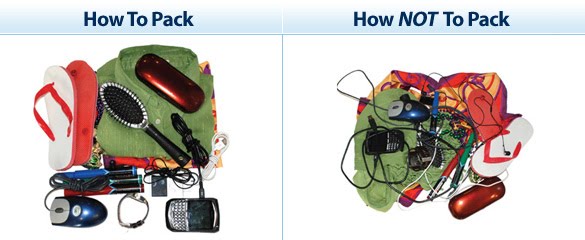
Though the advice may seem mundane, following it may be the most useful way the average citizen can contribute to airline security. The tips include how to pack, how to get through the line faster, the ‘right’ clothes to wear and how to best deal with special circumstances. The most important, according to Blogger Bob:
The best piece of advice I could give a traveler is to arrive early. No matter what happens, (aside from a flight being cancelled) if you get to the airport early, you should be fine. Worst case scenario is you’ll have some time to catch up on some reading or a few Z’s while you wait on your flight.
The full post and more information on travel security can be found here.
From the TSA Blog’s “Summer Travel Tips”
These icons link to social bookmarking sites where readers can share and discover new web pages.
The word ‘fear’ has gotten a bit of bad rap this decade. And, I would argue that’s hurt the country’s public preparedness. Let me explain.
I think the fear of being accused of fearmongering has put a significant crimp in the ability of our leaders to communicate with and prepare Americans for terrorism. That’s a problem since the public’s current level of emergency readiness, is, in the words of a top federal preparedness official, “very concerning and frankly very frightening.”
Almost nine years after 9/11, government officials at federal, state and local levels have still not determined how best to communicate with the public on those threats. What is already a difficult task has been made even more challenging, I would argue, because officials are worried about being accused (by political opponents amplified by the media) of scaring the public.
The inability to raise the topic of potential threats in any detail has not only hurt the country’s citizen preparedness. But it has also made things more difficult for the government to get public input and buy-in on how best to allocate the nation’s resources and find the right balance of risk when it comes to disasters.
From the beginning of her tenure, U.S. Secretary of Homeland Security Janet Napolitano has said that she wants to better inform Americans about the threats facing the nation and highlight the citizen role in the homeland security enterprise. She believes that addressing public complacency is one of the biggest challenges for her Department. When asked by the Washington Post what keeps her up at night, she said:
“Complacency…The fact that it has been eight years since 9/11, and people just assume the government is going to take care of that. . . Safety, security is a shared responsibility. It doesn’t take much for everybody just to take a deep breath and say, ‘Okay, what would I need to do to be prepared?’
In an another interview in the Post, the Secretary was asked “if the American people could see what you see — if they were privy to intelligence reports and they saw the whole spectrum of what was out there, do you think they would have a different view of preparedness?â€
Her reply: “Oh, yes, perhaps. But on the other hand, I think what is important for them to recognize is that we have hundreds of thousands of people working on this every day.†Even as she would like to get the public’s attention, the Secretary understandably does not want to unnecessarily stoke concern.
Napolitano has pointedly emphasized that she does not want to scare people, rejecting what she calls the “politics of fear.” Finding that balance is key. Yet to address “complacency,†officials will have to find ways to better illustrate what is “out there.†And there is absolutely no way to do so without explaining in some detail why Americans shouldn’t be complacent. To me, being scared and being prepared are not mutually exclusive. In fact, I think the former is a necessary part of the process to achieve the latter.
In their recent books, both of Napolitano’s predecessors, Tom Ridge and Michael Chertoff, make the need to address public “complacency” by explaining the terrorist threat a major theme. Chertoff warns of returning to a “September 10†mindset†urging the government “be candid with American people, sharing as much information as possible about dangers we face.†Both acknowledge that they were not able to accomplish that goal. Both men have told me in interviews of their frustrations with the inability to communicate threats and engage in a more frank sustained dialogue with the American public about post-9/11 homeland security.
Their inability to do so was in large part due to the fact that the Bush Administration was viewed — sometimes fairly and sometimes unfairly — as using terror communications as a political tool. As a result, no Administration official could discuss any type of potential threat without it being seen as suspect by the media and the public.
President Obama has the chance to start over in this area tabula rasa. But to date, the Administration while expressing an interest of doing so has not done it. That’s understandable. This is not easy stuff. There’s nothing to pull ‘off the shelf’ for preparing the public for all the threats of the 21st Century, a number of which have never been faced by anyone let alone Americans. In addition, new technology has also changed message delivery. It will take some real thought in designing both the content and distribution of the information.
Both one thing is clear: if officials are going to have a discussion of potential disasters, they cannot avoid communicating some level of fear. Explaining what citizens would need to do in the event of a biological or chemical attack cannot be done without contemplating dire possibilities. But just for a moment. These are scary, unfamiliar topics. But the objective is to do so in a responsible and constructive manner — not stirring up more fear than is necessary, handling it with perspective, and providing concrete things people can do to prepare themselves and communities.
And, ironically in some cases, the threats — e.g. a ‘dirty bomb’ — is not as serious as most Americans currently perceive it is. However, that fact has to be communicated in advance to the public, because — due to general public distrust about government and instances such as the health precautions and reporting during the World Trade Center cleanup — Americans will be skeptical about anything said during and after such an incident.
One of the reasons I think we need to (and can) rehabilitate the word “fear” is that officials are already using it in other areas. In fact, currently there is a preparedness double standard. Officials are not allowed to talk about terrorism threats without being accused of scaring people. But we seem to have no problem when it is used to generate public interest in more traditional disasters.
For example, with hurricane season beginning this week FEMA’s Twitter feed sent out this message: “In an average 3-year period, roughly 5 hurricanes strike the US killing 50-100 people anywhere from TX to ME” Isn’t that fearmongering? But the ‘tweet’ makes the important and fair point that Americans shouldn’t be complacent during storm season since hurricanes can kill people, and they should prepare for them. The fact is that fear can be a useful lever (as one part of a communications effort) to encourage constructive behavior. So, why are officials allowed to use it for natural disaster preparedness and not for terrorism?
Further, why has the campaign against global warming been successful and grabbed public attention? In large part, it is because proponents have made the case that if we don’t do something the planet will become inhabitable. That’s a ’scare tactic’ if I’ve ever heard one. Why isn’t that labeled fearmongering? To me, it’s just presenting the public the facts, offering government’s response and providing ways people can contribute towards dealing with the problem. And, by the way, I think the effort on climate change is very much related to disaster preparedness.
If the government isn’t allowed to discuss serious threats, there is no way that we can have the important discussion about what we expect the government to protect us from and what risks are we willing to accept. It would have been useful to have a debate on the costs/benefits of building levees before Katrina or an unprecedentally large oil well in the Gulf before the recent spill. Again, it may not have prevented worst case scenarios but it would have at least laid out for the public, elected officials and the media the real risks and the financial tradeoffs. In fact, the media has a major role in both explaining the threats more fully and not reflexively calling officials who talk about it “fearmongers”.
One way to mitigate the fearmonger attack is to offer people something they can do rather than place them into a victim, dependent mentality. The more information given will better empower the public and also underscore that citizens have a role in disaster preparedness. There is a role for fear. But it needs to be part of a broader effort of strengthening communities and citizens and making more resilient. (This blog attempts to find that balance. I don’t shy away from difficult or scary topics, but I try to handle them in a way that is responsible, have a purpose and offer suggestions on how citizens can become involved.)
Carrie Lemack from Families of 9/11 told the Commission on the Prevention of Weapons of Mass Destruction Proliferation and Terrorism in 2007 she knows from first hand experience that offering Americans information about terror threats does not engender fear but confidence:
I was told by one senior government official that marketing and communication professionals had determined that the best course of action was not to discuss the issue publicly, since it might scare Americans.I disagree.I spent 18 months traveling from Des Moines to Columbia, South Carolina. St. Petersburg to Manchester, New Hampshire. And in all the talks and forums I attended, not one person left in fear.
In fact, it was quite the opposite. Once they knew that the threat could be prevented, there was hope, even optimism.When Americans see a solution to a problem, though it may be difficult to achieve, they are quite capable of reaching their goal.I hope the next Administration is willing to talk candidly with the American public, to engage them, and to trust that they can accept the realities of the world we live in today.
As Lemack points out from her own work, officials have to give the public more credit for dealing with scary topics. With apologies to Jack Nicholson’s Colonel Nathan Jessep in A Few Good Men, “We can handle the truth.” Here in New York City, after the Times Square attack New Yorkers may have been frightened briefly, but then we moved on and went back to worrying about quotidian urban concerns like being hit by a taxi running a red light. And, as someone who is currently dealing with a life-threatening disease, I want to be told the truth however scary it might be.
What adds to the communications challenge is that security officials sincerely do not know how, when, and where future attacks will occur? But again, Americans can handle that uncertainty if we’re told that and are able to develop a trusting, transparent and ongoing dialogue with the government. Again, officials using fear frequently and irresponsibly is very wrong. But let’s not throw the baby out with bathwater. But fear does have a role public preparedness.
These icons link to social bookmarking sites where readers can share and discover new web pages.
Thanks to Sara Estes Cohen’s Twitter feed I found out about a new group in New Orleans, Evacuteer.org, that is recruiting volunteers to help in the event of an emergency evacuation of the city (an eventuality whose chances increased today with the announcement by Mayor Mitch Landrieu that he might order a full evacuation before a Category 2 hurricane.)
According to its website, Evacuteer.org was launched on June 2, 2009 as an organization of New Orleans citizens committed to helping execute the new City Assisted Evacuation Plan.
If you are interested in volunteering to be an Evacuteer, click here.
These icons link to social bookmarking sites where readers can share and discover new web pages.
New York City’s Office of Emergency Management (NYC OEM) will be sending NYC OEM Community Emergency Response Team (CERT) Program Staff, CERT Instructors from the Fire Department, and Department of Health and Mental Hygiene staff to train up to 400 Haitian residents in CERT. The team will leave for Haiti on June 7th. According to the City’s press release:
“This will be the first time New York City has ever taught its CERT Program outside of the United States and the first time that such a program has been brought to Haiti,†said Mayor Michael Bloomberg. “President Clinton, in his role as the UN’s Special Envoy to Haiti, and former FEMA Director James Lee Witt recommended our program to the Haitian government which in turn asked our instructors to lead the first CERT classes in Haiti. We are honored to do it.â€
[The Clinton Foundation also just announced through their Twitter feed @ClintonTweet that it had pledged $1 million for disaster preparedness and hurricane safety in Haiti. An article on the donation is here.]
The 12 member New York City team is comprised of:
Four Haitian-Creole speaking fire fighters, who will be instructing CERT trainees in fire suppression and light search and rescue; two FDNY EMS personnel, who will teach first aid and triage; two Health Department employees, who will run courses in public health; three OEM staff members, who will assist with course instruction and manage the team; and; a senior CERT instructor who will serve as an advisor and help manage the team.
The roughly 400 Haitians who will be trained live in temporary shelters at the Petionville Club, a former golf course that now houses more than 50,000 people displaced by the 7.0 magnitude earthquake that struck near Port-au-Prince on January 12, 2010. Shortly after the earthquake, the group that will be trained volunteered to serve with the fire brigade at the settlement and received training in fire suppression.
A company called Fortnight Lingerie created the video to promote CPR and its own products (not necessarily in that order), though it may be difficult to focus on either while watching. If the video inspires you to get trained as I did a couple years ago, you can find a location to do so here.
With the 2010 Hurricane Season starting today and the oil spill in the Gulf, the Louisiana Department of Social Services is encouraging residents to pre-apply online for Disaster Food Stamps. The Louisiana effort underscores the importance of citizen advance planning for disasters when it comes to their daily needs (whether it be government assistance or prescription medicine). According to the press release, Louisiana Social Services Director Nichols says:
“By completing the pre-application online, residents are taking a proactive step to prepare themselves and their families for a disaster.”
Disaster Food Stamps provide food assistance for eligible low- to moderate-income households not receiving regular food stamps who need help buying groceries due to lost income or damages following a disaster. Pre-applying for Disaster Food Stamps does not guarantee benefits.
Nichols said that the pre-application process is designed to save time, prevent long waits and to make it easier for applicants to collect the required income information before a disaster strikes…
Today, we honor those of our fellow Americans who have given their lives on our behalf and their families who continue to carry that burden.
When I was diagnosed with a life threatening disease at age 45, some would tell me I was young to have to face mortality. But throughout my treatment I’ve always felt that whether I survived my illness or not, I was lucky to have so many years — unlike the 21-year-olds who have died really young in Helmand, Balud, Quang Tri, Peleliu and the many other battles of our nation’s history.
And, on this day, we also must honor the sacrifice of military families. In a New York magazine issue marking the fifth anniversary of 9/11, a sociology professor made the point that the impact of the nation’s response to the September 11th attacks have fallen predominately on military communities. And, as deep as the wounds are here in New York and in Washington, D.C. from 9/11, it is now primarily in towns from around the U.S. where the impact of our response continues to be felt everyday by uniformed personnel and their families.
So, thank you. Though I realize it is hardly enough.
Mary McHugh in front of the Arlington Cemetery grave of her fiance Army Ranger James ‘Jimmy’ Regan who was killed by a road side bomb in Iraq in 2007.
These icons link to social bookmarking sites where readers can share and discover new web pages.
The U.S. Environmental Protection Agency (EPA) has launched an initiative to help communities more effectively participate in government decisions related to land cleanup, emergency preparedness and response, and the management of hazardous substances and waste. According to the press release:
The Community Engagement Initiative (CEI) plan lays out specific steps EPA is taking to provide communities with better information and opportunities to understand and influence decisions on environmental cleanups. The purpose of the plan is to present guiding principles, goals and actions to enhance EPA’s relationships with communities from across the country while protecting human health and the environment.
“Transparency, access and public involvement are essential to meaningful and deliberate decision-making at EPA,” said Mathy Stanislaus, assistant administrator for EPA’s Office of Solid Waste and Emergency Response. “Getting a diverse group of citizens – all with their own unique experiences and expertise – to provide their views and expertise to inform the decisions we make helps us better protect Americans where they live, work, play and learn.”
The plan includes activities that will help EPA: [Read more →]
These icons link to social bookmarking sites where readers can share and discover new web pages.