As the nation reels from the tragic floods in Arkansas on Friday that killed at least 18 people, Inga Jelescheff, senior director of operations for the Preparedness, Health and Safety Services Division of the American Red Cross, has an article on CNN.com on flood safety. The piece, “Preparing For Flood Danger In Wilderness,” offers some preparedness tips for the 40% of Americans who will camp or hike this summer:
• Share your travel plans with a family member, neighbor or friend
• Listen to area radio and television stations and a NOAA Weather Radio for possible flood warnings and reports of flooding in progress or other critical information from the National Weather Service.
• Be prepared to evacuate at a moment’s notice.
• When a flood or flash flood warning is issued for your area, head for higher ground and stay there.
• Stay away from floodwaters. If you come upon a flowing stream where water is above your ankles, stop, turn around and go another way — 6 inches of swiftly moving water can sweep you off of your feet.
• If you come upon a flooded road while driving, turn around and go another way.
• If you are caught on a flooded road and waters are rising rapidly around you, get out of the car quickly and move to higher ground. Most cars can be swept away by less than 2 feet of moving water.
• Keep children out of the water, as their curiosity could cause them to get too close to fast-moving flood waters.
• Be especially cautious at night when it is harder to recognize flood danger.
Download our Flood Safety checklist, visit redcross.org or contact your local Red Cross for additional information on how to prepare for emergencies and to get trained.
These icons link to social bookmarking sites where readers can share and discover new web pages.
Email Entry
Tags: Flooding · Preparedness Tips · Red Cross
As part of a special report from Seattle’s local public radio station, KUOW, “On Shaky Ground: Waiting for the Big One in the Pacific Northwest,” there’s a three-minute audio interview with JoAnn Jordan, the Public Education Coordinator, Seattle Office of Emergency Management, on how to stay safe in an earthquake.
Jordan is a top local public emergency communications official and has been pushing preparedness in Seattle so long she’s called “The Earthquake Lady”. It’s a nice, compact earthquake preparedness review, which includes both “Drop, Cover & Hold” as well as “Beneath, Beside, Between.” It can be heard on the KUOW website here. Thanks to the Seattle Red Cross Twitter feed for bringing this to my attention.

JoAnn Jordan, “The Earthquake Lady” (Photo: Deborah Wang)
These icons link to social bookmarking sites where readers can share and discover new web pages.
Email Entry
Tags: Earthquake Preparedness · Media
Andrew Revkin, author of the New York Times terrific Dot Earth blog, has a post this morning, “Downpours + Steep Hills + Sleeping Campers = Horror,” about yesterday’s flash floods in Arkansas which have killed at least 20 people with others still missing. Revkin’s post explains what happened and notes that “a network of thousands of streamflow gauges that can help generate flash flood warnings is steadily eroding under tightening budgets.”
The nightmarish flash floods in southwestern Arkansas early Friday morning that swept away dozens of campers — with some 20 dead and many more still missing — resulted from a horrible confluence of a late-night burst of extreme rains over a region of steep-sided, isolated river valleys long popular with folks eager for a taste of wild nature.

The image above, from the Little Rock, Ark., Web site of the National Weather Service, shows the progression of the downpours Thursday night. The weather service, according to news reports, issued a flash flood warning at 2 a.m. Friday, but it was of little help to the sleeping campers in the hilly region with scant cell-phone service. The news article in The Times includes wrenching firsthand descriptions of the nightmare scenario as the Caddo and Little Missouri rivers rose yards in minutes. There is a chart at the weather service site showing just how swiftly the waters rose. Jeff Masters has an excellent summary of the meteorological backdrop.
Earlier this spring, the weather service reviewed flood risks and safety tips — with a focus on the devastating debris flows that can swiftly develop in flash floods….Around the United States, a network of thousands of streamflow gauges that can help generate flash flood warnings is steadily eroding under tightening budgets. In the wake of epic flooding around Nashville, Tenn., earlier this spring, Joe Romm pointed out that neglecting this gauge network is a bad idea given that climate change is increasing the odds of rain falling in dangerous downpours.
Revkin’s full post can be found here.
These icons link to social bookmarking sites where readers can share and discover new web pages.
Email Entry
Tags: Flooding
CraigAtFEMA (a.k.a. FEMA Administrator Craig Fugate) tweeted a reminder this week: “www.DisasterAssistance.gov info how you might be able to get help from the US Gov’t before, during & after a disaster.” Though it mostly handles natural disaster aid, citizens can go there to file a claim with BP due to the oil spill.
The aim of the site is to consolidate disaster assistance information for the public in one place:
Currently, 17 U.S. Government agencies, which sponsor more than 50 forms of disaster assistance, contribute to the website. It is possible to apply for many forms of assistance with a single, online application. Application information is shared only with those agencies that the applicant identifies and is protected by the highest levels of security. Ultimately, DisasterAssistance.gov will speed the application process and allow applicants to check the progress of applications online.
DisasterAssistance.gov was developed to comply with Executive Order 13411, which requires the government to simplify the process of identifying and applying for disaster assistance. The ultimate vision for DisasterAssistance.gov is to be the collective point of application for all federal agencies that offer forms of assistance to those affected by disaster, as well as eventually provide a central repository for all forms of disaster assistance, irrespective of provider. FEMA and its sixteen partner agencies are working closely to turn this vision into reality. Individuals may still go to FEMA.gov, however, those who apply for assistance online will be redirected to the new DisasterAssistance.gov website.

These icons link to social bookmarking sites where readers can share and discover new web pages.
Email Entry
Tags: Federal Emergency Management Administration · Government Web Sites
I wanted to bring your attention to a brand new blog authored by Col. Randy Larsen (ret.), Biosecurity Blog.
Randy, a friend of this blog, has an illustrious and varied career in the military, homeland security and communications. Most recently, he was the Executive Director of the Commission on the Prevention of Weapons of Mass Destruction and has, along with co-chairs Bob Graham and Jim Talent, formed the Bipartisan WMD Terrorism Research Center. They will be working to implement the Commission’s extensive recommendations. (The Biosecurity Blog’s subhead is: “Improving America’s Capability To Respond to Bio-Threats.”)
Randy is author of Our Own Worst Enemy: Asking the Right Questions About Security to Protect You, Your Family, and America (Grand Central Publications, 2007) and was the co-host of one of my favorite radio shows, “Homeland Security Inside & Out”.
I recommend following the Biosecurity Blog.
These icons link to social bookmarking sites where readers can share and discover new web pages.
Email Entry
Tags: Biological Terrorism · Nuclear Terrorism · Preparedness 2.0
The New York Times’ Idea of the Day blog summarizes a new study (which sounds like it could have come from The Onion) in a new post, “The Botox-Terror Connection”:
And you thought people with cosmetically frozen facial expressions were scary. Writing in the latest Scientific American, two bio-terror experts, Ken Coleman and Raymond A. Zilinskas, warn about the proliferation of international counterfeiters of the wrinkle-smoothing drug Botox. The worry is that through the counterfeiters, terrorists will be able to obtain or make lethal forms of the drug’s active ingredient, botulinum neurotoxin.
The stuff isn’t such a concern in a typical cosmetic Botox dose — its presence is so minuscule it would take hundreds of vials to kill a person — but it wouldn’t take much to wreak widespread havoc, the two say.
Foreign Policy summarizes their work:
[Read more →]
These icons link to social bookmarking sites where readers can share and discover new web pages.
Email Entry
Tags: Biological Terrorism
On the subject of preparedness ‘carrots’, the Georgia Emergency Management Agency’s Ready Georgia campaign is working with the private sector to provide a free or discounted NOAA Weather Radio for residents who use its new online family preparedness planning tool.

According to the agency’s press release:
…Through July 19, Georgians who visit ready.ga.gov and sign up to use Ready Georgia’s interactive planning tool not only get a customized checklist of emergency supplies and a tailored emergency communications plan, but they are also entered to win one of 200 state-of the-art, digital alert Midland radios – a critical life-saving tool – from WSB-TV.
In addition to being able to win a radio from WSB-TV, Kroger stores statewide are also giving Georgians the opportunity to purchase NOAA Weather Radios at a discount. Throughout hurricane season, Kroger will offer weather radios for just $29.99 (regularly $49.99). A list of Georgia locations can be found at Kroger.com.
GEMA/Homeland Security director Charley English says that NOAA Weather Radios are as crucial to family safety as smoke detectors or alarm systems. In Georgia, 29 transmitters broadcast throughout the state, and approximately 98 percent of Georgia’s population lives within range of a NOAA Weather Radio transmitter.
I like this government-business linkage, because the public is being offered significant incentives — a free or 40%-off a weather radio — to prepare (though of course I would like to see a more extensive partnership.)

200 NOAA weather radios like this are being given away by Ready Georgia.
These icons link to social bookmarking sites where readers can share and discover new web pages.
Email Entry
Tags: Contests · Preparedness 2.0 · Preparedness Ideas · Preparedness Incentives · State Preparedness
In today’s Wall Street Journal, Peggy Noonan has a column about the nation’s lack of readiness for weapons of mass destruction (WMD), “‘We Are Totally Unprepared’: Nine years after 9/11, a chilling complacency about WMD attacks.” She writes:
The most important overlooked story of the past few weeks was overlooked because it was not surprising. Also because no one really wants to notice it. The weight of 9/11 and all its implications is so much on our minds that it’s never on our mind.
I speak of the report from the Inspector General of the Justice Department, issued in late May, saying the department is not prepared to ensure public safety in the days or weeks after a terrorist attack in which nuclear, biological or chemical weapons are used…
Noonan notes that the Justice IG was not alone in noting the lack of WMD readiness:
[Read more →]
These icons link to social bookmarking sites where readers can share and discover new web pages.
Email Entry
Tags: Biological Terrorism · Media · Nuclear Terrorism
The Menu: Alaskan Dungeness crab flan with fresh ginger-yuzu broth; organic Long Island duckling in almond and spring garlic broth, parsley root puree, white truffle honey glaze and fresh chamomile; and Colorado cherries roasted with fresh verbena and lavender, strawberry sorbet, rhubarb granité, and pomegranate…and CPR?
This blog’s ongoing effort to find creative ideas for engaging the public on preparedness brings us to celebrity chef David Bouley’s Test Kitchen in downtown Manhattan. Bouley along with American Red Cross of Greater New York created an event last week, which paired gourmet dining with CPR training. According to the story on the Red Cross’ website:
Guests were first treated to a 30-minute reception with hors d’oeuvres that were prepared right before their eyes by Bouley Test Kitchen chefs. This was then followed by a CPR training protocol specifically designed by American Red Cross in Greater NY CPR instructors for this type of venue. The protocol, which included an instructive video and hands-on instruction and demonstrations, focused on raising awareness of the importance of adult CPR skills and providing guests with an opportunity to experience hands-on practice of these skills.
“In the culinary world and in life, whether it is with the right ingredients and/or the right training, one needs to be prepared,†said Chef Bouley, who graciously donated the evening’s food and wine. “We are proud to sponsor an evening of fine dining paired with the important CPR lifesaving training provided by the American Red Cross in Greater New York. Our goal is to demonstrate how to help save a life in two valuable ways ––eating right and being CPR-trained.â€
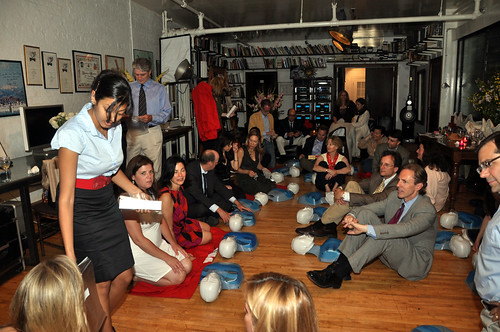
Diners receiving pre-dinner training at David Bouley’s Test Kitchen during the National CPR Week event.
These icons link to social bookmarking sites where readers can share and discover new web pages.
Email Entry
Tags: Preparedness Ideas · Red Cross
A bill, co-sponsored by a bi-partisan group of members of the U.S. House Homeland Security Committee and introduced yesterday, would require the U.S. government to better inform the public about weapons of mass destruction (WMD).
Those provisions are part of comprehensivelegislation addressing the WMD threat which is based largely on the recommendations of the Commission on the Prevention of WMD Proliferation and Terrorism’s final report, “World At Risk.â€
Of most interest to this blog, the bill has several provisions that deal specifically with public information, a significant focus of the WMD Commission report and its chairman Bob Graham.
The House legislation, sponsored by Rep. William Pascrell (D-NJ) and Rep. Peter King (R-NY), joins a Senate WMD bill. Both aim to codify many of the WMD Commission recommendations. This bill’s submission comes two days after a top DHS official said in a speech that the U.S. has “to start thinking very seriously about what we would actually do the day after [a nuclear or biological] attackâ€.
The public information provisions, according to the bill’s summary, are:
[Read more →]
These icons link to social bookmarking sites where readers can share and discover new web pages.
Email Entry
Tags: Biological Terrorism · Congress · Nuclear Terrorism