The Federal Emergency Management Agency is funding the development of a video game, “Disaster Hero,” to teach children and their parents, caregivers and teachers how to prepare for various emergencies, according to an article in Occupational Health and Safety. It is being created with the help of the American College of Emergency Physicians (ACEP) and is expected to be completed in 2011. According to the article:
Players will be encouraged to learn about the types of disasters that might occur in their geographic region or state. The most common disasters — earthquakes, floods, hurricanes, and tornadoes — will be used to teach preparedness steps and to help users know how to prepare and what to do during and after an emergency event.
The game will include a variety of different game genres, depending on the type of educational content to be conveyed. For example, time management and puzzle gameplay will be used to teach how a person prepares for a possible emergency, including determining escape routes and meeting places. Hidden object gameplay will be used to teach what items belong in an emergency supply kit, such as batteries, flashlight, and canned food. Simulation gameplay will be used to present quick-care tips such as applying pressure to control bleeding.
The players take the role of a “Disaster Hero” to help different families prepare for various disasters. Each disaster scenario provides a variety of game experiences and quizzes on what was learned. Points are earned throughout the experience and displayed on the Disaster Hero website. Downloadable learning activities and checklists targeted to teachers and parents also will be available on the website.
I recently read about two interesting examples of programs aimed at training teenagers in emergency preparedness — the St. Charles (Missouri) County Teen CERT program and Operation Safeguard Academy, a week-long readiness camp in Indianapolis.
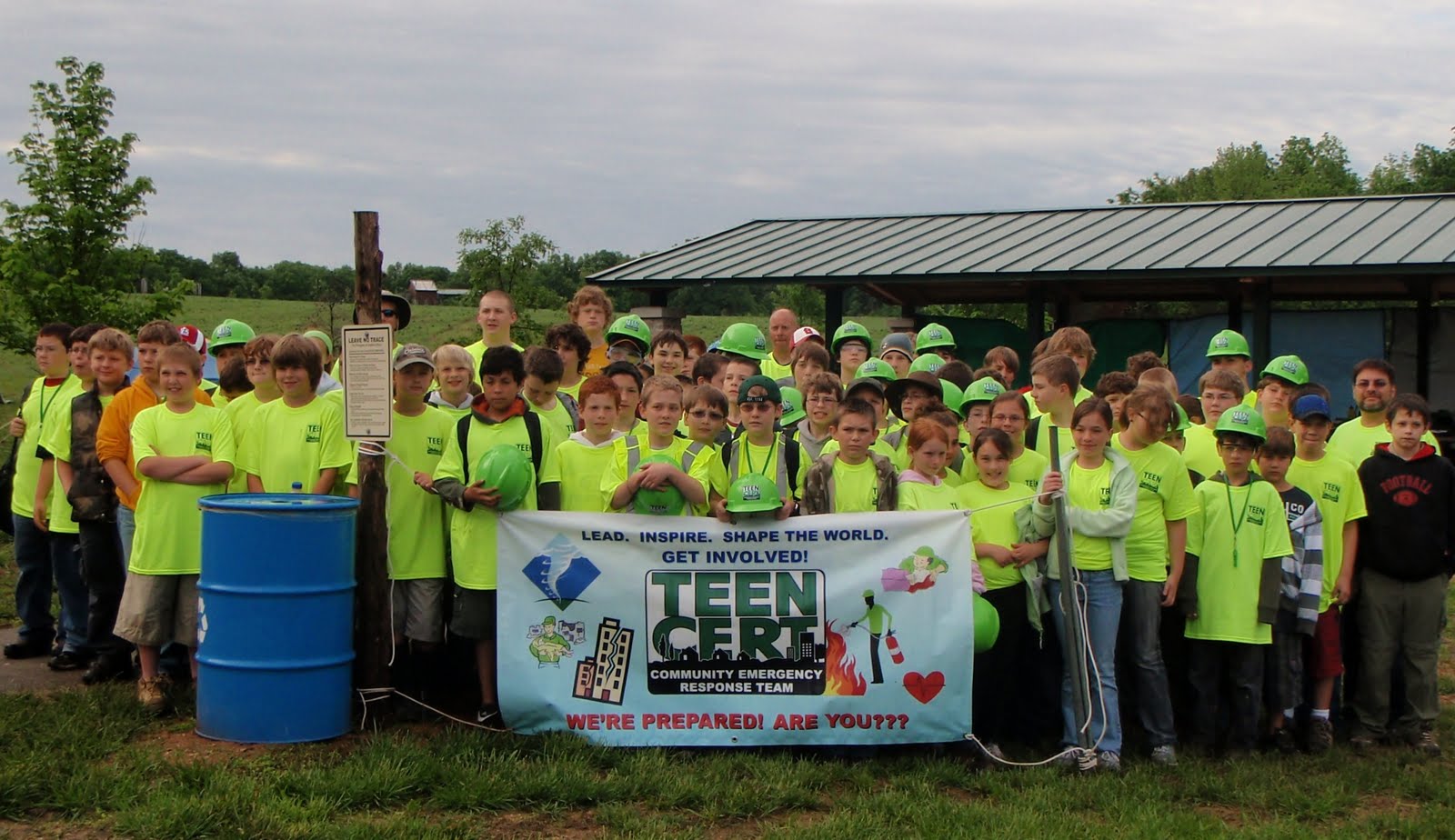
Four Boy Scout and two Girl Scout troops participated in the emergency preparedness and response training at Indian Camp Creek Park in northern St. Charles County. The specialized training provided students the skills necessary to perform under pressure by developing multi-functional response teams that supplement community emergency services during major disasters. The St. Charles County Teen Community Emergency Response Team (TEEN CERT) program is made up entirely of volunteer citizens and is more than 230 members strong.
While many people will respond to others in need without any training, one goal of the TEEN CERT program is to help these citizens do so effectively and efficiently without placing themselves or others in unnecessary danger. With the mandatory 20-hours of training, students learn to manage utilities and put out small fires, and treat the three medical killers by opening airways, controlling bleeding, and treating for shock. TEEN CERT also trains students how to provide basic medical aid, search for and rescue victims safely, organize themselves and spontaneous volunteers to be effective, and collect disaster intelligence to support first responder efforts…
In Indianapolis, at the Operation Safeguard Academy, according to the IndyStar.com:
The Federal Emergency Management Agency, National Oceanic & Atmospheric Administration and the American Red Cross have produced a menu with their various social media tools (including Twitter, Facebook, YouTube and widgets) for the public to use/bookmark during hurricane season. It can be found on FEMA’s website here. You can also receive e-mail and text alerts from FEMA by signing up here.
Click on the icons to go to FEMA’s social media sites above.
These icons link to social bookmarking sites where readers can share and discover new web pages.
“The concept was basically centered around the challenge of trying to be a fresh voice of preparedness in a sea of ‘white noise’ for our citizens,” Adam Crowe, Johnson County’s Assistant Director for Community Management, told me in an email. “They’ve only got so much time to think about things outside of the stress of their lives and we’ve got a lot of competition. So we came up with an idea that blended Smokey the Bear with the Travelocity Gnome. Fortunately, people seem to enjoy the concept.”
Recently, Preparedness Pig had a meeting with the nation’s top preparedness official, FEMA head Craig Fugate at an International Association of Emergency Managers conference. When I asked what the two preparedness pros discussed, Crowe told me: “They talked about Preparedness, of course. They talked about the challenges of emergency management in the 21st century and how to continue to make America (or my local community) more resilient.”
The post, written by Lorin Bristow, reacts to a recent study of more than 400 notification system decision-makers, in which 58% said they use their systems for “emergency situations only” while 42% said they use it for “emergency, urgent, and non-emergency situations equally.” Bristow lays out the two “camps”:
For those in the “emergency only” camp, there is often a fear by managers that frequent use will desensitize citizens to alerts. If the public receives regular, routine messages through the notification system, according to the theory, people may ignore alerts when a real crisis exists. Also, the E911 data used to populate these systems may not legally be applicable for non-emergency situations–another possible factor.
For those in the “emergency and non-emergency” camp, there is a belief that more liberal use provides citizens with greater familiarity and deeper comfort in interacting with the system. It also serves as a highly visible connection point between citizens and first responder agencies, creating a sense of community involvement and trust.
Last night, on the CBS Evening News, Steve Hartman told the touching and inspiring story of 11-year-old Olivia Bouler who decided to paint watercolors of birds as a way to raise money to support animal relief efforts on the Gulf Coast. Amazingly, she has raised $100,000 in donations from the paintings through an internet site. She is donating the money to the Audubon Society which plans to use it for animal rescue and to establish a new bird habitat in the Gulf. It’s a great story and Hartman, as usual, tells it beautifully. Olivia’s website can be found here.
“CBS Evening News” segment on 11-year-old Olivia Bouler
These icons link to social bookmarking sites where readers can share and discover new web pages.
On Sunday afternoon at Yankee Stadium, American Red Cross President Gail McGovern was ‘pitching’ in more ways than one.
She threw out the ceremonial first pitch (video below), while the Stadium scoreboard asked the crowd to make a text donation to the Red Cross (photo below). And, the public address announcer urged fans to take steps to prepare for unexpected emergencies.I don’t know how successful the texting or preparedness solicitation were, but her throw to Yankees’ catcher Jorge Posada looked pretty good.
Gail McGovern throws out ‘first pitch’ at Yankee Stadium on Sunday.
Stadium scoreboard asks for text donations to Red Cross
The U.S. government is looking to recruit thousands of men and women for its cybersecurity efforts, according to an article in Homeland Security Newswire, and a nationwide talent search has been launched t0 help fill the need:
The U.S. Cyber Challenge is looking for 10,000 young Americans with the skills to fill the ranks of cybersecurity practitioners, researchers, and warriors.
“The U.S. Cyber Challenge is a nationwide talent search that aims at nurturing those individuals who are interested to make it through the abyss on the other side where there are scholarships, internships and jobs,†says Karen Evans, the one-time de facto federal CIO. “This is a framework to develop their skills, give them access to advanced education and exercises, and enable them to be recognized by colleges and employers where their skills can be of the greatest value to the nation.â€
Though the @GOHSEP feed has been up for only a month and a half, it has already become a useful model of Twitter’s use by government in emergency management crisis communications. Last month, I wrote about GOHSEP’s extra effort to thank users who were ‘retweeting’ the agency’s announcements on the oil spill — it’s the kind of small (and cost-free) reward/positive reinforcement for the public not normally done by government entities.
Since then, I’ve noticed another smart (and unusual) thing GOHSEP is doing: aggressively adding the Twitter feeds of citizens to its “following” list. It is something that a lot of government agencies in the emergency area (and actually government agencies in any field) have been hesitant to do. As of this writing, @GOHSEP has 2132 “followers” and is “following” 1892 feeds; by contrast, many governmental feeds have thousands of “followers” but only are “following” a small fraction of that number.
In an interview, GOHSEP press secretary Christina Stephens told me that the agency has found that “following” citizen feeds has become a useful information source on what is happening ‘on the ground’. She says that many of those who reach out to the agency through Twitter are involved (and informed) citizens, activists or bloggers. Not only are those people information resources for GOHSEP as it tries to deal with the quickly changing spill situation, but those same people are the ones likely to be contacting reporters with their concerns — and therefore are influencing mainstream media coverage. So, seeing what these citizens are saying on Twitter helps GOHSEP anticipate what topics reporters will be asking them about. To Stephens, not “following” individual feeds limits Twitter’s potential value to a government agency.
“Twitter is a snapshot of what people are thinking and talking about,” she explains. “People are either talking about you or talking with you. We’d prefer to talk with you.” Stephens says emergency agencies should embrace Twitter to its fullest extent as it offers government a new way of engaging the public. She says she has found that the public appreciates the responsiveness Twitter allows GOHSEP.
Yet, it has been my experience that a lot of government agencies in the emergency area are somewhat gun shy about using Twitter and other social media applications in the interactive way they are designed for and instead they use it as just another one-way, top-down method of distributing the same institutional information (ie. press releases). The hesitancy comes from a lack of expertise, commitment, manpower or confidence.
Stephens recommends that other agencies jump in and use Twitter more extensively. But she does say GOHSEP has had to develop some guidelines on the fly — for example, it will not ‘retweet’ unconfirmed information, and it avoids any kind of political content in its communications with followers.
Another government agency that has taken advantage of Twitter and has been aggressive in adding “followers” is the city of Philadelphia’s Office of Emergency Management (@PhilaOEM). An official told me that they view the public as a resource during an emergency and see Twitter as a way to begin setting up those two-way relationships with individuals in advance. GOHSEP also has a Facebook page. Stephens said in the event of a disaster evacuation GOHSEP would use Twitter but that  – with its greater penetration numbers — would probably be even more useful.
These icons link to social bookmarking sites where readers can share and discover new web pages.
I hope you will indulge me if from time to time I write about some cancer-related subjects, particularly leukemia and bone marrow donation. This morning, I was struck by an article in the sports section of the New York Times, “At Yale, A Fight To Help A Teammate.” It tells the story of Yale University hockey player, Mandi Schwartz, who is in desperate need of a bone marrow transplant, and her teammates valiant efforts to find a donor.
Mandi has the same disease, acute myeloid leukemia, that I have. Like me, er cancer went into remission after the initial chemotherapy regimen but after awhile returned. I was very lucky to have been able to find a bone marrow match, but the article describes how to date doctors have been unable to locate a suitable donor for Mandi:
That is where her teammates and friends come in. Finding a perfect bone-marrow match is essential, because even a “9-out-of-10†match can cause life-threatening complications, said Dr. Tedd Collins, a New Haven-based clinical immunologist who is trying to find Schwartz a donor.
More than 1,600 people got their cheeks swabbed at bone-marrow drives held at Yale the past two springs, but no one was a match for Schwartz. Additional drives have been held or are planned for eight Canadian cities this summer.
Schwartz’s friends and family are also trying to collect umbilical cord blood, which Collins said was preferable to a bone-marrow transplant because the match does not need to be as precise.
“We have basically a one-week mission,†said Yale’s leading goal-scorer, Bray Ketchum, who was among several teammates who spent this past week calling obstetricians around the country on Schwartz’s behalf. “No one is holding back.â€
To learn more about the Mandi Schwartz donation effort, go to www. becomemandishero.org. For more information on becoming a bone marrow donor and nearby donation registry drives, the website of the National Marrow Donor Program can be found here. It is not hugely difficult or painful, and registering involved only a swab inside your cheek. Thank you.
These icons link to social bookmarking sites where readers can share and discover new web pages.