FEMA Administrator Craig Fugate released a short video today promoting — and demonstrating – how disaster survivors for the first time can apply for government assistance with their smart phones through the agency’s mobile site, m.FEMA.gov.
Dr. Rick Knabb, a hurricane expert with the Weather Channel, has just published a list of “Top 5 Hurricane Vulnerable Cities” which “have been selected based on a combination of the amount of people and property at high risk, and how long it has been since the area has been directly affected by a very strong hurricane.”
The 5 cities are Atlantic City, Savannah, Tampa Bay, New York City & Miami/Fort. Lauderdale.
NPR.org has a story today pointing out that “more American colleges are offering classes that teach students to deal with a shrinking and increasingly dangerous world.” I’m posting the article because a) it’s an interesting phenomenon and b) to me, it just underscores the fact that government officials should not be afraid to raise “scary” topics with public if academics are having no problem doing so with their students because that’s what is necessary and appropriate in this era.
…Whole programs — anti-terrorism, emergency management, cybersecurity, environmental pollution control — are designed to prepare students for lucrative careers battling the things that scare us.
“Traditionally,” says Gregory L. Shaw, co-director of the Institute for Crisis, Disaster and Risk Management at George Washington University in Washington, “emergency management has been primarily a second or later career for professionals from the first-responder community — fire, police and emergency medical services — and military personnel.” But, he says, “more and more, careers in emergency management … are becoming a first career for younger people entering the job market.”
In 1994, there were four university-level emergency management programs in the U.S., according to Shaw. Today there are more than 150 and another 30 currently in development or approved. And, Shaw adds, his graduating students seem to be finding jobs.
John Pistole, the new head of the Transportation Security Agency (TSA) used his inaugural post on the TSA’s blog to ask the flying public for feedback. In the post, “Talk To TSA: I Want To Hear From You,” Pistole writes:
What better way to start my first blog post than to let you know I am very interested in what the public has to say. My top priorities include improving TSA’s counterterrorism focus through intelligence and cutting edge technology, supporting the workforce, and strengthening our relationships with stakeholders and the traveling public.
I’ve seen firsthand that strong counterterrorism efforts include an engaged and informed public and it’s imperative that we listen.
Because I think the public’s voice is so important, I am launching “Talk to TSA.†It works the same as “Got Feedback?†did. You go to the web page and you can leave detailed feedback for a specific airport’s Customer Support Manager. The new and improved part of this process is that I will also be regularly reviewing your input along with the comments that are made here on the blog.
I commit to you that I will utilize “Talk to TSA†to address some of the more commonly asked questions and themes. I’ll be addressing those concerns right here on the blog. So send us your ideas, suggestions, and feedback. I’m listening.
To leave a comment, click here or on the icon below.
These icons link to social bookmarking sites where readers can share and discover new web pages.
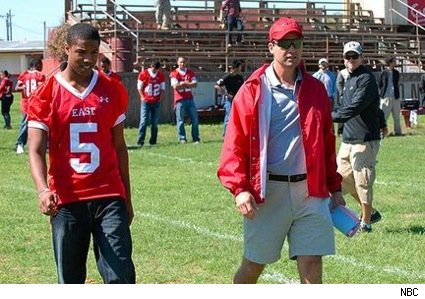
“Friday Night Lights” is one of my favorite tv programs, and the Red Cross is one of my favorite organizations. The show is filming at the Cotton Bowl stadium Friday and Saturday night and are looking for extras; the production is offering to donate $20 to the Red Cross Dallas chapter for each person who shows up to root on the East Dillon Lions.
I realize a) most readers aren’t nearby the Cotton Bowl and b) it’s short notice. But I just heard about it from the Dallas Red Cross Twitter feed and figured I’d post it for anyone in the area. The details can be found on the chapter’s blog, “Red Alert” (which by the way I think is a very clever name for a Red Cross blog).
Vince Howard and Coach Taylor in an episode of “Friday Night Lights”
These icons link to social bookmarking sites where readers can share and discover new web pages.
The Federal Emergency Management Agency is soliciting nominations from citizens for “Individual Achievement Awards” honoring Americans “who have made a difference in making their community safer and better prepared.” According to the Citizen Corps webpage:
“These are people who have given their time and energy, offered skills and capabilities, been leaders in providing education and training, responded to crises and disasters, or simply made a call when they saw something suspicious. As a result, they have saved lives, property, or positively impacted their communities. These are the individuals we wish to highlight and celebrate.”
If you would like to nominate someone for an “Individual Achievement Award,” send an email explaining how that person has made a difference to citizencorps@dhs.gov with “Outstanding Individual†in the subject line by August 15th.
These icons link to social bookmarking sites where readers can share and discover new web pages.
In MIT Tech Review, Christopher Mims writes about a study by Vasileios Lampos, Tijl De Bie and Nello Cristianini of the Intelligent Systems Laboratory at the University of Bristol (UK) about the utility of Twitter for tracking flu outbreaks.
The work builds on research pioneered in 2008 by scientists at Google that resulted in Google.org’s Flu Trends. but according to the article, what’s different about tapping social media instead of search queries is that individual tweets are qualitatively different from search strings, which tend to be quite short:
There are a couple very exciting disaster preparedness and response events occurring in Washington, D.C. at the end of this week — the CrisisCommons Roundtable and the First International CrisisCommons. (I was hoping to attend but my medical treatment prevents me from traveling right now.)Â The good news that if you cannot make it to the Nation’s Capital, you can follow the proceedings on the web.
CrisisCommons, according to its website, “is a volunteer technology community dedicated to bringing together technology, innovation and volunteers to help people and communities in times and places of crisis.â€Â I was lucky to have attended the first CrisisCamp held in Washington last June. Since then, the organization has taken off with CrisisCamps organized all over the world in the wake of the Haiti earthquake and Gulf oil spill. Already, output from the Commons (such as the Oil Reporter) is having a significant impact.
On Thursday, the CrisisCommons and the Woodrow Wilson International Center for Scholars are hosting, with support from the Alfred P. Sloan Foundation, a series of roundtables with crisis response organizations (nongovernmental groups or non profits), members of the private sector and the academic community.
To sign up for the CrisisCommons roundtable series, click on any of these: NGO/Nonprofit Roundtable, Private Sector Roundtable, Academic Consortium Roundtable. If you are a member of these communities and cannot attend, you can provide written feedback or suggestions on their wiki and participate via webcast. (Roundtable Webcast Schedule: 8:15AM EDT – NGO/NonProfit Webcast / 12:45PM EDT – Private Sector Webcast / 3:45PM EDT – Academic Consortium Webcast)
On Friday, CrisisCommons community with support from the Sloan Foundation and the World Bank will host the First International CrisisCongress at the World Bank headquarters in Washington DC. This forum will explore lessons learned from CrisisCamp Haiti and CrisisCamp Chile and the opportunities and challenges of building a sustainable volunteer community whose mission is to use technology tools and expertise to aid communities in crisis.
There are a small number of tickets left to attend the International CrisisCongress in person. To register to attend click here. To attend virtually please click to the Congress webcast beginning at 8:30AM EDT (mms://wbmswebcast1.worldbank.org/live). The CrisisCommons Twitter feed is here.
To give you a better sense of the CrisisCommons concept, I have posted this Current TV segment (below) “Geeks for Haiti”:
Current TV segment on CrisisCommons
These icons link to social bookmarking sites where readers can share and discover new web pages.
Earlier this month, I wrote about Homeland Security Secretary Janet Napolitano’s announcement that the Department was launching a national “See Something, Say Something” initiative.
In order to help develop the new program, FEMA’s Individual and Community Preparedness Division is partnering with the International Association of Chiefs of Police (IACP) to research how to improve the public’s response to suspicious activity. FEMA and IACP plan to present the research findings and recommendations at the police group’s Annual Conference in late October.
I think it is a terrific partnership which recognizes that the while the local “See Something, Say Something” campaigns are viewed as successful, law enforcement authorities are not yet fully tapping the public’s potential as a homeland security asset. The challenge is new, sensitive and requires some careful study both in the content and distribution which I expect it will receive from the joint FEMA/IACP research.
More details on the project should be forthcoming soon, and I will report on them here.
These icons link to social bookmarking sites where readers can share and discover new web pages.