In a new report released on the eve of Hurricane Katrina’s 5th anniversary, the Red Cross details some lessons and improvements that the agency has made in Louisiana and nationally on disaster response since 2005.
The study, “Bringing Help, Bringing Hope,†says the Red Cross has improved response capacity in large part by developing more extensive partnerships with non-profit community groups as well as government; added more pre-positioned supplies; trained many more volunteers; and added technology tools to assist the relief effort.
According to a news release from the Southeast Louisiana Red Cross chapter:
One critical lesson was that the Red Cross needed to increase its capacity to respond and build partnerships with other organizations that can help in large events. As a result, the Red Cross established a nationwide warehouse system and pre-positioned more than two Katrinas’ worth of disaster relief supplies in warehouses—enough to support 350,000 shelter residents. It also enhanced local, state and national-level planning efforts to plan for how it would respond to large-scale disasters and created new partnerships with national, state and local groups to help ensure that all segments of the community are served after a disaster.
In the past five years, the Red Cross expanded the number of trained disaster volunteers from 25,000 to nearly 95,000, including nearly 50,000 available to travel to disasters around the country. The organization also created tools for the public to use during a disaster, including a National Shelter System accessible online, and a “Safe and Well†website to reconnect families during disasters, including through social media.
“The hurricanes of 2005 tested us all,†said [Russ] Paulsen, [executive director of the Hurricane Recovery Program at the American National Red Cross] “Although we’re on better footing than we were five years ago, every individual and community has to be on board in order for our country to be more disaster-ready. There is much more that we as a nation can do. Everyone—government, businesses, non-profits and the faith community—needs to work together to have better prepared communities,†said Paulsen.
The growth of partnerships with non-profit community groups is a topic that I learned a lot about when I had the opportunity to moderate a Red Cross “Town Hall” on the subject in Washington, which included Kay Wilkins, CEO of the Southeast Louisiana chapter.
The American Red Cross is holding a very exciting event in Washington on Thursday and is encouraging interested members of the public from around the U.S. and the world to follow it and participate through the web.
It is the organization’s first “Emergency Crisis Data Summit: Answering The Cry For Help” which will bring together government agencies, emergency management professionals, disaster response organizations and tech companies to discuss how best to harness the communications power of new media to prepare and respond to crises.
The day-long event — whose agenda is here –will be open and broadcast on the internet (more information about the Summit can be found here). You can keep track and take part in the conference using several social media properties:
* It will be ustreamed live via the NextGenWeb site. Register on Eventbrite for ustream details. The archived U-Stream will be available online, too, and on the Emergency Social Data blog. C-SPAN will also be providing coverage of the event.
* You can participate in the Twitter discussion at the hashtag #crisisdata as well as add to or comment on the Summit’s aggregated information via the Emergency Social Data Wiki. There will be a formal Twitter chat at 1 p.m. EDT/10 a.m. PDT featuring questions from @ntenhross and @ikepigott.
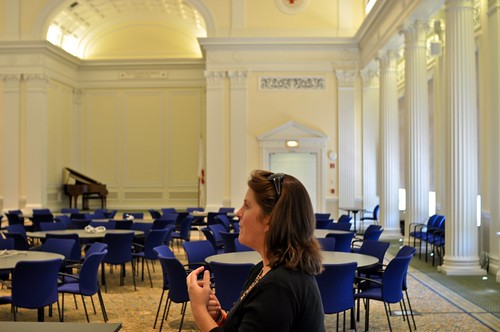
American Red Cross’ Social Media Director Wendy Harman doing a walkthrough at the Hall of Service in Washington where the Emergency Crisis Data Summit will take place Thursday.
These icons link to social bookmarking sites where readers can share and discover new web pages.
I watched an incredible video this morning, “Military Reunion,” which is a compilation of homecomings with soldiers and with their loved ones. All Americans should see this as it underscores the sacrifice of military families. The scenes with kids seeing their parent after months away are amazing. I urge you to watch the 10-minute piece and dare you not to cry.
The University of Maryland’s Center for Health & Homeland Security’s blog has an interesting post on shortcomings in emergency alert systems for the deaf and hard of hearing.
In the post, Nuclear Alert Sirens Fall Short For The Deaf And Hard Of Hearing,” Greg Sunshine points out that in the event of a radiological emergency, people who live within a 10-mile radius of nuclear power plants will hear a system of sirens sound the alert. However, for their deaf and hard of hearing neighbors, the sound of the sirens alone provides no warning whatsoever. He explains:
According to Nuclear Regulatory Commission (”NRC”) regulations, each nuclear power plant must have an emergency notifications system for its surrounding 10-mile “emergency planning zone.” The purpose of the sirens is to let residents know that some type of emergency has occurred, and to tune to their television or radio for specific Emergency Alert System (”EAS”) instructions (the same EAS that interrupts late night television for a weekly test).
Although the Americans with Disabilities Act requires television EAS messages to include closed captioning for the deaf and hard of hearing, without an alternative to the sirens, residents who cannot hear the sirens will not know to check their television in the first place. This creates a significant notification problem for radiological emergencies when getting quick emergency information could save lives.
Although sirens provide no notice to the almost 1,000,000 Americans who are functionally deaf, the NRC inspection manual indicates that sirens are an acceptable means of notifying the populace. In fact, NRC Inspection Procedure 71114.02 – which provides the guidelines for inspecting plants’ alert and notification system – indicates that sirens are the primary means of notification. According to the manual, if a plant’s siren system is adequate, the plant is considered to have met the “notice to the populace” requirement, regardless of how many deaf or hard of hearing residents would receive no such notice.
Though Sunshine points out that there are steps deaf and hard of hearing citizens can take to overcome the notification gap:
On this blog, we’re always looking for ways of making public preparedness more fun and engaging for the public, particularly young people. That’s why I wanted to highlight the work READYColorado’s Disaster Ready Training for middle and high school students. As has been written about here, Colorado has been a leader in youth preparedness initiatives.
One part of the curriculum is the use of “Moulage” which many of you know is disaster simulation makeup. As part of the Disaster Ready program, the student applied the makeup to the adult “victims” who helped out with the last day of training when the students responded to a mock incident (tornado). Moulage is one of the more fun and gruesome parts of emergency management training which I can attest to because I have been an enthusiastic user during our CERT drills.
Students putting Moulage on volunteer “victims” participating in a mock tornado drill (READYColorado Facebook page).
There is a video of the makeup session imbedded in the READYColorado’s Facebook page so I cannot put it on the blog. If you go there, you’ll see the big smiles of the kids as they create huge ugly wounds with many resembling zombies by the end.
Making Moulage part of citizen disaster training makes it more enjoyable and interesting; it also underscores the point that people can handle the possibility of scary injuries. I wanted to highlight this, because maybe it will show citizens — of all ages — that preparedness activities can be fun and even recruit some new volunteers.
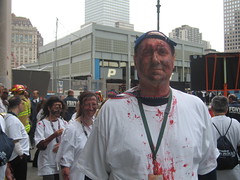
One of my CERT experiences with Moulage as a bombing “victim” during a police training drill near the site of World Trade Center.
These icons link to social bookmarking sites where readers can share and discover new web pages.
With Pakistan suffering its worst flooding in 80 years, I wanted to bring to your attention a web-based, civilian-created effort to raise money and be an information conduit both inside and outside the country on the disaster.
The Pakistan Crisis Wiki was created in 2005 by Pakistani native Sabahat Ashraf, a technical writer living in Silicon Valley, in response to an earthquake in the northern part of the country. He, along with a group of Pakistani bloggers (or “blaagers” as they call themselves) have kept the wiki up posting specific pages for other social issues (including human rights).
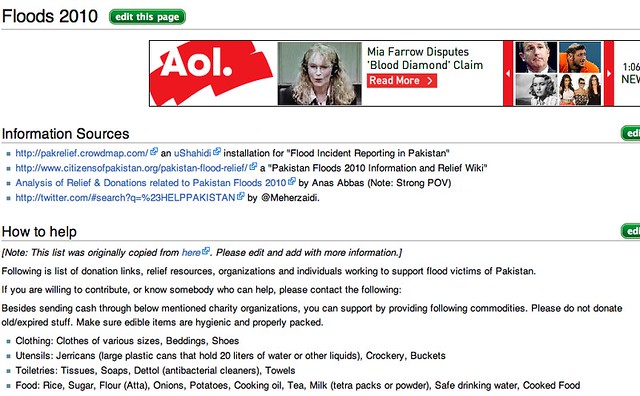
They recently created the Floods 2010 page with information on what is needed from the public in the relief effort. Ashraf also said that the Wiki can help local aid organizations inside Pakistan which do not always have significant web presences.
The Pakistan Crisis Wiki is a terrific example of the kind of technology application that is set up and ready in preparation for a disaster so people know where to go for information. It is very much along the lines of the CrisisWiki that NPR’s Andy Carvin and CrisisCommons have set up (I recommended to Ashraf he get in touch with Andy). And, I encourage you to check out the Floods 2010 Wiki page here.
A screenshot of a part of the Pakistan Crisis Wiki’s “Floods 2010″ page.
These icons link to social bookmarking sites where readers can share and discover new web pages.
A very interesting American Red Cross survey released this morning indicates that many web users would turn to social media to seek help for themselves or others during emergencies—and they expect first responders to be listening.
In fact, 74 percent of those polled expected help to come less than an hour after their tweet or Facebook post.
The Red Cross commissioned the survey in advance of its Emergency Social Data Summit set for Thursday, August 12, in Washington, D.C. The meeting, convened by the Red Cross, will bring together thought leaders and experts in the government, social media, emergency response and the non-profit sectors to discuss better ways to handle information that flows through the web during disasters.
The online survey asked 1,058 adults about their use of social media sites in emergency situations. It found that if they needed help and couldn’t reach 9-1-1, one in five would try to contact responders through a digital means such as e-mail, websites or social media. If web users knew of someone else who needed help, 44 percent would ask other people in their social network to contact authorities, 35 percent would post a request for help directly on a response agency’s Facebook page and 28 percent would send a direct Twitter message to responders.
Web users also have clear expectations about how first responders should be answering their requests. The survey showed that 69 percent said that emergency responders should be monitoring social media sites in order to quickly send help—and nearly half believe a response agency is probably already responding to any urgent request they might see.
As the story I posted yesterday about the Boston subway flasher indicates, not all government agencies are yet monitoring social media.
The survey also found that among web users, social media sites are the fourth most popular source for emergency information, just behind television news, radio and online news sites. More web users say they get their emergency information from social media than from a NOAA weather radio, government website or emergency text message system.
These icons link to social bookmarking sites where readers can share and discover new web pages.
to increase awareness about immunizations across the life span, from infants to the elderly.
August is the perfect time to remind family, friends, co-workers, and those in the community to catch up on their vaccinations. Parents are enrolling their children in school, students are entering college, and healthcare workers are preparing for the upcoming flu season.
Last week, I wrote about the Get Ready preparedness campaign of the American Public Health Association (APHA), which calls for immunization as part of the basic emergency readiness steps. Though immunization is not presented as part of the Department of Homeland Security/Ready.Gov emergency preparedness recommendations (last year with the threat of the H1N1 flu was an exception), including those shots as part of the overall message does make some sense, because it is a more familiar public health action.
It might be a good way to introduce citizens to the emergency preparedness in a less threatening way. Conveniently both National Immunization Awareness Month and National Preparedness Month occur sequentially around the beginning of the school year. (And, the Red Cross suggests that when parents buy back-to-school supplies, they consider adding an emergency preparedness kit to the shopping list.)
Of course, an argument can also be made that adding another step might dilute the Preparedness Month message, particularly if terrorism awareness is also potentially added as was discussed in a recent blog post.
These icons link to social bookmarking sites where readers can share and discover new web pages.
I’m posting another story from today’s Boston Globe, because it is a good example of Twitter as a useful public safety tool, and it illustrates how a good number of government entities are late to the social media party.
The article explains how a Twitter tweet led to the arrest of a man accused of exposing himself on the subway. The transit police chief said a passenger posted a picture on Twitter that led to the suspect. But it got to the authorities somewhat indirectly: yesterday, the Boston Herald reported they alerted the transit police — which is not yet on Twitter — to the tweets about the incident.
The transit police now plan to set up a Twitter account within a month. General manager Richard A. Davey said that although it is not a cure-all, technology can help law enforcement keep passengers safe and secure. “It is not in place of 911,’’ Davey said, “but if there are crimes and people report them, that helps us keep passengers safer.’’
Thanks to David Stephenson (@data4all) for bringing this story to my attention.
These icons link to social bookmarking sites where readers can share and discover new web pages.
A Kansas animal response team held a fun and creative way to promote preparedness — a “Dog Wash” that doubled as a pet readiness event/fundraiser. According to an article in The Wichita Eagle:
Members of the Sedgwick County Animal Response Team (SCART), a nonprofit organization dedicated to educating the public about how to handle pets during disasters, were on-site washing away summertime smelliness, clipping nails and pulling out sticker burrs.
For a suggested $20 donation, dog owners left with fresh-smelling pets and a packet of information instructing them how to prepare for an emergency.
A cocker spaniel named Dexter gets a bath on Saturday The dog wash was a benefit for the Sedgwick County Animal Response Team. (Photo: Travis Heying/The Wichita Eagle)
According to the article, SCART’s first big challenge was helping after the Greensburg tornado, which illustrated the need for public education on animal preparedness, according to the team director, veterinarian Christen Skaer: