The questioner urged Fugate to move CERT from the Department of Homeland Security to FEMA’s jurisdiction. Fugate  was able to answer, with smile, “Done,” noting that he now oversees the program which trains citizen teams to assist during emergencies. That answer was easy. However, Fugate knows that determining and then making the necessary changes in CERT to make it most useful for FEMA, local authorities, the citizen volunteers and the nation will not be as simple.
Fugate said that FEMA is considering major changes in the program, including creating a shorter training course which could be offered to more Americans and significantly expanding CERT training for schools and other youth groups in order to better imbed preparedness into society for the long-term.
The CERT program faces a good news/bad news situation, according to Fugate. There are just not enough emergencies in which the civilian teams can take part in. Without activity, it is difficult to keep the citizen volunteers energized, interested and trained.
“Here’s the problem,” he explained, “People say I’ve taken all this training and there are no disasters. Well that’s good thing.” Maybe for the nation as a whole but not for the strength of the CERT program. (The C-SPAN video of Fugate’s speech is here.)
FEMA and local emergency management officials have to answer, in Fugate’s words, “a perennial question we run into: after CERT training, what’s next?”
And more importantly what’s next for the CERT program as a whole?
FEMA Administrator Craig Fugate talks about the CERT program at the Red Cross’ Emergency Social Data Summit on Thursday.
As Fugate correctly diagnoses, there is need for some changes in the program. Right now, in most places there is just not enough work for CERT’s to do. It is a theme that I also hear from members around the nation who contact me through the blog, and I see from my own experience as a CERT here in New York City.
But while CERT teams are not getting enough business, Fugate is bullish about a larger market for preparedness training among the general public.
“We’re looking if there are ways we can take the CERT training and break it up. A lot of [business and social] groups have approached us and said we think this is really great but attention span of our audience won’t get you there. [At present, the CERT training is 20 hours, usually taught over 10 weeks.]Â But if you could give us 2-4 hours and we could give you our group what could you put together for us in that time that would empower and train people not necessary not to the level of CERT.”
From my experience both serving and reporting on CERT, the idea of spreading its resources out more broadly through the community for adults and kids makes a lot of sense.
One question is how the government should organize this new horizontal model of citizen preparedness training. What should stay under CERT? Should these new ideas (shorter training for adults, kids) be put in another high profile civilian volunteer preparedness or resilience program?
I’ve always felt that CERT training is less about the skills you learn and more about awareness about the community and the various emergency authorities (and identifying citizen crisis organizers in advance). To me, CERT is just basic citizenship training for the 21st Century, which I think every American should get a chance to receive. I might suggest that the smaller reduced curriculum be called something along the lines of “Citizen Resilience Training”.
The overarching philosophy of CERT is terrific: take advantage of citizen’s desire to want to help in crises and their ability to be useful. I believe that interest is even more robust since 9/11, Katrina and with other threats on the horizon. (The rapid  growth of the CrisisCommons citizen technology initiative over the past year is just one example of how much public interest there is to assist in emergency situations.)
An extensive survey done by the Citizen Corps (which oversees the CERT program) found that almost two-thirds (64%) of Americans say they would be willing to take a 20-hour training class to assist their community recover from disasters. The 64% figure was striking to me, because it points out an interest of many Americans to become more knowledgeable in emergency preparedness/response. That’s not to say that two-thirds of the population want to join the CERT program, but it does seem to indicate that a lot of Americans would be amenable to some sort of disaster education/training — particularly it was held in their workplace, house of worship, social club, etc.
Now, there are some communities around the U.S. where CERT teams are more fully engaged with activities than others. When I asked readers last month for their thoughts on CERT, Paul Garth from an Ojai, California team said it was up to the members themselves to go out and find things to do, which his group had. To some extent, Garth is right that CERTs themselves should try to develop ideas, but it can also be difficult because they are usually dependent on government emergency officials.
One question is whether the expectations for CERT service be more clearly delineated. There are no ‘cuts’ for anyone who passes the training, and then there are some members who go to every meeting and assignment and others who never show up. It can be difficult to keep a cohesive, engaged group going when some of the team — particularly when it involves sensitive emergency activities — are not fully committed.
It might make sense to have a better-trained CERT civilian group along the lines of another Citizen Corps program, Medical Reserve Corps, which is comprised of volunteer medical personnel. That might make government officials more comfortable in integrating CERT volunteers into its activities like a police auxiliary.
Fugate’s idea of broadening CERT-type training may be most useful when it comes to a younger generation. He believes that if the nation really wants to change social behavior on preparedness it needs to do so with the younger generation — who are not only more impressible than adults but are more likely to influence their parents and will also have a more long-term influence.
It would also be an opportunity to include preparedness into the curriculum in the schools where Fugate believes a culture of preparedness has the best chance of becoming imbedded. One useful historical model is the commitment to school-based fire education after the 1974 publication of the national “America Burning” report. In some cases, youth preparedness/CERT training can piggy back on these existing classroom programs.
Fugate mentioned that there are some excellent CERT programs for young people in parts of the nation. I recently wrote about interesting youth initiatives sponsored by READYColorado and the Colorado Division of Emergency Management, including the creation of a teenage ‘Social Media Response Team’ to help the authorities and the public during disasters. Eastern Michigan University has also taken leadership in developing Teen CERT programs in a number of states
I believe that a decision to expand CERT-type training in the schools would be welcomed on a bipartisan basis. In an interview I did with former Bush Administration Homeland Security Secretary Michael Chertoff last year he agreed that a key to creating a long-term prepared nation is to focus on schools and kids. In the discussion, he sketched out two suggestions  – a “minimum†and a “maximum†approach. The “minimum†would be “to get the fire management and emergency management people to come together to create a program to be exported to the schools on basic preparation.â€
Chertoff’s “maximum†option is that there be a more substantive course developed for U.S. schools on planning and preparation, which would include teaching “basic skills”. It would almost serve as a very limited albeit useful national basic training.
“If you’re not going to have a national service then as part of graduation from high school there should be a course over a period of time that teaches you the kind of basic things you might need in an emergency,†Chertoff says, adding “It’s going to do two things. It’s going to create a cadre of more capable people, but it is also going to demystify the process of preparation. Most people are intimidated that they don’t know how to do it. They’re afraid of being embarrassed.â€
As FEMA officials examine what to do with CERT going forward, I imagine they will be undertaking an analysis of the future need and demand. Though it is a very well-intentioned idea — and I have really enjoyed and learned from my CERT work — there may well be that there a limit to what moderately trained part-time volunteers can really do in the official emergency services world. Maybe the bulk of CERT volunteers who are willing to commit just to the basic training and limited participation would be better to be transferred to the disaster services unit of Red Cross chapters from around the U.S.. which is busier with fires and local emergencies.
I recommend that FEMA Â should also reach out to some CERT team leaders/members in communities around the U.S. as government officials do not always know what is going on within the CERT teams (as this blog post from state emergency management official Mark Chubb underscores).
To me, civilian CERT members can best serve the community by being, in Fugate’s words, preparedness “ambassadors” providing information and guidance to their neighbors. When it comes to citizen preparedness, there is a real need for explanation and modeling, and CERT members can be hugely helpful in part as emergency management offices don’t always have the time always the inclination to do so. Further, the growth of social media platforms underscore the value of friend-to-friend, peer-to-peer education both before and during emergencies.
I received a thoughtful e-mail last year from the State of Florida’s former CERT coordinator Bill Firestone who served under Fugate in which he elaborates on the value of the “ambassador” role.
While it’s very unlikely that most CERTers will participate in a mass casualty triage or perform in pairs in fire suppression, CERTers will talk to their neighbor, participate in their children’s schools, attend neighborhood activities. Consequently, they can reach out to people that government and non-profit preparedness messages cannot reach or it is too expensive.
In my role as a “CERTerâ€, here in Florida, I am reaching out to neighbors and talking to them about the network of non-profits in disaster and the importance of knowing what services and assistance they can provide before and after disaster. Here in hurricane-prone Florida I have begun to send along the url for information about the importance of completing an SBA loan application and how that is tied to receiving additional disaster assistance. Most of my neighbors that have incurred damages to their house have been told about the low-interest loans following disaster, but not aware of the other benefits to completing the application.
If you have any thoughts on FEMA’s reevaluation of CERT, I’d love to hear them.
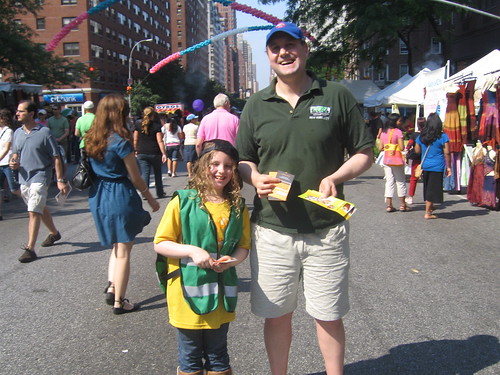
Handing out preparedness information at a Manhattan street fair with my own youth CERT in training.
These icons link to social bookmarking sites where readers can share and discover new web pages.
President Obama and his family travelled to the Gulf Coast on Saturday to take a dip in support of the area’s recovery from the oil spill disaster. The willingness of the swimmer-in-chief to jump in literally and figuratively and even take his family in sent a strong message, amplified by the huge media coverage, to the public about the Gulf. These types of photo-ops are an important presidential function, though I think the power of the image here comes in part because it also involved his role as a father as well
So, of course, this blog must ask what kind of activity/photo-op could President Obama undertake to promote citizen disaster readiness for National Preparedness Month which starts in just two weeks? I think it would be great for the President to undertake a similar high profile event (also ideally involving his family in some small way).
My suggestion: have the President create a mock family emergency communications plan.
President Obama and daughter Sasha show they are not afraid of the post-oil spill Gulf water in Panama City, Florida. (Photo: White House)
Obama will undoubtedly issue a proclamation at the beginning for National Preparedness Month. But he — like his predecessor George W. Bush — has not done a public family preparedness event to promote the issue with the media and the citizenry.
One activity that might make sense is for the President to start on a rough mock family communications plan as a model and inspiration for other American families. This would be very appropriate since his FEMA Administrator Craig Fugate said in an interview with me on Friday that if he could get the public to do one thing this National Preparedness Month it would be create their own family communications plan.
It’s actually a topic he’s raised before. During a visit to FEMA last Spring at the start of hurricane season, the President made a very strong statement calling preparedness a responsibility of citizenship and specifically urging Americans to make a family emergency plan:
“…one of the most important things we can do is make sure the families have prepared appropriately. We just saw some statistics coming out of Florida indicating that a huge percentage of people in hurricane areas simply don’t make plans. They don’t have a plan, they don’t have a set of contingencies that will allow them to respond in an effective way. Those people who have the capacity to plan, they will thereby relieve some of the resources that the government has to provide and we can stay focused on those folks who are most vulnerable and have the most difficulty dealing with a storm. So I hope that message of personal responsibility sinks in.â€
Now, obviously the President of the United States does not have to worry about an emergency communications/evacuation plan (as he happens to have an entire agency, the Secret Service, dedicated to that exact challenge). But the other 112 million or so  American households do not have that support system in a disaster, and it can be daunting to begin that process themselves.
But if Obama raised went through the disaster planning process even in a very broad way it would significantly increase the profile of the issue and the task. He wouldn’t need to get into his own family’s personal specifics at all but just go through the some of the steps recommended on Ready.Gov “Make A Plan” section, including:
setting up an out of town contact, learning how to text message, subscribing to local alert services, trying Ready.Gov/Ad Council’s online planning tool, picking places where your family will meet, both within and outside of your immediate neighborhood, checking with work and school (no mention of the Obama kids’s school of course) about their emergency plans, and planning for your pets.
Having the President do something rather than just say it would signal to the public and the media that he feels the objective of family preparedness is really important. Now, I understand there are sensitivities about bringing the First Family into the public discussion, but this would not be an actual plan and could be done very generally and half tongue-in-cheek (Obama could say that I’m hoping I won’t need to use this for six more years not two!)
And, as I have written recently, there is a real need for the emergency management community to include far more personal stories and modeling in its disaster preparedness messaging in order to more directly and effective engage and guide the public. This would personalize preparedness from the top.
In the almost nine years I have covered the issue of citizen preparedness, one of the things that has confounded me most is how political leaders have generally ignored the issue. There is not one major elected official who has identified public disaster readiness as one their top issues (despite the fact that even the smallest interest has a political backer in Washington). To me, it’s amazing that no one has taken up leadership considering the number of major emergencies that have either occurred or threaten the nation, and the fact that preparedness — unlike most issues — should be a bipartisan, community-building, patriotic apple pie issue. So, in the absence of political, media and public focus at present, to have President Obama take the time to do a high profile event would be hugely helpful in jump starting citizen interest and action.
“I’ve said it time and time again, and I will continue to say it: personal disaster preparedness is and must be a national priority, and every elected and appointed official at every level of government must make it a priority.”
Obviously, the President already has many pressing issues on his plate, but if he does indeed feel that preparing for disasters is indeed “a responsibility of citizenship” as he said last year (and I totally agree with him) I would think it is worth a public appearance and a high profile photo-op demonstration. And as an added bonus, it will give him a chance to get a start on the civilian-life Obama family communications plan whenever they end up needing it.
These icons link to social bookmarking sites where readers can share and discover new web pages.
Readers of this blog know I am a sucker for creative, fun preparedness events that involve business, community groups, government and the public — and also educate on emergency readiness.
Thursday’s Canadian Red Cross “Disaster Dining” contest — in which competitors had 30 minutes to prepare their best dish using only foods that would be found in an emergency preparedness kit — fits that bill. The Toronto event launched a 3-week in-store campaign at Walmart in support of Canadian Red Cross local disaster relief operations.
When all the food had been tasted, Walmart District Manager Eeva Jalo took home (or to her office) the coveted 1st annual Golden Spoon award. Her dish — a combination of salsa, tuna, chickpeas, parsley, and cayenne and black pepper — beat out a group of aspiring top disaster chefs with a number from the first responder community. The other — apparently tasty  – entries included Chief of Emergency Management Ontario Dan Hefkey’s ‘Tex-Mex’ corn, crab and salsa filling in a soft taco shell.
Walmart District Manager Eeva Jalo shows her prestigious Golden Spoon award.
The idea for the competition came from a Red Cross staffer, Jen Mayville, who initially held a party “to experiment to see what sort of dishes we could create in a disaster-type situation. We got together for a dinner party and each made one dish with the following guidelines: No electricity could be used in the cooking process, No tap water, Only non-perishable food.” The cook-off came out of that evening. The Atlantic Canada chapter held a similar contest earlier this month.
Eeva Jalo’s Golden Spoon winner was made from tuna, chickpeas, salsa and spices.
These icons link to social bookmarking sites where readers can share and discover new web pages.
On the Amtrak train back to New York City Friday night from Washington, I saw something and said something — but this tip was good news.
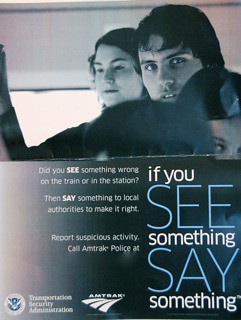
The Department of Homeland Security (DHS) has just begun rolling out a national “If You See Something, Say Something” campaign, and I saw its new advertising posters in many of the cars. I had been at DHS headquarters earlier in the day hearing more about the new launch from officials managing the program. They weren’t sure how extensive distribution has gotten thus far, and my e-mail tip confirmed that the ads were at least up all over my train. Below are a couple of the new posters hot off the presses:
A new “If You See Something, Say Something” poster just going up on Amtrak trains aimed at the public.
The new measures are based on recommendations made by the Homeland Security Advisory Council’s (HSAC) “Countering Violent Extremism†Working Group—comprised of chiefs of police, sheriffs, community leaders and homeland security experts—on ways DHS can better support community-based efforts to combat violent extremism in the United States.
Expanding the community and citizen role in homeland security has been encouraged by the blog, and I think it is a terrific development. Most of the new initiatives are directed towards bolstering the work of state and local law enforcement organizations — including a series of regional summits beginning this fall on successful community-oriented policing and other crime reduction programs. But Napolitano also announced some proposals focused directly on the public, most prominently the expansion of “See Something, Say Somethingâ€.
In the coming months, DHS will continue to rollout the campaign nationally the U.S. with public education materials, the poster ads and other outreach tools to engage travelers, businesses, community organizations and public and private sector employees to remain vigilant and play an active role in keeping the country safe. The focus on the state, local and public reflects an increased threat coming out of communities from around the U.S., which might not fully hit the national intelligence radar.
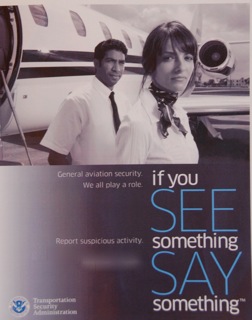
Poster for general aviation locations
The campaign posters will begin to become ubiquitous in the transportation sector, including on trains, general aviation sites and soon on buses and subways. It has been developed to be customizable by location. For example, in cities one of the taglines is:Â ”did you see something suspicious commuting to work or grabbing some lunch” along with a local contact phone number. Officials from many sports facilities and college campuses have also expressed interest in taking advantage of the campaign for their locations.
The new blue “if you SEE something logo SAY something” logo — which is a little softer and less visibly urgent than the original New York executions with yellow background and block black lettering (but now also blue) — was created by a designer at the Transportation Security Administration. If you’ve ’seen’ the new ads yourself, what do you ’say’ about them?
These icons link to social bookmarking sites where readers can share and discover new web pages.
The U.S. State Department’s blog, Dipnote, this weekend is promoting text donations for Pakistan flood relief. It is also asking for public input on this question: How can we encourage the international community to maintain focus on natural disaster response?
How you can help: …Please visit the links below for more information about aid organizations operating in the areas mentioned. U.S. citizens can also still text “SWAT” to 50555 to donate $10 for flood relief in Pakistan.
2010 has seen natural disasters strike around the world, from the devastating earthquake in Haiti at the start of the year, to recent mudslides in China, wildfires in Russia, and flooding in Pakistan.
The United States has joined with the governments of these countries, as well as with nations, NGOs, and citizens around the world, in rushing humanitarian relief and assistance to where it is needed most.
How can we encourage the international community to maintain focus on natural disaster response after the initial crisis has passed?
Dipnote last week asked readers for “Innovative Ways The International Community Can Respond To Natural Disastersâ€.
(UPDATE: The State Department website has posted a list of ways that people can assist Pakistani flood victims here.)
These icons link to social bookmarking sites where readers can share and discover new web pages.
Andrew Revkin’s terrific DotEarth blog has two interesting posts this week with contributions from two experts on disasters and resilience.
1) In “Lessons In Resilience From New Orleans,” Robert Kates, a scholar studying human development patterns, offered some lessons on building resilient communities derived from the history of New Orleans. The lessons are:
The United States is vulnerable to enormous disasters despite being the richest and most powerful nation on earth, creating community resilience is a long-term process, surprises should be expected, the  best scientific and technological knowledge does not get used or widely disseminated, Major response capability and resources were invisible, refused, or poorly used, Disasters accelerate existing pre-disaster trends, overall vulnerability to hurricanes has grown from multiple causes, and efforts to provide protection reduced vulnerability to frequent small events but increased vulnerability to rare catastrophic events.
In regard to citizen involvement in developing that resilience, Kates argues:
In coping with extreme events from climate change and other hazards, there is much talk of partnerships. In every disaster there are unanticipated or unaddressed needs and “shadow responders†often emerge from households, friends and family, neighborhoods, non-governmental and voluntary organizations, businesses, and industry. In responding to Katrina, they were sometimes refused or poorly used by government officials, even though they provided most of the initial evacuation capacity, sheltering, feeding, health care, and rebuilding, and much of the search and rescue, cleanup, and post-Katrina funding. For resilient communities, in advance of hazard events, the tri-level system (city, state, federal) of emergency response needs to welcome, effectively use, collaborate with, and coordinate the combined public and private efforts.
A new study  says “individualistic” Americans may be too optimistic about the risk of disasters, including terrorism, as opposed to more “interdependent” cultures such as in Asia. The report argues that the perception of disaster risk is influenced by culture more than experience.
It may help explain why many Americans still do not prepare for disasters (and, by contrast, Japan and China hold special disaster preparedness days for its citizens). It also may underscore the challenge — as well as the need — of building community preparedness in the U.S.
People from different parts of the world rate differently their risk of dying or getting injured in a disaster, and this has more to do with cultural factors than actual exposure to an event, suggests research published online in Risk Analysis. It also indicates that people across cultures share a belief that they are less prone to harm than others around them…
Unlike risk assessment, which is based on objective information, risk perception tends to rely on a person’s psychological state, personal experience and socio-cultural factors. Cultural values influence which hazards are believed to be relevant to a group, the authors explain. “Members of a group construct shared meanings to explain the reasons behind hazardous events to promote a sense of stability and allegiance within the group.â€
Researchers measured and compared risk perceptions between 365 mental health workers from Japan, Argentina, and North America — countries that represent different degrees of interdependence and histories of exposure to disaster:
There was a whole lot of information, ideas and energy among the 200 attendees at the Red Cross’ Hall of Service in Washington and the hundreds of others who joined remotely from around the U.S. and the world. Red Cross’ CEO Gail McGovern summed up the event very well late in the afternoon when she said “my brain is exploding” from everything she took in during the day. (C-SPAN filmed the parts of the conference, which can be found here.)
I thought I would ask one of the Summit organizers, Red Cross Social Media Director Wendy Harman, for her initial thoughts on the day and the next steps. In the five-and-half-minute video below, Harman offers a nice summary for those who were not able to attend in person or remotely. Harman discusses the goals of the conference including identifying and raising awareness of the gaps in disaster response, reaching consensus on what can be done to address the issues, and beginning to determine future action items. She hopes the event helped get the attention of the emergency management and non-profit community of the potential of technology to assist and tap the capacity of regular citizens in crises.
American Red Cross Social Media Director Wendy Harman Discusses The “Emergency Social Data Summit”
As far as future steps, Harman says that the Red Cross will be going through and analyzing all the discussions both inside the conference room as well as online. It will be reporting out the findings by completing the Summit White Paper whose initial chapters can be read here.
Those interested in the follow-up, Harman says, should check the Summit wiki (which now has the reports of roundtables both at the event and on Twitter with some initial ideas on proposals and priorities). Harman says she hopes anyone who has some ideas should contribute them to the wiki.
Harman also raises an interesting idea that was discussed throughout the day — should there be a 4th basic citizen preparedness step added to “Get A Kit”, “Make A Plan”, & “Get Informed” along the lines of “getting to know your community” which might range from asking citizens to store emergency numbers in their mobile phones to personally connecting with their neighbors in advance of an emergency situation.
I think this is a good idea which both captures the need to integrate new technology into preparedness recommendations and also better highlights the fact that personal community building should featured more as a key citizen disaster resilience objective. I have written often about to need to better define what ‘preparedness’ means for the public, and I believe this proposal should be part of those discussions.
These icons link to social bookmarking sites where readers can share and discover new web pages.
After his well-received speech to the American Red Cross’ “Emergency Social Data Summit” yesterday, I had a chance to interview FEMA Administrator Craig Fugate.
I asked him about the role of social media in disasters, how he has benefited from having (and tweeting on) his own Twitter account, and what he wants to accomplish during the upcoming National Preparedness Month in September. The four-and-half-minute video is below.
My videography does leave a little bit to be desired (the shakiness was not the result of a sudden earthquake in D.C. though there were some powerful storms in the area, and there is also short break in the interview after the first question as I fiddle with a sticky Flip camera button. (I am a little out of practice having not shot a video for the blog in 7 months.)
In the video, which was shot in the kitchen of the Red Cross’ Hall of Service, Fugate says:
* social media provides FEMA and other emergency management agencies the chance to get 2-way input from disaster survivors to better shape response to their needs in a crisis. He notes FEMA is trying to offer emergency information to the public in “flexible” formats that match how they will be using it before and during a disaster (such as on their smartphones).
* his Twitter account @CraigatFEMA (and he does his own “tweets) helps “get rid of the mystique of being an administrator of a federal agency. There always seem to be these barriers between you and interacting with people everyday.”
* for National Preparedness Month, he wants Americans to do at least one thing: create an emergency communications plan for their family. Fugate says that sometimes authorities make preparedness too complex and believes developing a family plan — described on most emergency management websites — is a good disaster readiness “first step”. (He also slips in some nice words about this blog in this answer, which were totally unsolicited but very much appreciated.)
FEMA Administrator Craig Fugate talks about social media, preparedness and the public.
(UPDATE: Ed O’Keefe who writes the interesting “Federal Eye” blog for The Washington Post was at the Crisis Data event and just did a post about the Fugate interview here.)
These icons link to social bookmarking sites where readers can share and discover new web pages.
I am in Washington this morning and was about to walk over to the American Red Cross’ “Emergency Social Data Summit” when –Â maybe appropriately considering the topic of the event — I received on my BlackBerry from the District of Columbia’s Emergency Management Agency’s AlertDC “Flood Warning” and “Severe Thunderstorm Watch” e-mail/text:
National Weather Service has issued a Sever Thunder Storm warning for the District Of Columbia and Metropolitan area. Scattered showers & Thunderstorms will affect the Washington area until 745AM Thunderstorms will contain cloud to ground lighting along with Locally heavy rain hail size of quarters with damaging winds in excess of 60MPH Storm moving southwest at 25MPH
Though the participants do not need any more motivation, the weather will only underscore the need for this summit. You can follow and participate in the conference remotely. More information on doing so and the conference can be found in yesterday’s post. I will be writing about the event later in the day.
These icons link to social bookmarking sites where readers can share and discover new web pages.




![Pakistani villagers stranded by flood water wait be evacuated, Sanawan, Pakistan, Aug. 5, 2010. [AP]](http://blogs.state.gov/images/Dipnote/behind_the_scenes/2010_0813_pakistan_flood_victims_m.jpg)
