With my chemotherapy finished, I have had the time and energy to participate in several Community Emergency Response Team (CERT) training sessions being offered by the New York City’s Office of Emergency Management (OEM) which oversees our CERT program. I ended up completing three in the same week (in addition to the drill at the the World Trade Center site). Two of training sessions were held at OEM headquarters which is located at the foot of the Brooklyn Bridge; the other one I did online:Â
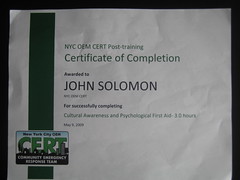
1) Cultural Awareness/Psychological First Aid — Among the objectives of this three -hour course is to “provide a heightened awareness to the cultural diversity of NYC and how that relates to being a member of CERT and educate attendees on the psychological and emotional effects of disaster work and how that may affect you, your team members, and the survivors you may assist.” A group of about thirty CERT members from throughout the City heard presentations from two experts from the Department of Health and Mental Hygiene. One presentation was “Mental Health Implications of Emergencies and Self Care for CERT Responders,” and the other was “Enhancing Cultural Competence in Disaster Response.”
We also broke into groups of five to prepare a scenario and present it to the rest of the class. Our scenario was very timely in light of the H1N1 outbreak as it involved CERT members being asked to staff a Point of Distribution (POD) to give out medicine to the public. The scenario asked how we as CERT members would deal with a request to report to a POD for a 12-hour shift if our husband/wife/partner was out of town and we had three children at home. In our group, we discussed how that would involve a tension between being a CERT member and a parent. Most of us would feel responsible to our family first, but we raised the possibility of finding a neighbor or family member  to babysit our kids or alternatively bringing them to the POD as they would probably need to get the medicine as well.
Scenarios are a great way of putting you into a situation and raising questions that should be addressed in advance. One of the takeaways that came out of our group was that we felt individual CERT teams should be discussing the issue of how members should deal with a situation where they are deployed but might have child care or other domestic responsibilities.
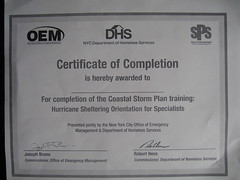
2) Coastal Storm Plan Training: Hurricane Sheltering Orientation For Specialists –Â This training is done completely online. It is a very interesting exercise for CERT members who might be asked to staff an evacuation shelter in the event of a major storm in the New York area. City officials have developed a comprehensive coastal storm plan which CERT members play an important role. A couple years ago, I participated as a “storm evacuee” during a major hurricane drill in downtown Brooklyn so I was somewhat familiar with sheltering procedure. However, this interactive training offered detailed descriptions of the different responsibilities a CERT member might have during a storm emergency. Throughout the web training, users are given various tricky situations that would come up and asked to come up with the right solution.
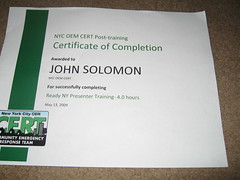
3) Ready NY Presenter Training — The third class I completed was focused on training CERT members to offer public preparedness presentations in the community. It aims to “introduce you to the concepts of the Ready New York program such as Knowing the Hazards, Making a Plan, Evacuation and Sheltering in Place, Creating a Go Bag, Creating an Emergency Supply Kit and Staying Connected;Â Review basic instruction techniques;Â Give you the opportunity to practice your public presentation skills;Â Prepare you to participate in Ready New York presentations and events throughout New York City.” Initially, a couple of OEM officials briefed us on the basic Powerpoint Ready New York presentation and offered us some speaking tips. We all were then broken up into groups and asked to present a few of the slides. We will soon be receiving evaluations from the OEM staffers who observed our presentations. I hope to have the opportunity to do some Ready New York presentations in the near future.
As you can see in above photos (taken by my daughters), after completing each of these trainings we were given graduation certificates. First of all, at our ages it’s nice to be called a graduate of anything. But more importantly, these certificates, as I have written about before, are a small tangible recognition that make volunteers feel good about their service and help engender a team spirit among CERT members.
These icons link to social bookmarking sites where readers can share and discover new web pages.
The Safe America Foundation is launching a new campaign, “Drill Down for Safety,” designed to “create local practice drills on an annual basis in communities large and small to assure that Americans are prepared for disasters.”Â
The nationwide campaign will focus initially on getting businesses — small, medium-sized and large — to organize emergency drills during September 11th. According to Safe America official Bob Surrusco, the organization will be creating three scenarios — a power outage, a flood, and a pandemic — for participants to use in their exercises. ”Getting people to practice – just like staging a fire drill,” the Safe America website explains, “will be a first step in making executives, families, disabled, senior citizens and children feel empowered – and convinced – that in an emergency, their actions can both protect their lives and minimize property loss.”
This video provides more information on the campaign:
Â
A video (above) describing the “Drill Down For Safety” Campaign.
The Safe America Foundation is a 501(c)(3) non-profit organization with headquarters in Marietta, Georgia. Founded in 1994, the foundation partners with corporate, governmental, public and private sector organizations, and other nonprofits to improve the safety awareness and preparedness of Americans nationwide. If you are interested in getting involved in the “Drill Down For Safety” campaign, contact Bob Surrusco (bsurrusco@safeamerica.org) or Joel Mendelson (joel.mendelson@safeamerica.org).
These icons link to social bookmarking sites where readers can share and discover new web pages.
The U.S. Department of Homeland Security’s Ready.Gov program and the American Red Cross are adding mobile phones and chargers to its recommendations for basic supplies in citizen emergency preparedness kits. This marks both a real and symbolic step for wireless communications and social media in public emergency preparedness and response.Â
The Red Cross has already changed its “Be Red Cross Ready” sheet which provides the “minimum” basic supplies every American should have to prepare for a disaster. DHS will make the changes to its Ready.Gov website later in the week, Ready’s acting director Rebecca Marquis confirmed today. The addition of mobile phones and chargers to the list is something that this blog has advocated.
Marquis says that the proliferation of cell phones and their value as a communications asset for citizens in emergency situations were the main reasons for the change. She says that the Ready.Gov website will also explain ways a mobile phone can be used in a disaster (e.g. text messaging when circuits are overloaded), and the site will also suggest that citizens add an ICE/In Case of Emergency entry to their mobile address books.
The move comes as mobile communications and social media are becoming increasingly central to public disaster preparedness and response. In fact, with information so important in an emergency, it can be argued that a mobile phone may be a citizen’s most valuable disaster tool. There had been some hesitation in the past about including mobile phones in minimum recommendations due to “digital divide” concerns, but their widespread proliferation has made that objection anachronistic. The need now is to explain to the public how best to use their mobiles in emergency situations. As I have witnessed first hand, including at a Red Cross relief shelter, having a phone charger is also very important, as would be an extra cellphone battery.
Credit for the web site changes should go in part to Boston-based homeland security consultant and blogger David Stephenson who has been in the forefront of promoting the use of wireless communications and social media in disasters. Stephenson interested the The Wireless Foundation, which had been involved in getting Amber alerts distributed wirelessly, in the subject. And, they collaborated on a very useful guide, the “VITA Advisories”, for using mobile phones in emergencies. Over the past couple years, the Foundation has been actively pushing for governmental and non-profit preparedness sites to include mobile phones. Mobiles are also a way that citizens have accessed social media applications, such as Twitter, in disaster situations. And, I would expect that social media will be increasingly integrated into government preparedness websites in the near future.
These icons link to social bookmarking sites where readers can share and discover new web pages.
On Sunday, I participated in “Operation Safe PATH 2009,” the largest terrorism drill in New York City since 9/11. I was one of approximately 150 Community Emergency Response Team (CERT) members who played bombing ‘victims’ for the exercise.
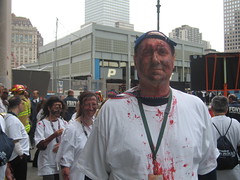
I am standing outside the PATH train station near the site of World Trade Center along with other CERT “victims”.
The New York City Office of Emergency Management (OEM) and Port Authority of New York and New Jersey hosted the full-scale, multi-agency two-hour exercise to test the City’s and the Port Authority’s response to an Improvised Explosive Device (IED) detonation on a New Jersey-bound Port Authority Trans-Hudson (PATH) train.
More than 800 emergency responders participated in the simulated response to two explosions on a train in one of the PATH tunnels between the World Trade Center and Exchange Place Station in New Jersey. The exercise focused on the integration of PANYNJ and New York City assets and tested the decision making necessary to save lives and protect the public. Specifically, the exercise tested on-site incident management, search and rescue, mass casualty medical support, intelligence and investigation, and tactical interoperable communication. The drill was modeled after the July 2005 subway bombings in London.
The volunteer ‘victims’ in the drill were CERT members from throughout New York. Last Monday, there was a three-hour “Actors Briefing” in which OEM, fire and police officials gave us an overview of the exercise as well as the do’s and dont’s for volunteers in an emergency drill. We were asked to report to a school near the train station at 5:00am, three hours before the scheduled start of the exercise. After a short briefing from our drill “Controllers”, we were given our official plain white t-shirts, divided into groups and provided “moulage” by makeup artists with varying levels of wounds. I had a pretty severe looking one: a major cut to my forehead caused by piece of glass — which was attached to my face — along with a lot of imitation blood and grime.
CERT members have “moulage” applied to them with varying wounds before the exercise started.
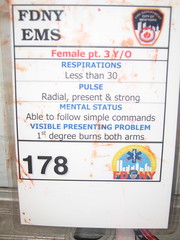
(There were a lot of memorable images from the day for me, but one of them is definitely having make up applied by a man with a gun.) Earplugs and a light sticks were handed out in case we needed it in the tunnel. We were also given a card with our victim profile with details on our “condition” for the role we were playing. These were worn around our neck so the responders could see what our situation was. However, my role was changed before the exercise started. So instead of a 3-year-old girl with 1st degree burns, I became a 45-year-old bleeding man with a piece of glass in his forehead.
Each of us received a card with our ‘victim profile’.
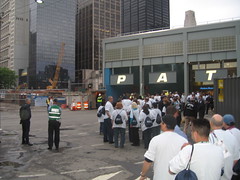
The CERT team members then all left the school and walked a couple of blocks south towards the World Trade Center site and the PATH train station so we could get into position.
All the CERT members lining up to go down inside the train tunnel for the drill.
We were led by our controllers through the station turnstiles and down into one of the track tunnels. We walked about 200 yards or so on the tracks before going into a small enclosure underneath where Tower 1 of the Trade Center once stood. Our job would be simulating passengers coming off the front of the train after a bomb had exploded. (There were train cars farther into the tunnel where other CERTs were). We waited just off the tracks until the actual exercise began, and the makeup artists dropped in and freshened up our “injuries”. At just about 8:00 the walkie talkies of our controllers indicated that the drill had begun; soon after, we saw the first wave of heavily-garbed emergency responders heading past us towards the train.
After the train ‘explosions’ we watched as the initial emergency responders in special Hazmat suits walked past us on the tracks and towards the incident.
We were then instructed to begin our self-evacuation back up the tracks as simulated smoke was being pumped into the tunnel. Those of us with green tags could walk on their own, while others with yellow tags needed assistance. My CERT team colleague Will Sanchez (one of six volunteers there from my ESNA-CERT team) and I helped carry a woman with a yellow tag along the tracks until rescue workers with stretchers took her the rest of the way.
Firefighters roll CERT victims down the track back to the station.
As we continued on down the tracks other firefighters responding to the scene would stop us, check our tags to see our condition, and ask if we needed help ourselves (which we declined, according to our role). When we climbed up off the tracks and got to station level, the scene was filled with hundreds of uniformed officers from various places. We were directed to a group of paramedics (who asked how we were and then put a tag with our name and condition around our neck) and police detectives who asked us questions about the incident (”How many explosions did you hear?” “Did you see anyone suspicious beforehand?”). Then, we were escorted up  and out of the station to a nearby Post Office garage where paramedics did a final check and a numbers count.
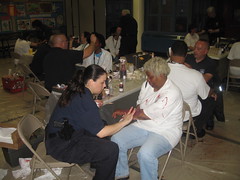
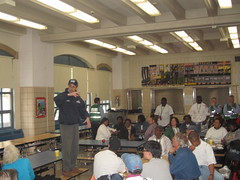
After the exercise was completed, the CERT victims all returned to the School for a wrap-up discussion with OEM Commissioner Joseph Bruno and our controllers from the Fire Department.
OEM Commissioner Joseph Bruno speaks to CERT members after the drill has been completed.
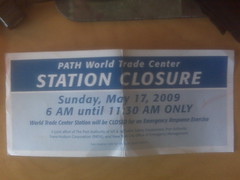
From our perspective as victims, it is difficult for the CERT members to know how successful “Operation Safe PATH 2009″ was for the responders. That will be determined by the authorities in post-exercise analysis in the weeks to come. Though one lesson was already learned before the drill began: after the Air Force One photo fly-over frightened residents of lower Manhattan, the government agencies involved bought television and radio ads and put up posters in the train station and around the neighborhood warning about the drill.
A flier distributed to PATH riders and neighborhood residents last week announcing the emergency drill.
In fact, one of our controllers said at the wrap-up that he hoped being in the drill would make it more likely that we would take a leadership role if we found ourselves in a similar train (or other type of) incident (”Show your training,” he urged). He also suggested that participation in the exercise might lead some of us to think about carrying a small flashlight or a snack/granola bar in our handbag or briefcase. (In fact, as I have mentioned previously on the blog, I think that more citizens should get the opportunity to take part in preparedness drills. It forces you to think about what you would do in advance of an emergency situation which leads to more preparation and better response if something happens.)
One of the major reasons for these exercises is to allow the responders from different agencies to meet each other before the ‘real thing’. (”You shouldn’t be handing out business cards at the scene of a disaster” is a common refrain I’ve heard.) I believe it is similarly important for CERT members, particularly those from nearby areas, to forge relationships in advance as well. And we did yesterday. The agencies involved deserve credit for including CERT in this major exercise. I hope that we were a helpful part of the exercise and will continue to have opportunities to participate in these drills in the future. We were told that this drill was the most extensive involvement by CERT thus far and that our work as victims makes it more realistic and helpful for emergency responders.
These icons link to social bookmarking sites where readers can share and discover new web pages.
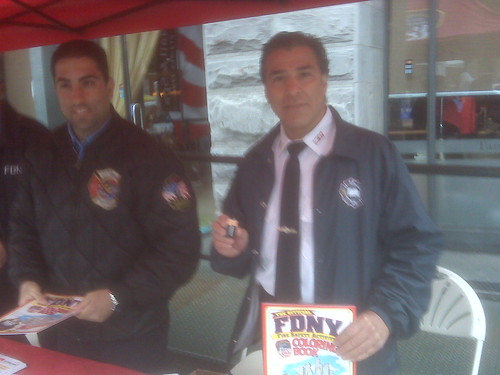
I have written before about the importance of offering the public some kind of incentive when it comes to trying to spur preparedness. One example is that New York City Fire Department regularly gives away batteries at public events to encourage New Yorkers to keep their smoke alarms working. Recently, I took this photo of a couple of firefighters distributing batteries (and other fire safety information) at the Tribeca Film Festival neighborhood street fair.
These icons link to social bookmarking sites where readers can share and discover new web pages.
I want to bring to your attention a terrific new report, Public Role and Engagement In Counterterrorism Efforts: Implications of Israeli Practices for the U.S., prepared for the U.S. Department of Homeland Security’s Office of Science and Technology by the Homeland Security Institute (a federally-funded research and development center which serves as the Department’s think tank). The study was co-authored by Dr. Sibel McGee (the principal investigator), Catherine Bott, Vikram Gupta, Kimberly Jones and Alex Karr. It is not yet available on the web. However, if you would like a PDF copy, please contact me at jsolomon@incaseofemergencyblog.com and I will e-mail you it.
The 145-page study offers a comprehensive review and analysis of citizen preparedness efforts in U.S. as well as Israel and then makes some excellent suggestions on how we can learn from Israeli experience in this area. I recommend it to anyone interested in the subject of public readiness. As has been discussed regularly on this blog, Israel provides a helpful model for the U.S. when it comes to civilian preparedness and engagement. Of course, Israel’s special circumstances (terror threat, size, militarily-trained populace, etc.) limit the transferability of many of its lessons. Nevertheless, the U.S. needs to move farther down the citizen preparedness continuum towards Israel. The key questions then are how much farther and how we do it. This report should be helpful in answering to both those questions.
To me, we can learn and draw from Israel on citizen readiness particularly in three areas — more robustly informing the public on potential terror threats, better educating kids on emergency preparedness, and expanding readiness drilling to include the public. I believe this study will be very useful in developing new efforts here in the U.S. to prepare and engage the public going forward with the goal of building more societal resilience. I have excerpted a portion of the summary results below.Â
The report’s key observations on the different Israeli and American approaches to the public role and engagement in counterterrorism are:Â
In Israel,
• The public is treated as a key partner in counterterrorism.
• Both the public and government agree on a high level of public responsibility for personal safety and national security.
• The public is interested and motivated to assume its responsibility in counterterrorism issues.
• The level of public participation in counterterrorism efforts and readiness programs for terrorism-related emergencies is high. This is likely to be the result of the high threat level and strong national consensus on public preparedness.
• The government programs and messaging are centralized, highly coordinated, and consistent.
• The government organizes and funds extensive, diverse, and ubiquitous programs that provide the public with appropriate information and education to facilitate its active role in counterterrorism.
• The Israeli government enjoys a high level of public trust and credibility on terrorism-related issues.
In the U.S.,
• Within the official paradigm of homeland security, terrorism is subsumed under an “all-hazards” approach.
• Both the public and the government perceive counterterrorism primarily to be the responsibility of the government.
• In official emergency management and security/counterterrorism programs, the term “the public” appears to be frequently understood to mean only uniformed /official first responders. Thus, large parts of the public at large are excluded.
• The level of public participation in counterterrorism efforts and readiness programs for catastrophic incidents-both natural and manmade, including terrorism-related emergencies-is low.
• The current public apathy may be a result of the lack of effective/adequate programs for greater citizen involvement in counterterrorism practices.
• The number of and funding for effective programs for public education and training on terrorism-related issues is limited and reflects a lack of prioritization at the national level.
• Even though there are examples of good practices in the field at the state and local level, there is little awareness of these efforts at the federal level. Moreover, these efforts are disjointed, inconsistent, and lack federal-level coordination and mandate.Â
Some of the report’s key recommendations are:
• DHS needs to champion greater understanding, in both the general public and within those responsible for homeland security, of the public‘s unique role in ensuring its own safety and homeland security. Emergency authorities, in particular, need to change their perceptions of the public from seeing them as victims to considering them as partners and force multipliers.
• As a way to reinforce this understanding, DHS needs to support programs that inform, educate, train, and prepare the public to take a role in ensuring its own safety and security.
• Despite its benefits, the current all-hazards approach has an unintended consequence-terrorism-specific preparedness issues are not adequately understood and addressed. There is need for more systematic and comprehensive terrorism awareness and education programs in the United States that can highlight terrorism-specific risks and coping strategies.
• Given the perception that the terrorist threat to the United States is non-immediate, the government will need to work creatively to overcome public apathy, and must increase preparedness for disasters in general and terrorism-related emergencies in particular.
• To mount an effective counterterrorism strategy, DHS and other federal agencies involved in homeland security issues need to improve information sharing internally and better coordinate their risk communications with the public.
• Providing the public, particularly the more youthful segments of the population, with terrorism-related information, education, and training may prove useful in facilitating and maintaining public resilience as a long-term counterterrorism strategy.
As I mentioned, the report is not yet available on the web. However, if you would like a PDF copy, please send me an email at jsolomon@incaseofemergencyblog.com. (Thanks to the “Homeland Inside & Out” radio show for bringing this report to my attention.)
Â
Â
The logo in Hebrew & English on Israel’s Home Front Command from its public preparedness website.
These icons link to social bookmarking sites where readers can share and discover new web pages.
Do you know how to say “pandemic flu” in Creole? (PANDEMIK FLOU) Czech? (NA PANDEMII CHŘIPKY) Korean? (악성 ë…ê°) Or in 20 other languages? Now, you can. New York City’s Office of Emergency Management (OEM) has recently released a new pamphlet , “Ready New York: Pandemic Flu”. The guide is available for download on the OEM website in 23 different languages. Yes, 23.
Not only must that be a record for preparedness guides, but it just underscores the challenge of communicating important emergency information in diverse urban areas, such as New York. Until this new pamphlet (which was developed with the City’s Department of Health and Mental Hygiene), OEM had been publishing its preparedness resources for the public — which my CERT colleagues and I are often asked to distribute —  in 14 languages. You can download any of the 23 pandemic guides here.
These icons link to social bookmarking sites where readers can share and discover new web pages.
The U.S. Department of Homeland Security’s Ready campaign is currently recruiting coalition members for “National Preparedness Month” (NPM) in September. Below is an email I just received from the Ready office:
September is National Preparedness Month (NPM) and 436 organizations have already registered as Coalition Members! If you have not yet signed up to be a 2009 Coalition Member, visit http://ready.adcouncil.org/ to register. Becoming a Coalition Member means you pledge to promote emergency preparedness during the month of September. This can be done either by providing information, hosting events and/or sponsoring activities for your customers, members, employees, stakeholders, and communities. Please remember, even if you were a Coalition Member last year, you still need to re-register this year if you intend to participate.
Â
National Preparedness Month Coalition membership is open to all public and private sector organizations for free. Once you register you will receive access to the NPM Web site where you can find a toolkit full of templates, resources, and tips to assist you with promoting emergency preparedness.
Â
As we mentioned during the Webinar, Ready brochures are limited. So, for those of you who are interested in obtaining more than the maximum order quantity of brochures, we encourage you to use our two-page printer-friendly versions that may be printed out and duplicated as needed. You can download these at http://www.ready.gov/america/publications/allpubs.html. These two-page versions are perfect for distributing to your employees, colleagues, members, or stakeholders to help spread the preparedness message. We are looking forward to a successful NPM this year! As always, if you have any questions or need assistance, please write us at npm@dhs.gov.
As I wrote about recently, this year’s National Preparedness Month comes as the Ad Council has found that citizen preparedness is “leveling off”. Though the H1N1 outbreak has definitely raised the profile of the emergency readiness issue.
These icons link to social bookmarking sites where readers can share and discover new web pages.
I wanted to highlight points that two friends of this blog, Robin Parker and Jon Abolins, made last week in regard to government’s social media effort during the H1N1 flu outbreak. Both of them noted that social media content suitable for computer users is not necessarily effective for those utilizing a mobile phone, and that emergency communications must be developed with both in mind. In a comment posted to my blog entry, “H1N1 Flu Response Shows Government Needs To Improve Social Media Public Communications For Future Emergencies,” Parker, who manages the Oregon Trail Chapter of the Red Cross’ excellent Cross Blog, said of the governmental H1N1 social media efforts:Â
They’ve been posting links to PDFs, but many people can’t click the links if they’re reading twitter from their mobile devices (or even some computers). If the CDC were to pull out the main points from those PDFs and tweet them it would be much more useful (and then people could easily retweet the info to correct misconceptions).
While we are looking at using social media, we can get locked into thinking of it as primarily *computer* media, forgetting the large part of social media & network that goes on with the mobiles…A key factor may be Gen Y’s preference for mobile phones for texting and other communications. Easier than pulling out the notebook PC, booting up, finding a WiFi connection, etc. The convenience factor points to why we must not forget the mobile phones. Many, if not most, people will have a mobile phone with them more often throughout the day than a computer. A continuous wireless connection on the go is more practical than with a laptop/netbook PC. (Yes, there are cellular Internet services for computers, but they are still too pricey for most people.) In an emergency, many people won’t be anywhere near a PC. But they will have a mobile phone. If there should be an evacuation, it is more likely that the mobile phone will go with the people than a PC.Â
Hurricane Season is starting soon. How soon? You can know exactly: FEMA is offering a hurricane season countdown widget (below) which not only marks, to the second, the time until May 1st (correction: June 1st), but also provides a link to flood preparedness and insurance information. The widget can be found on the FEMA website here.