In a new post today on the U.S. Homeland Security Department’s Leadership Blog, Secretary Janet Napolitano asks the public “to live in a constant state of readiness, not a constant state of fear.” The post titled, “The Department’s Five Responsibilities,” summarizes a longer speech Napolitano delivered last week at the Aspen Institute. The first “Responsibility”, according to the Secretary is “Protecting the American people from terrorist threats.” Yet the people also have a responsibility there. As she writes:
“Protecting the American people from terrorist threats is the founding principle of the Department and our highest priority. This is an effort where everyone–families and communities, first responders, the private sector, state and local governments, as well as the Department–must contribute. My approach is simple: direct every resource available towards prevention and preparedness, and ask Americans to live in a constant state of readiness, not a constant state of fear.”
The other four Responsibilities are: Fulfilling our mission also means securing our borders;Â When it comes to immigration, we need to facilitate legal immigration while we crack down on those who violate our nation’s laws;Â As a nation, we must develop a more urgent sense of readiness; and Finally, we must unify and mature our Department.
I think it is terrific to see Secretary Napolitano highlight the citizen’s role in the nation’s homeland security as part of the Department’s top priorities. I expect that she will continue to talk about the “constant readiness” theme in the weeks to come. Her full post can be read here.
These icons link to social bookmarking sites where readers can share and discover new web pages.
Email Entry
Tags: Department of Homeland Security
I received a birthday e-card this morning from my friend, David Stephenson, which said: “I’m sure today will be one the happiest birthdays of your life. Enjoy it to your fullest.” He’s right. Finishing six months of chemotherapy just weeks ago has made today, my 46th birthday, happy indeed. And I tried to enjoy it to my fullest.Â
The day’s activities began early (after a couple of great homemade birthday cards from my two daughters) with “Rock & Run”  a benefit event in support of Memorial Sloan Kettering Cancer Center’s Survivorship Initiative.  It is tough to beat spending a beautiful Sunday exercising with my family on the New York City waterfront on behalf of a cancer survivorship program. We walked three miles with hundreds of others and then headed for Pier 84 for a picnic next to the U.S.S. Intrepid (and to top it off the Bruce Springsteen tribute group, the “B-Street Band”,  played on the stage). Just a great morning all around.
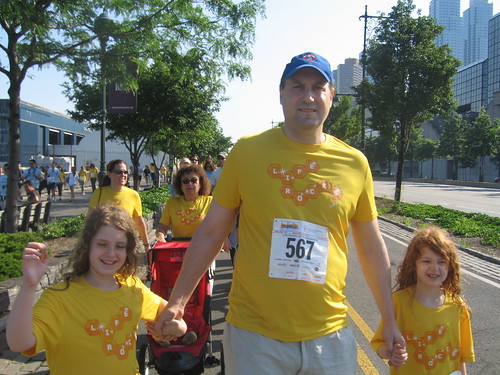
‘Rocking & running’ (actually walking) with my daughters in New York’s Hudson River Park
Afterwards, I switched out my yellow “Rock & Run” t-shirt into my green CERT uniform to distribute preparedness information at the “Third Avenue Street Fair” on the East Side of Manhattan. Along with my daughter and CERT teammates, I handed out Ready New York Pocket Guides and other emergency information. One item  that was very popular among the fairgoers (particularly  those walking their dogs) was Ready New York For Pets.
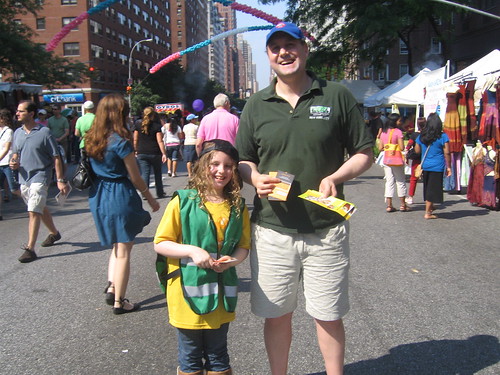
Father & daughter tag team distributing preparedness information on Manhattan’s Third Avenue.
These icons link to social bookmarking sites where readers can share and discover new web pages.
Email Entry
Tags: CERT · Preparedness Events
Patty Brooks, a very knowledgeable CERT member/trainer from San Jose, California, and author of the website, www.GoBag.org, has created a special forum on preparedness at http://www.gobag.org/forum/index.php. Patty describes it “as a brand new forum for folks who want to talk about, share, ask questions and learn more about preparedness.” She says that “the purpose of the website and forum is strictly for sharing free information about preparedness.”
These icons link to social bookmarking sites where readers can share and discover new web pages.
Email Entry
Tags: Preparedness 2.0 · Preparedness Resources
With the hurricane season beginning, FEMA has a free E-mail subscription service that delivers news updates and disaster-related information directly to your computer or wireless device, such as: when a major disaster is declared, where local recovery centers are located, what kind of financial aid is available, how to obtain disaster-related assistance, and what to do after a disaster has passed.
To sign up simply click on the following link: https://service.govdelivery.com/service/subscribe.html?code=USDHSFEMA_153. No personal information is required. Just enter an e-mail address and your zip code and state to receive news that affects you in your area. Another FEMA resource that is quite useful is the agency’s Twitter feed, FEMAinFocus.
These icons link to social bookmarking sites where readers can share and discover new web pages.
Email Entry
Tags: Federal Emergency Management Administration · Preparedness 2.0 · Preparedness Resources
With a new survey reporting that residents of coastal states are unprepared for hurricane season, Virginia held its annual hurricane preparedness tax holiday last week to try to boost civilian readiness in that state. Virginia made a significant effort to promote the week and enlist the private sector with its marketing capacity and expertise behind citizen preparedness. The state also pitched the week as being a way for Virginians to get some good deals during the recession. Estimates say that residents saved $2.3 million on preparedness-related products last week .
Laura Southard from the Virginia Department of Emergency Management sent me a report from one of its preparedness events which enlisted Radio Disney to reach out to families in a creative way:
“Between the two Radio Disney events Monday, I would say nearly 100 families were reached through a fun, game show-style “Get Ready Virginia” event. Every parent received a goody bag containing Ready Virginia information, including a template for making a family emergency plan, kids’ game sheets, and a flyer listing the hurricane/flood season items exempt from sales tax. This is the first time we have used special events to drive home the need for families to take action, so we are anxious to see how response pans out over the summer and into the fall. Just look at the faces of all the kids and parents and you can see they had fun. Interestingly, the kids knew a lot about how to get ready for emergencies. It will be curious to see if their knowledge will translate into current family readiness — or will show up in the next generation.”
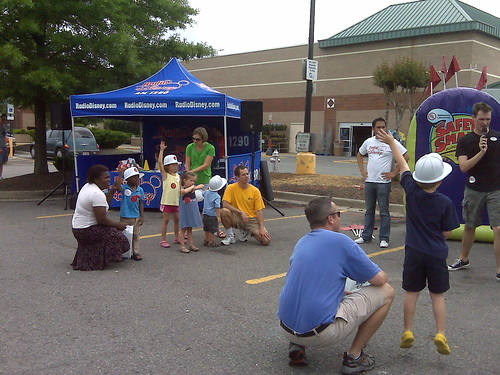
Ready Virginia/Radio Disney family preparedness event in Richmond, Virginia tied to the state’s hurricane preparedness tax holiday week (above).
One of the reasons that I am an advocate of these tax free weeks is that they provide an opportunity for government to get the private sector and their marketing operations involved in public preparedness. For example, in Virginia, ‘big-box’ chains Lowe’s and Target took out full-page ads in Sunday newspapers to promote the readiness week — a win/win/win for the businesses, the public and government emergency management officials.

Full-page Lowe’s newspaper advertisement promoting Virginia’s tax free hurricane preparedness supplies week (above).
These icons link to social bookmarking sites where readers can share and discover new web pages.
Email Entry
Tags: Preparedness Incentives · Preparedness and Business · Public Opinion
In his forthcoming book, former Homeland Security Secretary Michael Chertoff, warns about the U.S. becoming complacent and returning to a “September 10 mindset.” But he is equally cautionary about going too far in the other direction. “There are two opposite extremes that must be avoided,” he writes in the book, Homeland Security: Assessing the First Five Years (University of Pennsylvania Press), “one, hysteria and fear, and the other, complacency and almost blithe disregard of the threats we face.” In fact, much of the book attempts to find the right balance in policies and attitudes to keep the nation safe.
I was given the ‘uncorrected page proofs’ of the book this weekend at the 2009 Book Expo held here in New York City. It is scheduled to be released in September. (The former Secretary now runs a security and risk-management consulting firm, The Chertoff Group.)
In Homeland Security: Assessing the First Five Years, Chertoff offers substantive policy recommendations on a range of homeland security issues. Actually, the title sells the book a bit short. It is as much, if not more, prospective as retrospective. And he does so in a tone that is generally bipartisan and constructive.
The bipartisan approach is signaled from the beginning (former Democratic Congressman Lee H. Hamilton, wrote the book’s Foreword) and at the very end (the book’s final paragraph: “As my successor, Janet Napolitano, assumes the challenging task of protecting the homeland, it is my hope that when her tenure has ended, she will pass on to her successor an even stronger, better department, one that has served our country well.”)
Many of the themes he strikes in the book will be familiar to those who have followed Chertoff’s public statements during his time as Homeland Security Secretary. In fact, one of his major aims in writing the book seems to be to educate — and sometimes try to persuade — the public and in turn their elected representatives. (The decision to have a university press publish the book underscores that objective.) Chertoff argues throughout the book that the government needs to communicate with the citizenry early and often on homeland security issues.
I know Chertoff would readily acknowledge (and he did in a couple interviews I had with him last year) that he did not accomplish nearly as much as he might have liked in this particular area. There were a number of reasons, including a lack of trust between the government and much of the governed on homeland security (which began before Chertoff took over DHS but was exacerbated by the government’s response to Katrina) as well as a concern about being accused of scaring people by bringing up potentially frightening scenarios. I would also argue that there is not yet a clear consensus on how best to communicate these new and delicate preparedness issues (ie. how and how much to brief the public on WMD threats) that will educate and engage citizens in a useful and non-scary way. But the Obama Administration has the opportunity to start its public education and engagement efforts with a clean slate. And Chertoff clearly thinks they should take advantage of it.
“It seems that only when we crystallize a problem around an individual circumstance can we ensure the kind of emotional commitment that inspires people on every level to make the necessary and prudent investments to secure the nation,” Chertoff writes. “That is why frank discussion about past terrorist attacks is not, as some would claim, fear-mongering. Rather it is a necessary antidote to the inertia that arises when individuals do not want to be inconvenienced by the short-term impact of policies or programs that prevent further attacks from occurring.” He adds that future Administrations should be “candid with the American people, sharing as much information as possible about the dangers we face and the nature of our enemies.”

Chertoff raises important questions about bio-preparedness that have really yet to be discussed directly with the public (though the recent H1N1 flu did at least provoke some discussion), such as how to distribute medicine quickly, when to use isolation and quarantine as well as how businesses and schools should deal with those long-term distancing situations.
“It is essential that they be discussed and deliberated upon before, not after, a national emergency arises,” writes Chertoff. “Clearly the time to have thorough, candid and public conversations about these issues and tradeoffs is today, before anything happens tomorrow. This is true not only of legal matters, but also of every aspect of the threat and how we should respond.”
The target of much of Chertoff’s criticism in the book are interest groups he believes have worked against the nation’s overall homeland security interests. In a provocative chapter, “Why Washington Won’t Work?” Chertoff explains his frustration about the obstacles that the political system throws in the way of implementing long-term changes that benefit the whole nation but which might come at the expense of a smaller interest: “Measures designed to promote the general good of the country are countered by small but highly concentrated, well-organized activist groups that perceive their own individual interests to be adversely affected by new proposals or ideas.”
[Read more →]
These icons link to social bookmarking sites where readers can share and discover new web pages.
Email Entry
Tags: Media · Preparedness Ideas · Preparedness Resources
In his first ‘Blogger Roundtable’, new FEMA head Craig Fugate said today that increasing citizen preparedness will be a major priority for the agency and the “one area you’ll hear me talk about more often about.” He acknowledged that the emergency management community “hasn’t done a good job of using the public as a resource” and instead often views average citizens as “a liability” in disaster preparedness and response. Fugate said repeatedly that he was going to focus a great deal of attention on changing that approach:Â ”There is so much more we can do with people. We need to make them part of the team.”
The Roundtable was set up by FEMA to focus attention to the need for personal and government preparedness and was pegged to the beginning of hurricane season. The other two bloggers on the telephone conference call were Rich Cooper of Security Debrief and Ed O’Keefe of The Washington Post’s Federal Eye blog. Fugate, previously Florida’s well-regarded Emergency Management Director, was confirmed by the Senate three weeks ago.
Fugate emphasized that preparing was not only important for citizens themselves but for the disaster effort as a whole: “The more prepared the public is, the better the response will be.”
The Administrator acknowledged “the bully pulpit won’t do it alone” in significantly increasing citizen preparedness noting that two successful social marketing campaigns — cigarette smoking and seat belts — did require incentives to alter public behavior. But he wasn’t sure yet what would make sense for to promoting preparedness. He did say that disincentives need to be addressed pointing out that in some places homeowners who retrofit their homes face higher tax assessments.
Fugate was refreshingly candid about the vexing challenge of getting Americans to prepare, something his boss, President Obama, on Friday called a responsibility of citizenship: “I’ll be honest with you. I don’t know what’s going to work.” He said that preparedness required long-term cultural shift. “At this point all I know is that it won’t happen overnight. Not even a couple of years.” But he said it was a “journey” he wanted to take. Fugate said there is a need to bring together social science research to better understand why aren’t people still aren’t preparing for hurricanes and other potential emergencies. And then act upon it. ”We need to help provide the tools and the information for the public to prepare and to empower themselves.”

FEMA Administrator Craig Fugate
Fugate said that social media would be central to that effort both empowering citizens as well as to helping personalize preparedness for them with more customized information. He said new technology applications allow for “two way exchanges”, and that FEMA (which already utilizes social media) would be figuring out how best to engage the public and deliver useful tools and data to them.
Fugate’s focus on empowering the public nicely dovetailed with something suggested by a reader in response to a request I made yesterday on the blog for questions. Ralph Dutcher, a Community Emergency Response Team (CERT) instructor and county public health official from Rochester, New York, recommended I ask the new Administrator for his views of the CERT program. In response to Ralph’s question, Fugate said that he had been a “big proponent” of CERT in Florida and that the local teams across the U.S. had an integral role in the type of new citizen empowerment effort he is envisioning — calling them “the ambassadors” of preparedness in their communities. Fugate also said there was a need to provide advanced training for CERT members on one end of the spectrum and offer a less intensive course covering the CERT “high points” on the other for those citizens who want to get involved in preparedness but without as big a time commitment.
Fugate closed the 35-minute teleconference by urging Americans to take just the “basic steps” to prepare for a hurricane or any other likely emergency in their particular area. In fact, he said that while as a former Florida official he tends to talk about hurricanes, his experience being in Washington, D.C. during the first days of the ’sniper attacks’ in 2002 underscored the value of having a kit and a plan for unexpected emergencies.
These icons link to social bookmarking sites where readers can share and discover new web pages.
Email Entry
Tags: Federal Emergency Management Administration
I wanted to mention a new mini-guide/chart from the Yale University School of Public Health Preparedness called Social Media And Preparedness. In a simple basic form, it lists the leading social media tools and how they can be used in public health and emergency preparedness. As the introduction describes:
“The internet is buzzing with tweets, diggs, podcasts, widgets, and avatars. With these new social media technologies emerging at such a fast pace, it can be a challenge to make sense of what these developments mean for public health, and to decide how to use them to increase emergency preparedness. However, with some planning, you can incorporate social media technologies into your communication plans to increase the impact of existing strategies, to reach new audiences and to enhance trust among existing ones.”
The guide is a helpful brief overview for any institution using or planning to use social media in public health and emergency preparedness. It’s also a good introduction for individuals who want to take advantage of these new applications in preparing themselves. The two-page piece can be found at http://publichealth.yale.edu/ycphp/newsletters/Social%20media_PH.pdf. Thanks to Robert Buzzerd, a paramedic and graduate student, for bringing this to my attention.
These icons link to social bookmarking sites where readers can share and discover new web pages.
Email Entry
Tags: Preparedness Resources · Public Health Preparedness
On Tuesday, the day after Hurricane Season officially starts, recently confirmed Federal Emergency Management Administration head Craig Fugate will be holding a ‘blogger roundtable’ — a telephone press conference for bloggers like myself. The purpose of the roundtable is to draw attention to the need for personal and government preparedness, especially as it relates to hurricanes.
I have some questions I would like to ask Administrator Fugate, but I thought I would open it up and see if readers had some queries of their own. If you have a question, please e-mail me at jsolomon@incaseofemergencyblog.com. I will try to ask one of them on the call. If I don’t get a chance to do so I will try to get an answer from other FEMA officials afterwards.
Â
These icons link to social bookmarking sites where readers can share and discover new web pages.
Email Entry
Tags: Federal Emergency Management Administration
During a visit to FEMA’s National Response Coordination Center on Friday, President Obama said that preparing for hurricanes and other disasters was a “personal responsibility” and a responsibility of citizenship. According to the President:
“True preparedness means having federal and state and local governments all coordinating effectively, and as you just heard, one of the most important things we can do is make sure the families have prepared appropriately. We just saw some statistics coming out of Florida indicating that a huge percentage of people in hurricane areas simply don’t make plans. They don’t have a plan, they don’t have a set of contingencies that will allow them to respond in an effective way. Those people who have the capacity to plan, they will thereby relieve some of the resources that the government has to provide and we can stay focused on those folks who are most vulnerable and have the most difficulty dealing with a storm. So I hope that message of personal responsibility sinks in…As we enter into hurricane season, I hope that everybody who’s watching is going to be paying attention and take seriously their responsibilities as citizens so that the entire country is ready.”

(President Obama confers with Homeland Security adviser John Brennan at the conclusion of a hurricane preparedness meeting at FEMA headquarters in Washington Friday, May 29, 2009. At left is Homeland Security Secretary Janet Napolitano. Official White House Photo by Pete Souza)
Obama’s visit was to check on and highlight the federal government’s planning as hurricane season begins. However, his strong language about the role and responsibility of the public in that planning process was terrific to hear.
These icons link to social bookmarking sites where readers can share and discover new web pages.
Email Entry
Tags: Federal Emergency Management Administration · Hurricane Preparedness · President Obama