A new report gives state and local health departments mixed grades for distributing information through the internet to the public during the H1N1 outbreak. According to an article in U.S. News & World Report:
After the U.S. government declared a public health emergency in April, 46 of 50 state health departments posted some information about the H1N1 outbreak within 24 hours of the federal announcement, according to Rand Corp. researchers. However, only a third of the 153 local health departments included in the study posted information on their Web sites within 24 hours of the federal announcement.
The researchers also found wide differences in performance among local health departments in the five states with confirmed swine flu cases at the start of the outbreak — California, Kansas, New York, Ohio and Texas. About 73 percent of counties in California quickly provided some information on their Web sites, compared with 18 percent of counties in Texas and eight percent of counties in Kansas.
The study also found that content posted by most state health departments was of high quality. Forty-three of 47 state health departments provided information about how people could protect themselves or their family, 36 of 47 offered information about when to seek treatment and 27 of 47 explained who should take antiviral drugs.
[Read more →]
These icons link to social bookmarking sites where readers can share and discover new web pages.
Email Entry
Tags: City Preparedness · Preparedness 2.0 · Public Health Preparedness · State Preparedness
An Obama Administration working group has issued new guidelines which aim to strengthen the government’s oversight of the nation’s food supply, according to the Associated Press:
“A food safety panel established by President Barack Obama developed the new rules for eggs, poultry, beef, leafy greens, melons and tomatoes as well as for better coordination and communication among the agencies overseeing the nation’s food supply. The panel announced today Food and Drug Administration and the Agriculture Department would adopt the standards, which follow a string of breakdowns in food safety.
Earlier this year a massive salmonella outbreak in peanut products sickened hundreds, was suspected of causing nine deaths and led to one of the largest product recalls in U.S. history. In the past month, Nestle Toll House cookie dough and 380,000 pounds of beef produced by the JBS Swift Beef Co. of Greeley, Colo., have been recalled due to connections with outbreaks of E. coli. In March, Obama said he would create a special advisory group to coordinate antiquated food safety laws and recommend ways to update them. The FDA does not have enough money or workers to conduct annual inspections at more than a fraction of the 150,000 food processing plants and warehouses in the country, Obama said. Under the new rules:
*The FDA will help the food industry establish better tracing systems to track the origins of a bacterial outbreak.
*A new network will be established to help the many agencies that regulate food safety to communicate better.
*Egg and poultry producers will have to follow new standards designed to reduce salmonella contamination.
*The Food Safety Inspection Service, the Agriculture Department agency that inspects meat, will increase sampling of ground beef ingredients in an effort to better find E. coli contamination.
*The FDA will recommend ways that producers of leafy greens, melons and tomatoes can reduce disease strains, and require stricter standards in those industries within two years.
*The FDA and the Agriculture Department also will create new positions to better oversee food safety.”
These icons link to social bookmarking sites where readers can share and discover new web pages.
Email Entry
Tags: Food Safety
In another example of government authorities utilizing social media as a new way of reaching out to the public, Ohio State University police have posted a request for tips regarding a fatal house fire on Facebook. In the post titled “OSU Fires — Looking for Answers,” the police write:
“Do you remember this??? We are desperately looking for any information on this OSU fire that killed 5 students. It has been 6 years and we still have no answers. Anything you can remember may help. Feel free to post here, e-mail us or call Crimestoppers with an anonymous tip (1-877-645-8477). There is still $12,000 in reward money available!! We haven’t forgotten and we hope you haven’t either, please help.”
The Natural Hazards Center Twitter feed, where I saw this story, points out that this is an instance of the police using social media to solve a ‘pre-social media’ crime.
These icons link to social bookmarking sites where readers can share and discover new web pages.
Email Entry
Tags: Preparedness 2.0
The Federal Emergency Management Administration (FEMA) has 10 regional offices (see map here for how they are divided). Each of them now has their own Twitter feed. You can go to the Homeland Security Department’s social media page here to sign up. These have just started up, and they vary by office as far as frequency of use thus far. However, I think these feeds will be useful, particularly the one that covers your area.
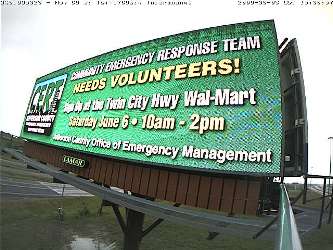
On the subject of FEMA Twitter feeds, the agency’s FEMAinFocus recently tweeted about a Government Technology article about about how the Office of Emergency Management in Jefferson County, Texas is using electronic billboards to offer multiple preparedness messages to its citizens.
“We live in an advancing technology society, and we thought we had to go the extra step to get people’s attention,” said Greg Fountain, emergency management coordinator of the OEM. “They get tired of just listening to you on the radio or the news. Print materials are just something that people are handed and throw away, or they rarely pick up a brochure like you would hope.”
Fountain said Lamar Advertising has three electronic billboards in the county and the OEM purchased time on each of them. He said the company sells six ads for each billboard, and each message appears for 10 seconds of every minute. One of the billboards is located at the intersection of Highway 347 and Highway 69 — a location that nearly all of the county’s more than 250,000 residents drive through, he said.
The billboards offer high exposure, the ability to promote multiple messages and the opportunity to change information quickly in the event of an emergency. It’s a creative public education idea.
These icons link to social bookmarking sites where readers can share and discover new web pages.
Email Entry
Tags: County Preparedness · Federal Emergency Management Administration · Preparedness Ideas
Below are the winners of the ‘Send Me A Preparedness Tip, Win A Disaster Kit’ Contest. Readers were asked to send one of the following: an emergency preparedness tip, something you have done to prepare for a disaster, or a suggestion to improve preparedness in your community. Entries came by email, on the blog and through Twitter. The winners, chosen by random, will receive a disaster kit (see photo below) thanks in part to the CaliforniaVolunteers’ WEPrepare program. (Though I have also listed some of the other entrants at the bottom whose preparedness tips will also hopefully be helpful).
The Winners:
Scott Kidder/Oakland, California
I recommend keeping backup copies of your personal records in electronic form both at home and off-site. This can prove very useful in the event that your home is severely damaged or destroyed in a disaster. I purchased several rewritable DVDs with a capacity of 4.7 GB. Rewritable CDs may work, too, depending on how much information you want to store. To keep the information secure, I created an encrypted disk image (256-bit AES encryption) that contains all of my sensitive and valuable information. I consider it important to encrypt the data on the DVD so that the information is inaccessible should the disc become lost or stolen.
Jei-Nhy Quirantes/Kekaha, Hawaii
Information I store on the backup disc includes personal finance records (Quicken, Money, etc), tax returns, insurance policies, a home inventory (photos, videos, receipts), and irreplaceable photos and videos. I update the contents of the DVDs at roughly 6 month intervals. The update process takes only about 1-2 hours. You might keep a copies of the discs at work, in your briefcase/work bag, and in your go-bag/emergency kit at home. Having the information distributed lessens the likelihood of a total loss.
I’ve gathered important documents i.e. birth certificates, medical cards, insurance papers, will, placed them in a ziplock bag, and put them in my emergency kit. I’ve also scanned digital copies of each of them and uploaded them to a jump drive and emailed them to myself.
Rich Madden/Aurora, Illinois
The thing that most people overlook with emergency preparedness is that anything that you can do to mitigate the uncomfortableness of an emergency goes along way to keep them safe and sane. If you need to use restroom facilities and there are none, what are you going to do; I have heard to many stories of people using unknown leaves to clean themselves and using something like poison ivy, “Ouch”. Having a roll of toilet tissue and a garbage bag to contain the waste will go a long way to keeping you comfortable and safe. Also having a toothbrush and toothpaste helps with that morning after mouth that tastes so foul. Also having an extra pair of glasses just in case you loose your current pair so you can at least see clearly or not. The comfort of an event will go along ways to help ease the rehab of getting over the event.
One other thing if you have to evacuate your residence due to flood, fire, or earthquake, you will have to prove yourself to re-enter your community a copy of your homeowners insurance your, marriage license, your driver’s license or passport, will go a long way to secure your right to be in the community. These copies in certified form or in microfilm are acceptable.
Jon Abolins/Trenton, New Jersey
Mentally prepare for resilience in daily activities. One way is to develop the habit of “having an exit plan” mapped out as you go along. In the train carriage, note where the exits — including the pop-out window emergency exits — are. Count how many seats you are from the nearest exist. Similar practice applies to plane travel. When going into an office, school, etc. pay attention to the emergency exits, fire alarms, extinguishers, and such.
Mike Everett-Lane/Brooklyn, New York
Here are a couple I’ve gleaned from various sources:
1) Get several hundred dollars out of the bank, in small bills (ones and fives). If there’s a power outage, the ATMs and credit card machines will be down. Stores will run out of small bills quickly. Put the money in an envelope, and store it some place where you won’t spend it.
2) Make sure at least one of your phones can be powered with just the phone line, again in case of power outage you’ll still be able to make calls.
3) Keep a pair of old slip-on shoes under your bed, and a flashlight at hand. I use a Pak Light ( http://www.9voltlight.com/ ), attached with velcro to the underside of the bed frame.
David Chesler/Leesburg, Virginia
I work for the Loudoun County Chapter of the American Red Cross. As part of our Community Disaster Education (CDE) program I provide to any group or organization a free one-hour Disaster & Emergency Preparedness presentation. I promote Be Red Cross Ready… Build a Kit, Make a Plan and Get Informed. I start out with a ‘Shelter in Place’ scenario to get the group thinking. I enjoy this part of my job. I let them know when it comes to Disaster & Emergency Preparedness… I talk the talk, but more importantly I walk the walk.
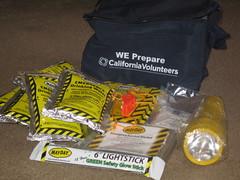
CaliforniaVolunteers’ WEPrepare Disaster Kit
[Read more →]
These icons link to social bookmarking sites where readers can share and discover new web pages.
Email Entry
Tags: Contests · Preparedness Tips
A recent Red Cross survey found that almost one in two Americans have had a “drowning scare”. That’s a stat which grabs your attention and offers a good reason to review summer safety, which includes swimming and CPR/AED. See this American Red Cross webpage for more information. Swimmers of all ages and abilities can develop their water safety skills by contacting their local Red Cross chapter (which can also give you the confidence to respond in an emergency situation with skills that can save a life through their CPR and AED programs). To find your local chapter, enter your zip code in the far right column of this page.

The Floating Lady swimming pool docked in the water off Baretto Park in the Bronx, New York. (photo: New York Daily News)
These icons link to social bookmarking sites where readers can share and discover new web pages.
Email Entry
Tags: Red Cross
On July 4th, some tips on fireworks safety from the U.S. Fire Administration:
*The best way to protect your family is not to use any fireworks at home – period. Attend public fireworks displays and leave the lighting to the professionals.
*Kids should never play with fireworks. Sparklers can reach 1,800° Fahrenheit (982° Celsius) – hot enough to melt gold.
*Steer clear of others – fireworks have been known to backfire or shoot off in the wrong direction. Never throw or point fireworks at someone, even in jest.
*Don’t allow kids to pick up pieces of fireworks after an event. Some may still be ignited and can explode at any time.
*Think about your pet. Animals have sensitive ears and can be extremely frightened or stressed on the Fourth of July. Keep pets indoors to reduce the risk that they’ll run loose or get injured.

These icons link to social bookmarking sites where readers can share and discover new web pages.
Email Entry
Tags: Fire Safety
Calling citizens part of “the nation’s emergency response team,” FEMA Administrator Craig Fugate is urging Americans to prepare for emergencies this July 4th Weekend:
“As we take this opportunity to observe the July 4th holiday with loved ones and friends, we are reminded of all we have to be thankful for and why it is so critical that we do all we can to protect our families and communities. I encourage all Americans to take a few simple steps to ensure that if and when your community is impacted by an emergency or disaster, you are prepared.
“Most importantly, develop a family disaster plan – have the discussion now about what you will do if your community is impacted, where you will go, how you will communicate with your loved ones. I also encourage you to take a CPR or first aid course, transforming you from a survivor to an asset to your family and community in the case of emergencies. And, in the case of an emergency, after you have determined the safety of you and your family, check on a neighbor and make sure others are safe.
“We are all a part of our nation’s emergency response team, and the small steps we can each take now will go a long way in shaping our successful response to the next disaster. For more information on how to make sure you and your family are prepared please visit www.ready.gov.”
I think that emphasizing the public’s role as part of the overall disaster response “team” is a good approach. It offers both positive (’you are part of the solution’) as well as negative (’you don’t want to be part of the problem’) messaging.
[Read more →]
These icons link to social bookmarking sites where readers can share and discover new web pages.
Email Entry
Tags: Federal Emergency Management Administration
The Obama Administration will be holding a H1N1 Flu Preparedness Summit on Thursday at the National Institutes of Health in Bethesda, Maryland. Health and Human Services Secretary Kathleen Sebelius, Homeland Security Secretary Janet Napolitano, Education Secretary Arne Duncan, and Homeland Security Advisor John Brennan will host the all-day parley to further prepare the nation for the possibility of a more severe outbreak of H1N1 flu.
“Scientists and public health experts forecast that the impact of H1N1 may well worsen in the fall – when the regular flu season hits, or even earlier, when schools start to open – which is only five or six weeks away in some cases,” Secretary Sebelius said. “The goal of the Summit is to launch a national influenza campaign by bringing federal, state and local officials, emergency managers, educators and others together with the nation’s public health experts to build on and tailor states’ existing pandemic plans, share lessons learned and best practices during the spring and summer H1N1 wave, and discuss preparedness priorities.”
I think getting everyone in the room and around the table is a great idea in advance of the Fall. I hope and expect that there will be a good deal of focus on some of the citizen-related issues and questions that we have been discussing on the blog, such as school closings, work place sick leave and other community mitigation policies and procedures.

These icons link to social bookmarking sites where readers can share and discover new web pages.
Email Entry
Tags: Pandemic Flu · Preparedness Conferences · Preparedness Events
In a New York Times op-ed today, “Defend America One Laptop At A Time,” Harvard Law Professor (and former director of the Justice Department’s Office of Legal Counsel)  Jack Goldsmith argues that the everyday  computer user can play a key part in the nation’s cyber security initiative. Cyber security is seen as an increasingly vital piece of the the U.S.’s homeland security portfolio, and I have been focusing on finding ways that citizens (in addition to government and private industry) can contribute. Goldsmith, who is currently working on a book on cyber security, says the public’s computers are a vulnerable front for potential attackers. As he writes:
“Our digital security problems start with ordinary computer users who do not take security seriously. Their computers can be infiltrated and used as vehicles for attacks on military or corporate systems. They are also often the first place that adversaries go to steal credentials or identify targets as a prelude to larger attacks.
President Obama has recognized the need to educate the public about computer security. The government should jump-start this education by mandating minimum computer security standards and by requiring Internet service providers to deny or delay Internet access to computers that fall below these standards, or that are sending spam or suspicious multiple computer probes into the network.”
This is a subject I will be continuing to follow, and I’ll be interviewing Goldsmith to discuss it further sometime soon.
These icons link to social bookmarking sites where readers can share and discover new web pages.
Email Entry
Tags: Cyber Security · Preparedness Tips