Stephenson, a trailblazing thinker in the use of web 2.o tools in homeland security and government in general, argues that new personal technology offers an effective way for the Secretary reorient that approach and maximize the public as an asset. As he writes:
Crafting an effective strategy to productively involve the general public in homeland security should center on two technologies: the increasingly powerful and versatile mobile communication devices that most of us now carry and the Web 2.0 social media that have been created to capitalize on them.
The reality, as every major disaster in recent years has proven, is that we will use these devices in an emergency, whether or not government wants us to. They have become so ingrained in our daily communication routines that we’d automatically turn to them in disasters as well.
Stephenson says the citizenry is ready but needs some leadership and forward thinking from the authorities at the federal, state and local level:
The public have already kept our part of the bargain, buying these advanced mobile devices and mastering social apps that can be invaluable in disasters. Now the burden is on government to meet us halfway. That involves two things: coaching us on what kind of information would be helpful in an emergency, and, when one happens, both factoring in real-time location-based info from the public into their actionable intelligence for responding, and using social media to guide us.
In today’s Washington Post, there’s a good front page piece, “Northern Hemisphere Braces As Swine Flu Heads North”, which looks at the government’s efforts to plan and prepare for the possible return of the H1N1 flu in the Fall. In fact, H1n1 is on the agenda for President Obama’s meetings with the leaders of Canada and Mexico. According to the article:
“Everyone recognizes that H1N1 is going to be a challenge for all of us, and there are people who are going to be getting sick in the fall and die,” said John O. Brennan, the U.S. deputy national security adviser for counterterrorism and homeland security. “The strategy and the effort on the part of the governments is to make sure we . . . collaborate to minimize the impact.”
Concern about a second wave has prompted a flurry of activity by federal, state and local officials, including intensifying flu virus monitoring and making plans to distribute vaccine and antiviral drugs and other treatments if necessary. ”There’s a lot of moving parts to this,” said Joseph S. Bresee, who heads the CDC’s influenza epidemiology and prevention branch. “Hopefully we won’t have a panic, but instead we’ll have the appropriate level of concern and response.”
On Friday, the federal government issued revised guidelines for local schools in dealing with H1N1. Many officials felt that widespread school closures during the Spring were not effective in stopping the flu and had a negative collateral impact. As a result, officials are now recommending that schools only close when there is a major outbreak and reduce the amount of time sick students should stay home when their fever breaks. The article notes the challenging balance officials are trying to find when it comes to communicating with the public on these issues:
The Obama administration has been updating recommendations for when to close schools, what parents should do if their children get sick, how doctors should care for patients and how businesses should respond to large-scale absences. Officials are hoping to navigate a fine line, urging precautions to minimize spread, serious illness and deaths while avoiding undue alarm and misinformation.
“The last time we had anything similar to this was prior to the Internet,” said one senior official who spoke on the condition of anonymity last week during one of a series of background briefings for reporters.
First of all, I’m not sure it makes sense for “senior officials” to get themselves quoted only as “senior officials” during briefings for reporters on this topic. I think it lends a secretive tone that isn’t really called for here. Why couldn’t that statement be attached to a name? Further, though its possible the quotation is not in full context, the official probably should have noted that the Internet also can and would also play a positive role in a pandemic helping distribute information between all stakeholders, including the public.
But apart from the attribution language, I wanted to make a couple of brief points from the weekend:
* On Schools — I think it is good that officials have publicly issued the new guidelines. At the H1N1 Summit, I heard many experts dispute the widely-held view (among the public and the press) that the school closings had been effective in stopping the flu during the Spring. Correcting that history and publicly explaining the reasons for a ‘less agressive’ policy is smart.
However, in the Fall, if individual local school systems are ‘more aggressive’ in closing their buildings, it will be difficult — in this media age — for other places to resist pressure that will undoubtedly come from parents asking why they are not being similarly aggressive. It’s tough to resist that pressure as the situation in the Spring indicated no matter what the experts say. Here I think the media — particularly the cable news channels — are very important. Obviously, they need to report the truth. However they would best serve their viewers if they explain the pro’s and con’s of school closings and the specific situations in each place rather than just transmitting and exacerbating panic. The CDC and other agencies can help by doing more briefings (anonymous or not) and also discussing some of these scenarios with the public so they understand if their school districts do stay open.
On Businesses – While there is a governance structure that can implement policy on H1N1 in schools around the U.S., the challenge is more difficult when it comes to business, particularly small and medium sized firms. A big challenge in dealing with a major outbreak is how the private sector will deal with significant absentee rates due to illness to employees and their children.
For the government, the bully pulpit is the tool they have to rely on most over the next few weeks. Officials have been repeatedly asking employers to start planning for H1N1 in the Fall. In many businesses, particularly large corporations, that type of preparation builds upon existing plans and is definitely happening. The real challenge is smaller companies. No matter what they do in the event of a virulent outbreak business will be disrupted. However, I would suggest that officials — including President Obama — begin highlighting businesses and other institutions who are models of H1N1 prep as a way to guide others who aren’t sure how or even if they can do it.
On Communities — One final thing from the weekend. I read on the very helpful Avian Flu Diary blog about another H1N1 preparedness idea — that Canada was urging their citizens to find a ‘flu buddy’. This type of one-to-one preparation and planning is something that we all should be doing with our neighbors whether it has to do with H1N1 or another emergency like a power failure or fire. If H1N1 is the catalyst for more of this then something will definitely have been gained. public.
These icons link to social bookmarking sites where readers can share and discover new web pages.
I am heading to the “2009 National Conference on Community Preparedness: The Power of Citizens Corps” which begins in earnest on Monday in Arlington, Virginia. Hosted by FEMA’s Community Preparedness Division, the Conference is “intended to help communities become safer, stronger, and better prepared for all types of hazards.”
According to the Citizens Corps website, the event “will allow attendees to share best practices on collaborative emergency planning, discuss preparedness outreach and education for targeted populations, learn innovative approaches to funding, hear updates on DHS/FEMA initiatives, get updates on findings from citizen preparedness research, network with other Citizen Corps participants and much more.” The conference schedule can be found here. The first-annual National Citizen Corps Achievement Awards will also be presented; the list of finalists (which includes, I mention proudly, my own New York City Citizen Corps) in the various categories can be found here.
I am looking forward to attending, because it is one of the only national events focused solely on citizen and community preparedness. I am also excited to meet some fellow CERT members from around the U.S.
You can follow the conference proceedings on the Citizen Corps Twitter feed here or on its newly-revamped website here. Information can also be found on the website of the International Association of Emergency Managers here. I will be posting written and video reports on the blog as well.
These icons link to social bookmarking sites where readers can share and discover new web pages.
I have been following the activity on the site throughout the week and have been particularly interested by the terrific ideas being sent in by individuals. And, I have posted several of my own. Under each idea (besides your own), you are able to give a rating of 1-5 stars which are then averaged out. So far, none of my submissions have received more than an average of 2.7 starts — so much for the ‘Wisdom of Crowds’!
In the Blogger Roundtable on Monday, DHS Assistant Secretary for Policy David Heyman suggested that the star rating system was “Amazon.com-ish” and the public would find it easy to use. I agree. However, I would add that there is also an “American Idol” element as well.
You put your idea up there on the online stage, and America gets to vote on it. While there’s no Simon Cowell and you cannot be sent home for a bad idea, I can empathize with countless “American Idol” contestants who put their heart and soul out there and do not get the reaction they had hoped. Nonetheless, I will be posting a couple more ideas this weekend. I urge anyone interested in homeland security — or interesting government 2.0 experiments — to visit the Dialogue site and maybe rate or offer your own suggestions for the nation. Obviously, officials are not going to go strictly by the rating system but it does offer more helpful data points and provides a good way for stakeholders, including the public, from around the U.S. to weigh in.
The Quadrennial Dialogue actually consists of three separate dialogues. The initial one runs until Sunday. The second (August 31-September 6) will integrate the initial feedback and present additional content from QHSR study group. The third (September 28-October 4) will seek “a final review of the mission goals, objectives and outcomesâ€. There are six overall subject QHSR Dialogue areas — Counterterrorism and Domestic Security Management; Securing Our Borders; Smart and Tough Enforcement of Immigration Laws; and Preparing for, Responding to, and Recovering from Disasters; Homeland Security National Risk Assessment; and Homeland Security Planning and Capabilities.
One unexpected outgrowth of the online Dialogue is that it has provoked dialogue offline as participants read each others comments. I received an email today from Lee Foster who works with the Citizen Corps in Columbus, Ohio regarding my suggestion that the public be given more opportunities to do emergency drilling. Lee said he had been trying to accomplish that goal in the Columbus area and wanted to know if I had any ideas for doing so. I expect that the Quadrennial Review is the forum where we will be addressing that question (if, of course, my rating on that idea rises higher than a 2.7!)
These icons link to social bookmarking sites where readers can share and discover new web pages.
My New York City Office of Emergency Management “Tip-Of-The-Week” email tipped me off to some interactive web preparedness games the U.S. Department of Homeland Security has created to help teach children how to prepare for emergencies. They can be found on the Ready Kids website and the Ready New York For Kids site. The games include:  Make A Plan Crossword, Go Bag Memory Game, Emergency Hidden Treasures, and Ready Word Search. I think they’re fun and informative for adults as well.
Also on the DHS Ready Kids is a cute National Preparedness Month song written by teachers and students of Parks Elementary  School in Oklahoma City, Oklahoma:
(Sung to the tune of “She’ll Be Comin’ Round the Mountain”) Oh, September is the month to get prepared/For emergencies at home or anywhere/So now get your act together/Be prepared for stormy weather/Oh, September is the month to get prepared.
Know some basic stuff goes in your disaster kit/So be sure to make a list and don’t forget/Make your family plans together/Be prepared for any weather/Oh, September is the month to get prepared.
You need tools and food and water for 3 days/Also, radio, flashlight batteries for your stay/Grab your first aid kit and some clothes to wear/Don’t forget your underwear!/Oh, September is the month to get prepared.
Oh, September is the month to get prepared/You will know just what to do and not be scared./So let’s get our kits together/We’re prepared for stormy weather/Cause September is the month to be prepared.
These icons link to social bookmarking sites where readers can share and discover new web pages.
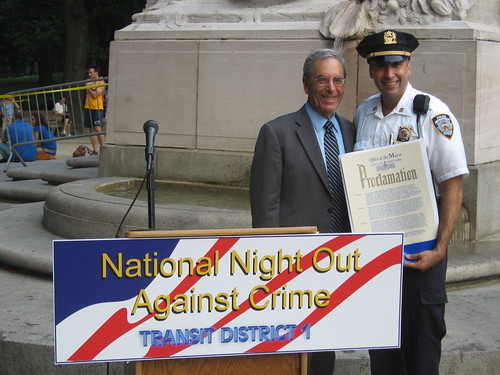
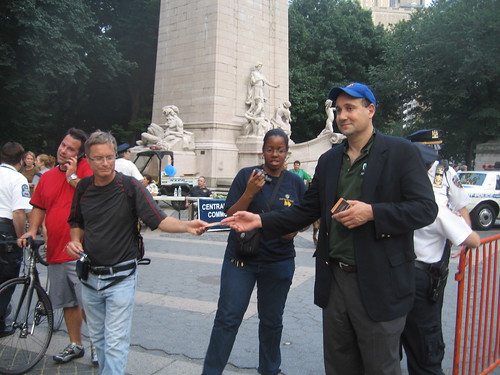
As part of yesterday’s “National Night Out Against Crime”, my Community Emergency Response Team (CERT) handed out preparedness information in Manhattan’s Columbus Circle. We joined members of the New York City Police Fire & Parks Departments during the annual event, which aims to promote crime prevention awareness as well as strengthen ties between uniformed emergency agencies and the public.
Each year during the “Night Out,” NYC-CERT members distribute Ready New York information to the public and encourage involvement in the CERT program. It’s always fun, particularly on a nice summer evening, because you get a chance to interact with a lot of people passing on the busy intersection at the entrance to Central Park.
My CERT colleagues and I found that most people were willing — and even eager — to take the orange pocket-size Ready New York pamphlets. It also gives us a chance to answer questions about citizen preparedness, ranging from H1N1 to CPR training. We also ended up giving a lot of directions since many of those passing by are tourists from around the U.S. and the world. One man asked me where the closest place was to buy a bathing suit (using my Blackberry we found a nearby sporting goods store; you never know what your CERT responsibilities will entail!).
This year, the NYPD barbecued hot dogs and hamburgers as part of the festivities. And, two officers did face painting for kids. (Who would have known that among the ranks of the men and women in blue were two skilled face painters?)
Handing out Ready New York pamphlets — I had to add a sartorial twist to my CERT uniform (a blue blazer over the green shirt), because I came to the event directly after a meeting.
These icons link to social bookmarking sites where readers can share and discover new web pages.
In the video below (shot between sessions at the Natural Hazards Workshop in Colorado last month), Claire makes the point that “you’re responsible for you” in an emergency, and she points out that volunteering for CERT and the Citizen Corps is another way to help out in your community.
DHS is conducting the first-ever “Quadrennial Homeland Security Review (QHSR),” a Congressionally-mandated strategic review which aims to help guide the Department and the nation’s homeland security for the next four years. It is due to the Congress on December 31, 2009. The “Dialogue”, being conducted in conjunction with the National Academy of Public Administration, is a web-based interactive project “designed to allow a broad range of opinions and ideas to inform the work of the QHSR study groups and strengthen the Department’s relationship with its vast array of partners and stakeholders.”
It is the first deliverable on the promise made by Secretary Janet Napolitano last week in New York City to begin “engaging and empowering our citizens” in the country’s homeland security effort.
At the “Blogger Roundtable,” Heyman said it was important to have the discussion on the QHSR go beyond just the government, something the online Dialogue offers in a logistical and cost effective way. He said the Department hopes to hear from interested parties throughout the homeland security community, including the general public.
Heyman said there were three major reasons for bringing the public into the “dialogue”: 1) to raise awareness and engage citizens about the “shared responsibility” for homeland security and address a “sense of complacency”; 2) to include the “shareholders” (ie. citizens) in discussions on how their government should be allocating its resources in homeland security; and  3) to solicit good ideas about how to keep the nation “safe and secure” from across the nation “capitalizing on the knowledge of the public”.
DHS Assistant Secretary David Heyman during “Blogger Roundtable”; DHS New Media official Graves Spindler is on right.
The QHSR Dialogue actually consists of three separate dialogues. The initial one runs until August 9th. The second dialogue (August 31-September 6) will present additional content from the QHSR study groups, and third (September 28-October 4) will seek “a final review of the mission goals, objectives and outcomes”. Visitors can view and weigh in on proposals already made by DHS-organized study groups in six different areas, suggest their own ideas, as well as tag and rate the submissions of others from “1-5″. (Heyman said users would find the rating system “Amazon.com-ish” before quickly adding with a laugh that his example was “not meant to be a promotion” for the company.) The Ideas can be viewed by the “Latest” and “Highest Rated”.
There are six overall subject areas divided into four Mission studies (Counterterrorism and Domestic Security Management; Securing Our Borders; Smart and Tough Enforcement of Immigration Laws; and Preparing for, Responding to, and Recovering from Disasters) and two Process studies (Homeland Security National Risk Assessment and Homeland Security Planning and Capabilities.)
DHS officials are admittedly unsure what specifically will come out of the Dialogue process (as it is an experiment in both content and technology). However, I think it is a terrific idea if only to make the point that the public has both a role and a responsibility in homeland security. In fact, I would argue that the medium sends a strong message in itself. Even in its first day, the website seems like the beginning of a national conversation on a subject — homeland security — that does not usually get such this type of open discussion.
Last night, I looked through some of the first day’s comments. Most of them came from people with some connection to homeland security (ie. local government officials, academics, CERT volunteers). Though the website is easily navigable, it may take citizens some time (as it took for me) to work through and get comfortable with the technology, terms and questions (ie. What’s the difference between Vision and Goals? Should my idea fit under Preparedness or Terrorism?). Some not in the homeland security community might find some of the discussion on language and emphasis a bit “inside baseball” arcana. However, I think a lot of people will find the submission in the Ideas section is really interesting to look through.
From the public perspective, this format offers individuals with specific ideas on any aspect of U.S. homeland security an opportunity to share them on a national level with DHS officials and others around the U.S. I can assure you that the DHS policy shop will be reading all of them. Going forward beyond the Dialogue, I think that this format would be quite useful in sharing local best practices and ideas on a topic such as preparedness across U.S. In my research, I have found that in the area of citizen preparedness many of the best ideas and initiatives are on the local and state level. Yet, there is often no way to spread these models to other areas of the country.
I wanted to highlight one sample citizen comment that struck me most last night. The commenter, Netwings, from “CERT Queens [New York] 1″ wrote, under the title, “National Outlet Stores”:
“allow the public to cheaply buy the necessary items for 3 day in place sheltering from a national outlet store or through tax credits. Allow the same for CERT teams that do not get grants and need supplies like cribbing materials, Tarps etc.”
Now, that is a good idea that has been discussed in the past but has never really been acted upon in an significant way. It would really only require the government to act as a catalyst working with the private sector, while also adding some very small tax incentives. It would actually take more focus and attention than anything else, and I believe could really make a dent in citizen preparedness (I have proposed something like that on the blog and have tried to set it up here in New York.)
I think that the fact that my fellow CERT member, Netwings, was willing to log onto the Dialogue and add his idea makes it more likely that it will be taken up by DHS. I will rate the comment a “5″ (The idea was actually posted to the Planning section rather than the Preparedness area where I think it probably belongs. But the system can be a little confusing to figure out so I totally understand the mixup. The administrators may want to move it.) I will be adding some ideas — eg. a national preparedness day, creating a citizen preparedness task force, increase civilian drilling opportunities — to the website today. (I hope I get good ratings!).
What I also like about this process is that it puts DHS in what I would call a “lead and listen” posture with the public, which I think is optimal for such a new and complex endeavor as homeland security (ie. ‘here are our initial thoughts but we’d like some help’). In fact, the QHSR comes as the new Administration takes a new look at the concept of homeland security and the agency’s work. It is an opportunity to rethink and introduce the concept of homeland security and the role and responsibilities of each stakeholder (including the public) in it.
DHS was created quickly in the wake of 9/11, and folks of both political stripes agree that there is a need to take a fresh look at the enterprise. This Dialogue offers everyone a chance to be part of that review. If you would like to weigh in (or at least check out this interesting experiment), you should go to go to www.homelandsecuritydialogue.org. I will be continuing to monitor the Dialogues and the QHSR as they unfold, and Heyman said he would continue to update the bloggers on what DHS is (and isn’t) learning from the process.
Heyman answers a phone question over the speaker; Deputy Assistant Secretary Alan Cohn is on the left.
These icons link to social bookmarking sites where readers can share and discover new web pages.
CIDRAP News reports that the Centers For Disease Control (CDC) will be holding public forums throughout the nation this month to get citizen feedback on how to implement this Fall’s H1N1 flu vaccinations. According to the article:
The CDC will hold 10 “public engagement” meetings around the country to get the citizenry’s advice on whether the vaccination program should be an all-out effort or something more modest, according to Roger Bernier, PhD, MPH, senior advisor in the CDC’s National Center for Immunization and Respiratory Diseases.
The agency wants to take the public pulse on the issue because there’s so much uncertainty about the scale and of the severity of the pandemic and the demand for the vaccine this fall and winter, Bernier said.
“We’re at some danger of either overreacting or underreacting, and that depends on how fully prepared we want to be and how we invest to be fully prepared,” he said. “We’re trying to learn how they [the public] value preparation in this case, and how they balance that against possible safety concerns and other issues that arise.”
I think it is terrific that the CDC is reaching out to the public on H1N1 preparedness in this way. In addition to whatever guidance it receives from these meetings, this type of outreach will help in educating the nation about the risk tradeoffs in preparing for H1N1 (in cost, safety, nuisance, etc.).
Obviously, the government must take a leadership role in dealing with such a significant public health challenge as H1N1, but engaging the public in decision making (on questions such as how much? how big? and how quickly?) not only will probably improve implementation but also help share the risk burden. It will also help the agency learn the public’s questions and concerns about the vaccination. Holding these meetings is a good example of the type of leading and listening that I think is a key in emergency preparedness for this and other major threats. It gives the public both a role and a responsibility in preparation planning.
The CDC has scheduled a meeting in one city in each of the 10 Department of Health and Human Services (HHS) regions, he reported. The all-day meetings will be held on Saturdays. Dates and locations are as follows:
Aug 8: Denver, Colo., and Lincoln, Neb.
Aug 15: Birmingham, Ala., Sacramento, Calif., and Vincennes, Ind.
Aug 22: El Paso, Tex., Bucks County (near Philadelphia), Pa., and New York City
Aug 29: Somerville, Mass., and Spokane, Wash. [Read more →]
These icons link to social bookmarking sites where readers can share and discover new web pages.
Occasionally, I will have to stretch a bit to tie a post to emergency preparedness. This is one of them, but I can make a connection — though I would have written a post even if I couldn’t find one.
Steve Luxenberg was one of the nicest and best editors I have ever written for when he edited the Outlook Section of the Washington Post. (He is currently an Associate Editor at the paper). He gave me an opportunity to write periodically in what is one of the most valuable pieces of journalistic real estate in the media/public policy realm. But more importantly Steve — and his colleague Zofia Smardazz — always dealt with me in a kind, straightforward and constructive manner (which is not always the rule in the media business when it comes to non-staff writers) even when they were turning down my ideas. And the final product in the paper was always far better than I originally submitted. (The tie to preparedness is that Outlook published my article on the topic, “It’s An Emergency: We’re Not Prepared,” last May.)
Steve has a new book out called “Annie’s Ghosts” (Hyperion). The book details his search for information on his mother’s younger sister whose existence had been hidden from him. It turned out that the sister had been sent away to an institution. So, Luxenberg set out on a mission — which took him to Detroit, Chicago, Los Angeles, Austin and even Ukraine — to find out more about his family and try to determine why his mother lied to him and others for so many years.
I have not yet read the book, but my wife already has. And she really liked it. So, I asked her for a short review:
“Annie’s Ghosts is a fascinating true story of family secrets that leaves you wondering what you would uncover if you were brave enough to dig into your own family history. It is also an illuminating look at how the special needs population was treated or mistreated in America — a subject still relevant and frought with controversy today.”
My wife also pointed out to me that the book actually does involve emergency preparedness and response — dealing with family members who are ill or in crisis (though she adds, correctly, that most everything in life has to do in some way with preparing and responding). By the way, my wife has already recommended the book to several friends as well as her mother. If you want to purchase the book, you can do so here.
These icons link to social bookmarking sites where readers can share and discover new web pages.