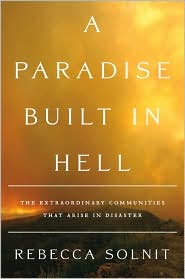
At a time when there is such polarization on many public policy issues, it was striking to read books by two authors from different sides of the political spectrum who, in a different ways, both argue for more of a bottom-up approach — and the centrality of local communities — to disaster preparedness and response.
In Homeland Security And Federalism, Mayer, a former DHS official who now leads the Heritage Foundation’s Homeland Security And States Project, traces the “nationalization” of disaster preparation and response. He argues the U.S. ”must reverse” that centralization and return to a more federalist approach which puts more responsibility in the hands of states and localities.
In A Paradise Built In Hell, Solnit, a contributing editor at Harper’s magazine, also focuses on the role of communities in responding to crisis. Using well reported case studies from five major North American disasters, including 9/11 and Hurricane Katrina, Solnit shows how (contrary to popular perception fostered, she argues, by Hollywood and the media) citizens do not panic but instead rise to the occasion in disaster. These two authors may come at the topic from disparate locations, but they both present similarly strong arguments for local empowerment and responsibility.
That theme is also touched upon in another new book, John Farmer’s The Ground Truth: The Untold Truth Of America Under Attack on 9/11(Riverhead Books). Farmer, a “9/11 Commission” staffer and former New Jersey Attorney General, looks closely at the nation’s response to the attacks during the day of September 11th. In his conclusion, Farmer’s first “starting point” is that “Crises are lived from the ground up, not from the top down.”
I will be writing more about these interesting books and interviewing their authors in the days to come.
These icons link to social bookmarking sites where readers can share and discover new web pages.
“The Family Preparedness Planner and the Shelter Finder provide interactive ways for residents to answer logistical questions that would arise in an emergency. The Planner is a personalized tool to assist Bostonians in creating an emergency plan and kit. In the Planner, residents enter addresses of important locations such as schools, workplaces, and an out-of-town meeting place; contact information for family, workplaces, schools, and doctors/veterinarians; and digital photos of household members and pets.
The Shelter Finder helps residents identify, map, and find directions by foot, car, or public transportation to their nearest Neighborhood Emergency Center. Pre-designated Neighborhood Emergency Centers (NECs) are located throughout the City to provide various types of support services during an emergency. These Centers are designed to support a number of different functions, depending on the type of emergency. For example, they may serve as an emergency shelter, an evacuation pick up site, a distribution site (for personal supplies or medicine), or a cooling/warming center. NECs are typically located in community centers or schools, and are activated by the City should the need arise.”
That’s the question asked on the American Red Cross’ Blog by Abi Weaver after the release of a new report by the International Federation of Red Cross and Red Crescent Societies, “First Aid For A Safer Europe”. Among the report’s recommendations is that first aid be made compulsory in European nations. In her post, Weaver writes:
“This year, our Red Cross colleagues in Europe pulled together a report about first aid trends that made us think – most would agree that first aid skills are fundamentally important, but what really motivates people to take a class?
The report tells us that, at least in Europe, it’s partly because they have to. First aid training is required for people who drive, work in industrial settings and care for children in many countries.
This bold approach means that Europeans are better prepared than most for a roadside accident, household emergency or workplace disaster. For example, the survey showed 95 percent of the population in Norway is trained in first aid. Close behind are Germany and Austria with 80 percent. And Iceland can boast that 75 percent of its people are trained. (Another set of trivia for your weekend social events)
Many U.S. states have also enacted laws that require CPR training for teachers and automated external defibrillators (AEDs) be placed in public buildings, but what do you think? Should first aid training be required in the United States?”
In an interview last month, former U.S. Homeland Security Secretary recommended the development of a course for U.S. schools on planning and preparation which would include teaching first aid. The Red Cross blog is currently running an online poll on the question of compulsory first aid training.
These icons link to social bookmarking sites where readers can share and discover new web pages.
The one-hour webinar is co-sponsored by the American Public Health Association, the International Association of Emergency Managers and the National Association of Government Communicators.
It will feature a terrific panel including Dr. Marsha Vanderford, Director of Emergency Communication Systems, CDC; Nigel Snoad, Lead Capabilities Researcher, Microsoft Humanitarian Systems; and Phil Dixon, Business Product Manager, Google; and the inimitable David Stephenson, Principal, Stephenson Strategies. If you are interested in registering for the webinar, click here.
These icons link to social bookmarking sites where readers can share and discover new web pages.
The traditional view of disaster communications holds that in an emergency, information and instructions must flow from an informed federal government, down to local communities and individuals. This view is dangerous and potentially harmful because it fails to distinguish sharing information from centrally controlling decision making. Traditional post-disaster communication centers on issuing orders rather than sharing information; it tells individuals what to do rather than empowering them to make their own decisions.
This experts-know-best mentality can be especially dangerous during and immediately after disasters. Because disasters are unplanned, attempting to conform them to normative prescriptions can create immense harm. Encouraging widespread dissemination of timely information, by contrast, does not make assumptions about what will happen in the future.
However, using a number of case studies from recent emergencies (including from Mercatus’ own extensive work in the Gulf Coast post-Katrina), the authors outline a new view of disaster communications. They conclude:
Information is only useful in context; knowing that the Earth revolves around the sun matters for the study of the cosmos, but it does not make much of a difference to our daily lives. During and after disasters, the context-the situation on the ground-is constantly changing, and information adjusts with it. Information is most useful when it is timely, accurate, and intelligible; that is, when it helps people make informed decisions about how to best deal with and recover from disasters. And that information is best produced and disseminated on a local level.
The traditional model of how information is produced and disseminated during and after disasters is based on old and disproven assumptions: that a central planner knows best and can disseminate orders to the masses, who must follow these directives. This model was churlish before the widespread democratization of information and communication technologies; today it is positively antiquated. As we have seen in the aftermath of disasters both natural and man-made, information travels in a variety of directions and through a variety of means. Attempts to control the spread of information will only be counterproductive, as people want information on which they can make informed decisions, not orders about what to do.
Because during and after a disaster everyone knows something — and nobody knows everything — the goal should be to aggregate and disseminate accurate information in a timely way. And the best way to do that is to respect that everyday citizens are producers and disseminators, and not just consumers, of all-critical information.
I recommend this article to anyone interested in disaster communications. Thanks to Jeannette Sutton’s Twitter feed for bringing this piece to my attention.
These icons link to social bookmarking sites where readers can share and discover new web pages.
San Francisco Mayor Gavin Newsom yesterday announced “The Big Rumble” marking the 20th anniversary of the Loma Prieta earthquake with a week-long series of special preparedness events. In a letter to the community, Newsom wrote:
“To commemorate the Loma Prieta anniversary, we invite you to participate in The Big Rumble, a week-long series of special events designed to connect our communities with preparedness resources. From October 13th-17th, these events will take place at large City venues and at smaller venues in various neighborhoods, as well as in other parts of the Bay Area.
The week will begin with a panel discussion on the 1989 earthquake on October 13th. On October 15th, San Francisco will participate in the Great California ShakeOut. This event consists of a statewide Drop, Cover and Hold Drill. City departments, businesses and other partners will also test aspects of their emergency plans during the ShakeOut event.
A series of neighborhood events will take place on October 17th, including block parties in San Francisco and throughout the Bay Area. These block parties will serve as localized gathering spots for neighbors to rally around the important topic of preparedness. ‘Block Party Toolkits’ will be provided to assist in the development and promotion of the parties. In addition to a “how-to” guide for planning your block party, the toolkit includes:
*Pocket-sized map of San Francisco full of potential resources and emergency tips
*Map Your Block workbook to integrate neighborhood capabilities into your plan
*Activities, helpful hints, and information to assist you with hosting a successful block party
As residents of an earthquake-prone area, it’s our responsibility to ensure that we are prepared. Our goal is to enhance preparedness not just at the individual or household level, but also at the community level. That’s why we encourage you to hold a block party on October 17th. It will be a great way to get to know your neighbors and put measures into place that will help you support each other following an earthquake or other emergency event.
For more information about the upcoming events, and to download the “Block Party Toolkit,” go to www.TheBigRumble.org.
These icons link to social bookmarking sites where readers can share and discover new web pages.
The headquarters of the American Red Cross of Greater New York is just a few blocks away from the Ed Sullivan Theater on Manhattan’s West Side where the “Late Show With David Letterman” is taped. So, it’s only appropriate that the chapter’s employees just put together a ‘Top 10 Tips For Preparedness Month’ video (below) which can be found on their ARG/GNY News Blog.
Among the ‘Top 10′ participants in the video are: Chief Administrative Officer Richard Kane (”Replace Alarm Batteries”) Chief Response Officer Scott Graham (”Help Neighbors Prepare”), Chief External Affairs Officer Rosemary Mackey (”Make A Plan For Pets”) and Chief Executive Officer Terry Bischoff (”Learn First Aid & CPR”).
AMERICAN RED CROSS OF GREATER NEW YORK’S ‘TOP 10 TIPS FOR PREPAREDNESS MONTH’ VIDEO (ABOVE)
I also wanted to post another recent video from the Greater New York Chapter. In a very straightforward but compelling manner, Senior Director of Health Services Jim Parker makes a good case for learning CPR.
THE RED CROSS’ JIM PARKER URGES PEOPLE TO TAKE CPR TRAINING (ABOVE)
These icons link to social bookmarking sites where readers can share and discover new web pages.
To garner a better understanding of what its residents could contribute to disaster response and recovery, Adair County, Iowa, is surveying its citizens to determine their availability for volunteering and how they’d be interested in contributing.
Robert Kempf, emergency management coordinator of Adair County, said in the past the county has relied heavily on service clubs if it needed volunteer support. “With the more advanced planning that we try to do now, we’ve decided we should try to solicit more people instead of depending on the groups,” he said. “In the rural areas, the same groups get called on again and again to help.”
The emergency volunteer survey asks residents when they would be available and what type of help they’re interested in doing – food services, baby-sitting, clerical work, answering phones, etc. It also finds out of residents would be willing to donate the use of their chainsaws, tractors or other machinery that could be used to aid emergency response.
This type of disaster volunteer ‘census’ is a terrific idea not only because it adds to the assets a community has to respond to an emergency, but also reaching out to everyone underscores the point — often made by Fugate — that every citizen is part of the local disaster preparedness and response “team”.
Though it divided on whether or not to maintain the color alert system, a U.S. Department of Homeland Security (DHS) advisory committee yesterday unanimously recommended that the Obama Administration make the government’s terrorism warning communications more robust, specific, transparent and actionable.
The Homeland Security Advisory System Task Force was appointed earlier this summer by DHS Secretary Napolitano. It was co-chaired by former top government officials Frances Townsend and William Webster. Napolitano will discuss the report with the White House and other members of the Cabinet before making any changes.
From my perspective, the report is generally on target. It correctly focuses much of its critique and recommendations on the public (one of the alert system’s “two primary audiences”) and emphasizes the need to improve government warnings to the citizenry whether or not the colors remain. By contrast, the report says the current system has “functioned reasonably well” for the other audience, “institutions” (ie. government/private sector), especially as alerts have become more targeted geographically and to specific industries.
“The system’s ability to communicate useful information in a credible manner to the public is poor. Significant rethinking of how to communicate to this audience is warranted,” the report concludes, adding, ”The Task Force members agreed that, at its best, there is currently indifference to the Homeland Security Advisory System and, at worst, there is a disturbing lack of public confidence in the system. In our judgment, this lack of public confidence must be remedied.”
As today is the last day that you can vote in the U.S. Health and Human Services’Â H1N1 Flu Prevention PSA contest on Flu.Gov, I thought I would ask some folks from the worlds of social media, public health and/or emergency preparedness for their top pick from the 10 worthy finalists.
Among those I surveyed, the most popular entry was “H1N1 Rap By Dr. Clarke” (which was also my favorite) with “Hazmat” second and several other finalists also receiving support (their PSAs are below). You can watch all the nominees and vote here through tonight.
PICKS
Sharon Sanders, FluTrackers.com– “They are all great! ‘H1N1 Rap by Dr. Clarke’ is my favorite. Apparently he wrote and performed the lyrics himself! If that Doctor gig does not work out, he has a real career in the music industry waiting for him!”
Jolie Kaye Breeden, University of Colorado’s Natural Hazards Observer — “I love the ‘Hazmat’ guy the best, although ‘Toothbrush Prank’ is also good at driving the message home-and might serve the dual purpose of getting my daughter to stop leaving her toothbrush on the bathroom counter.”
Nedra Kline Weidrich, Weidrich Communications — “‘Toothbrush Prank’. IÂ thought it made the point really powerfully.”
Rich Cooper, SecurityDebrief — “It’s a coin toss between the ‘Chainsaw’ and the ‘Flu Droplets’. I actually think the ‘Flu Droplets’ is better given it shows what happens when you don’t cover your mouth and that’s the message that needs to get out there….”
David Konig, EMS Blog Rounds –“My favorite is ‘Bagman’, but I’m also a fan of ‘Hazmat’. Similar themes that I think convey the point clearly.”
You can watch all 10 of the finalists and vote here through 11:59 p.m. EDT tonight. The winner will receive a $2500 prize and have their PSA featured on national television.
These icons link to social bookmarking sites where readers can share and discover new web pages.