On October 4th, it will be 10/4 and out for the Department of Homeland Security’s (DHS) interesting online experiment, A National Dialogue on the Quadrennial Homeland Security Review. The third and last round began this week and will run through Sunday.
The Dialogue tool was developed by DHS with the National Academy of Public Administration to help solicit input from stakeholders, including the public, on the “Quadrennial Homeland Security Review (QHSR). The QHSR is a congressionally-mandated process which will help guide the nation’s homeland security policies over the next four years. The final report is due on December 31st.
As part of the Dialogue, participants can weigh in on five areas – “Counterterrorism,” “Borders,” “Immigration,” “Disasters,” and “Risk Assessment”. In this round, users are being asked to comment particularly on the “objectives” and “outcomes” that are laid out for each. This public input through the Dialogues has complemented the work of the Department’s own QHSR study groups.
To kick off the third round, DHS held a ‘blogger roundtable’ yesterday with Deputy Assistant Secretary (Strategic Plans) Alan Cohn. There were similar roundtable briefings at the beginning of the first and second Dialogues as well.
During the second round which took place earlier this month, there were 11,000 unique visitors (up from 8,000 in the initial round) who posted 2000 comments, 4000 ratings and 400 ideas, according to Cohn. “We’re extremely happy with the level of public engagement, and we really would like that type of engagement to continue [in the third Dialogue].”
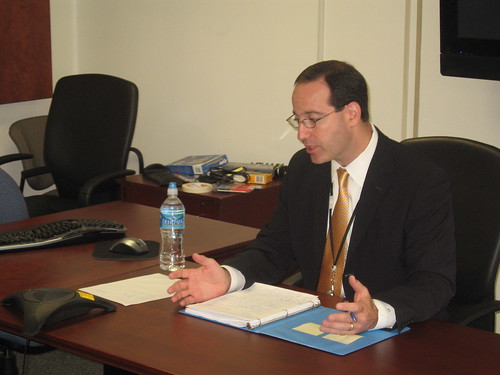
DHS DEPUTY ASSISTANT SECRETARY ALAN COHN ANSWERS A QUESTION DURING THE ‘BLOGGER ROUNDTABLE’ TELECONFERENCE AT DHS HEADQUARTERS.
The “Disasters” category (which is formally titled, “Preparing for, Responding to, and Recovering from Disasters”) has evolved through the Dialogue process with the concept of “resilience” becoming fully front and center to the vision, goals, objectives and outcomes. The challenge is fleshing out what “resilience” is, what it means for all the various stakeholders, and how to get there. The Dialogues, according to Cohn, is one way to include the nation in the process of answering those questions. In fact, the entire online project is the most concrete manifestation yet of DHS’ Secretary Janet Napolitano’s oft-expressed commitment to involve the public in making homeland security a “shared responsibility.”
Cohn said that most of the online contributors to the Dialogue have been from some part of the broad homeland security community but that many of them also commented in areas where they are not experts but rather just members of the general public  (ie. dealing with airport security, border crossings).
In a speech marking the end of National Preparedness Month, DHS Secretary Janet Napolitano today asked Americans “to raise your hand and ask ‘What’s our plan’” at their schools, workplaces, houses of worship, social organizations, and homes.
The full speech text has not yet been released but in the Department’s “Leadership Blog,” Napolitano summarized its contents:
“Today, in remarks at the American Red Cross, I’m speaking about another important mission: readiness and resilience. Our nation may be better prepared than we were before 9/11. But there is much more we can – and should – do. And to get there, we must treat our nation’s preparedness as a shared responsibility, one where everyone has a role to play.  Civilians are usually the first to arrive in a crisis, and history shows that they are critical in those important first minutes. And these citizen responders can be an even more potent force by:
Taking CPR training from the Red Cross;Â Training with a Community Emergency Response Team (CERT);Â Knowing when to take shelter or evacuate;Â Pre-planning evacuation routes and where to meet after a disaster strikes
If a disaster struck your hometown, that training, those skills, and those plans would free up first responders and emergency personnel to focus on those most in need.
So today, I’m calling on all Americans, across the country, to do two things.
First, take these basic steps: get an emergency kit; make a family reunification plan; and become informed about the types of emergencies your community is most likely to encounter.
Second, I’m asking all of us who are in book clubs, prayer groups, school boards, alumni associations, or other community organizations, simply to raise your hand and ask, “What’s our plan?â€
Together, we can build a culture of readiness and resilience, and together we can build a more secure future.
I think that Napolitano’s emphasis on asking Americans to ask “What’s our plan?” in all aspects of their lives is a good one. It’s catchy, relatively easy remember (and to do) and is something that can have a big impact on a community’s preparedness. Of course, the person who does the asking may find themselves given the responsibility for answering the question for the group. But it is in our own self interest to make sure the places we frequent do have a good answer to the Secretary’s question.
DHS SECRETARY JANET NAPOLITANO, WITH RED CROSS PRESIDENT GAIL MCGOVERN, AFTER HER SPEECH
“When families are prepared—when communities stand together and stand tall—so does our nation,†she said, adding. “United, we send a powerful message to those that seek to do us harm: we cannot be broken, we are America—strong and resilient.â€
“America’s history is not written by the tragedies that have befallen us, but by how we responded to them,†said Secretary Napolitano. “Since our earliest days, every time we have been challenged or have seen tragedy, Americans have shown a sense of purpose and resilience.â€
“We should measure our nation’s security not just by the borders we strengthen and the laws we enforce, but also by the strength and resilience of the communities we build,†said Secretary Napolitano.
U.S. Homeland Security Secretary Janet Napolitano will be delivering a major speech on preparedness at 2:15 ET at the Red Cross in Washington, D.C. to mark the end of National Preparedness Month.
In the speech, she will make a request that citizens: Stand up at school, or at work, or at home, and ask, “What’s our plan?†Napolitano will ask Americans to bring that question up “the next time you attend a meeting at your child’s high school, or at church, or around the dinner table.”
With news of several alleged terror plots across the U.S. just weeks after the nation marked the eighth anniversary of the 9/11 attacks, there have been renewed calls from current and former top officials warning Americans to avoid “complacency” and to continue to be “vigilant” about the potential terrorist threat. From the public’s perspective, that raises questions not only of what they should be doing differently but also of exactly what “complacency” and “vigilant” specifically mean when it comes to them.
One answer was offered by DHS Secretary Napolitano in an interview with the Washington Post earlier this month. When asked about what keeps her up at night, she said, “Complacency…The fact that it has been eight years since 9/11, and people just assume the government is going to take care of that. . . . Safety, security is a shared responsibility. It doesn’t take much for everybody just to take a deep breath and say, ‘Okay, what would I need to do to be prepared?’
To date, the most tangible way the public has been told to stay “vigilant” has been to keep an eye out for suspicious activity by such awareness programs as “See Something, Say Something”. Most officials I have spoken to have told me they feel these types of campaigns have been useful (though there has not been much feedback to the public on exactly how). But do the concerns expressed by officials about “vigilance” and “complacency” mean that law enforcement want more and better information from the general public? If so, that needs to be explained more explicitly.
Secretary Napolitano has called for Americans to be in a “state of readiness,” and she has pledged to treat the public as “an asset” in the nation’s homeland security. (She will be elaborating on these themes in a speech on Wednesday at the American Red Cross in Washington that will emphasize, according to a DHS press announcement, “the nation’s shared responsibility for preparedness” and “will focus on the important role that citizens must play in building a national culture of readiness and resilience.” It will be streamed live at www.dhs.gov)
As part of that shared responsibility, Napolitano has said, correctly, that the public should be viewed as part of the nation’s homeland security team. To continue the metaphor, if the public is to perform best as players on that team, they need more coaching as well as more context about the ‘game plan’ and the ’scouting report’.
Clearly, there is a limit to what can be disclosed without comprising intelligence sources and methods, but many in law enforcement believe that more can and should be told to the public. A goal of that education process should be highlighting how citizen involvement actually helps and more precisely what citizens should (and should not) be doing.
That was actually the finding of a recent FEMA/Citizen Corps public survey which which noted : “Individuals believed they had a personal responsibility to report suspicious behavior, but greater collaboration between citizens and law enforcement is needed.â€
Of course, the idea of expanding public involvement in homeland security can bump up against some sensitive areas. And, as DHS Secretary Napolitano has said on a number of occasions she does not want this to instill fear among Americans nor raise civil liberties concerns. It is indeed a careful balance.
Another aspect of addressing public “complacency” was raised by Former DHS Secretary Chertoff, in an interview last month. He expressed his concern that Americans not be “complacent” in their role as voters/citizens and urged them to continue to support government investments in preventing and responding to terror threats, particularly in the biological and nuclear area.
These icons link to social bookmarking sites where readers can share and discover new web pages.
As I’ve mentioned before, one of the most challenging aspects in the effort to plan for a possible H1N1 pandemic is dealing with the business sector. Unlike schools, there is no central managerial authority to make and implement policies; guidelines have to be created and implemented on a firm by firm basis. It will also have to be done on a volunteer basis as there are no laws or mandates (ie. compulsory sick leave) in most of the country. This will be particularly challenging for smaller companies and their employees. If workers who are ill (or have sick kids home from school) aren’t going to be paid or fear losing their jobs, they may will ignore public health recommendations to stay away from the workplace — which will obviously hamper efforts on H1N1.
I think that one way officials at local, state and federal levels can be helpful is by highlighting businesses of all sizes who are already making plans for their workforce. This attention would provide guidance, encouragement (and, in some cases, pressure) for other organizations. Using the bully pulpit in that way would underscore how seriously the government takes this and make special planning/policies for H1N1 seem like the norm not the exception. The media can also play a constructive role here by examining what is and is not being planned by organizations in their areas. The Minneapolis/St. Paul Star-Tribune recently had a couple of helpful articles along those lines which I wanted to post. According to “Next Test: Flu 101″:
…With the number of flu cases expected to peak within the next five to seven weeks and send absenteeism rates soaring, experts at a national conference in Minneapolis on Tuesday recommended that companies do what they can to make sure sick workers stay home. Suggestions include loosening sick-leave policies or allowing workers to use time off that they haven’t yet accrued.
Some companies already have taken that a step further. Medtronic Inc. is giving all its U.S. employees, including hourly workers, three extra paid sick days because of H1N1. The Fridley-based medical-device manufacturer said its decision was based on concern that workers would still come in despite being sick. “We were getting concerns from particularly the hourly side that if they’d already used up their sick time, well then what?” said Tanya Raso, Medtronic’s director of corporate risk and business continuity. “And managers were feeling some of the pressure of: ‘I’m going to send this person home and potentially they’re going to miss their car payment as a result.’ This will help alleviate concerns on both ends.” Raso said she realizes that some abuse might take place but that the company is relying on the honor code.
Best Buy is telling its managers to make sure employees know it’s OK to take sick time. It’s also telling managers to tell workers to go home if they appear to be sick. If a worker who doesn’t have sick time is sent home during a shift, managers are encouraged to pay the remainder of that day’s shift.
Focusing on the region damaged by Hurricane Katrina four years ago, the RAND study examines the ongoing policy and financial challenges that nongovernmental agencies face when supporting the often-overlooked area of long-term human recovery. ”What we’re seeing in New Orleans and other communities devastated by Hurricane Katrina is that recovery is more than just restoring roads and buildings,” said Anita Chandra, lead author of the study and a behavioral scientist at RAND, a nonprofit research organization.
“Human recovery includes things like rebuilding people’s social routines and a community’s support networks — actions that help restore a community’s physical and mental health,” Chandra said. “This is the kind of work nongovernmental organizations can do so well.”
Nongovernmental organizations such as the United Way and the American Red Cross have proven they can be invaluable assets to a community after a disaster, but their roles are poorly defined and frequently not supported by state and federal guidelines, Chandra said. ”There needs to be more recognition on the state and federal level that it may take years, not just months, for a community to truly recover,” said Joie Acosta, the study’s co-author and an associate behavioral scientist at RAND.
In April 2009, researchers from the RAND Gulf States Policy Institute, part of the RAND Corporation, the Louisiana Family Recovery Corps., the Louisiana Association of Nonprofit Organizations and the United Way of New Orleans met with local leaders from 47 Louisiana organizations in New Orleans.
The group discussed experiences from the region’s recent hurricanes, identified challenges the groups continue to face in supporting human recovery, and compiled recommendations to bolster support for communities and enhance the involvement of nongovernmental organizations in long-term recovery.
Among the findings:Â Human recovery is not well-defined at the federal, state or local level and there is no national recovery framework;Â Long-term human recovery takes longer and is more complicated following multiple disasters;Â There is no comprehensive system of services or operating plan to support human recovery;Â The federal Robert T. Stafford Disaster Relief and Emergency Assistance Act is designed to meet the needs of small disasters, but can create roadblocks when considering the needs of communities with long recovery periods.
Lieberman and ranking member Sen. Susan Collins (R-ME)Â introduced a bill that would implement many of the extensive recommendations of the commission’s report, World at Risk. “The mental images of mushroom clouds and nuclear blasts are powerful and frightening,” Lieberman said. “But as the Graham -Talent Commission rightly notes, the more likely terrorist threat is from a biological weapon,”
While there is some debate among experts on which weapon of mass destruction, biological or nuclear, is more likely (and which is the more serious threat), there is general agreement that both would be very serious and  would probably be much worse than the other two threats — chemical and radiological — that are usually included in the term’ WMD’ (including by the Commission itself). Yet, as the Commission itself reports, the latter two are not weapons of mass destruction in the same category as the first two. It’s not that chemical or radiological attacks would not kill ‘mass’ numbers of people, but the potential magnitude is much different.
The question of ‘WMD’ nomenclature came up yesterday with the indictment of Najibullah Zazi for conspiring to use “weapons of mass destruction” in connection with a terror plot, news reports say, to set off explosives here in New York City along the lines of the July 2005 bus attacks on London’s subway and bus system. Those bombings were horrific; 56 people were killed and many more people could have died. But the scope of casualties from a ‘traditional’ explosives is likely not be at the level of what potentially could happen in a biological or nuclear incident. I would guess that there was probably some confusion among the public upon hearing Zazi’s bombing plot being characterized in the indictment as a “weapon of mass destruction.”
In a post after the WMD Commission released its report, I argued that the term ‘WMD’ should be redefined and why I think it matters and isn’t just semantics. An excerpt is below:
In its report, the WMD Commission argues that the incoming Administration should make an effort to inform and engage the public on the subject of WMD’s. I agree. And, I suggest officials consider starting that process by defining (or redefining) what a WMD actually is. At present, it is most common to define a WMD for the public as a chemical, biological, radiological, and nuclear (or “CBRNâ€) weapon.
The Commission report, however, focuses primarily on the dangers of biological and nuclear terrorism, both of which could be absolutely catastrophic. By contrast, a chemical or radiological (better known as a ‘dirty bomb’) weapon could be very serious but would likely not cause as much lasting damage. In fact, both a chemical and radiological attack would likely be a one-shot event seriously impacting those directly near the event, closer in result to a ‘traditional’ terrorist bombing. A nuclear bomb or biological incident, however, could have wide and long-lasting ‘mass destruction’ impact to humans, property and the society itself.
“While the mandate of the Commission was to examine the full sweep of the challenges posed by the nexus of terrorist activity and the proliferation of all forms of WMD-chemical, biological, radiological, and nuclear-we concluded early in our deliberations that this report should focus solely on the two types of WMD categories that have the greatest potential to kill in the most massive numbers: biological and nuclear weapons.â€
When I speak to experts, they tend to divide nuclear and biological from chemical and radiological. I believe they should be communicating that dichotomy to the public. In fact, I believe that a vital part of educating and engaging citizenry on terrorism is giving them a more precise sense of potential terror weapons. It turns out that some of those threats are actually not as scary the more you know about them. But the time to tell people is before an incident not during it. That’s important because it allows policymakers and responders to focus time, money and public attention on the most dangerous threats.
The Obama Administration has taken the advice of the Commission and will appoint a WMD Czar, Gary Samore. I would hope that one aspect of his job is public education — and that defining (or redefining) what exactly WMD’s are is part of that effort.
Obviously, what we call these weapons is far less important than to preventing their use. But words do matter particularly on these sensitive, serious matters. And, therefore, I do think that better defining WMD’s for the public is something worth taking up.
These icons link to social bookmarking sites where readers can share and discover new web pages.
Speaking to a workshop on crisis communications yesterday, DHS Secretary Napolitano said both ‘old’ and ‘new’ media “can and need to” continue to address the accuracy of rumors and conspiracy theories on homeland security issues such as H1N1 and terrorism. In her remarks, she also outlined some other news/information challenges faced by the media as well as government officials on homeland security, including “the ability to communicate that things will change without undermining public confidence.”
Napolitano spoke in Baltimore to the “News & Terrorism: Communicating In A Crisis†program (described in the previous post below). It was the 17th workshop in the series which was created in 2004 by the National Academies of Sciences along with DHS and the Radio Television News Directors Association. After the Secretary’s comments, the participants — mostly local media and government officials —  took part in a tabletop scenario involving multiple terrorist bombings in the Baltimore area. Excerpts from the speech are below:
“…print, television, radio, text, Twitter, et cetera, et cetera—all forms of media—can and need to be an accurate source of information, so that as rumors spread or as conspiracy theories abound, or as fears that we are facing—for example, in the spring, the upcoming death of millions of Americans from the flu— we can begin jointly to get accurate information out and accurate assessments about what the risk really are. And also because I view security as a shared responsibility among individuals, families, businesses, so that people can be properly prepared about what they will need to do…
…I know the goal of today is pretty straightforward—is to more effectively work together during a crisis, specifically a terrorist attack—and those will be important steps to take. What you may want to be thinking about, however, is [how] you handle reporting an alleged terrorist investigation—as the investigation is going on when there has been no actual attack. Because there—there are judgments to be made from the media side as well.
I think one of the values I hope you take away from today is a better mutual understanding of what everybody is doing and what they are coping with. And that leaves from the government side, a better understanding, too, of what the media is coping with—that we will develop out of this some ways to more effectively work together and also, a deeper, more profound understanding of how incidents actually happen and how they are managed from a news perspective.”
SECRETARY NAPOLITANO SPEAKS TO “NEWS & TERRORISM: COMMUNICATING IN A CRISIS” WORKSHOP IN BALTIMORE. [Read more →]
These icons link to social bookmarking sites where readers can share and discover new web pages.
In Baltimore today, about 120 area journalists, government officials, business executives and scientists faced the following [mock tabletop] situation:
A major explosion at City Hall; another explosion at Baltimore’s World Trade Center; gunmen firing upon those on at the two sites; their actions are obviously being coordinated using complex communications partly utilizing info/images broadcast by the media; white powder found on one of the gunman who is killed my police; field test for bio agents inconclusive; responders in HAZMAT broadcast live; Communication is lost from a Coast Guard boat intercepting a suspicious vessel; numerous other smaller explosions throughout the city; and the terrorists using new media to increase the terror.
The scenario is the centerpiece of the latest workshop in the  “News & Terrorism: Communicating In A Crisis” program created in 2004 by the National Academies of Sciences along with the Radio Television News Directors Association and the Department of Homeland Security.
Among the “News & Terrorism” program’s goals are: fostering a better understanding of how each group responds to a crisis;Â learning each others needs, requirements, and obligations;Â determining the preferred means for communicating in a crisis;Â providing participants with additional contact information and networking opportunities to enhance both news coverage and a specific understanding of these situations.
I participated in one of the first “News And Terrorism” workshops held in Philadelphia in 2004 and afterwards did a story about the program for National Public Radio’s “On The Media” show. The workshops were originally developed by the National Academy of Engineering’s Randy Atkins along with the RTNDA’S Barbara Cochran. (By the way, the RTNDA announced yesterday that it will be changing its name to the Radio Television Digital News Association or RTDNA.
These icons link to social bookmarking sites where readers can share and discover new web pages.
HHS Secretary Kathleen Sebelius announced this morning that “H1N1 Rap By Dr. Clarke” by Dr. John Clarke of Baldwin, New York is the winner of the Flu.Gov PSA contest. “H1N1 Rap” was chosen by the public from among 10 finalists with more than 50,000 votes cast. Dr. Clarke’s video was ‘endorsed’ by this blog and was the top pick of experts I contacted.
“H1N1 RAP BY DR. CLARKE” (ABOVE), THE WINNING VIDEO IN THE HHS FLU PREVENTION PSA VIDEO CONTEST
The “H1N1 Rap” was chosen from more than 200 entries. Out of these initial entries, a panel determined the top 10 entries which were posted on the HHS YouTube Channel and put to a public vote. Dr. Clarke will receive $2500 in cash and his PSA will be featured on national television.
The announcement was made at a flu prevention ‘town hall’ for college students at George Mason University (a video of the event, including Dr.Clarke’s ‘acceptance speech’ can be found here). In his remarks, Clarke, who is the medical director of the Long Island Railroad, thanked “the voters, blogs and Twitter” as well as his wife who suggested he do the video. I believe Clarke — who Sebelius called the “hip-hop doctor” — could be the breakout star of the Fall.
I think it was a terrific idea for HHS to solicit, unleash and highlight the creativity from Americans of a variety of ages, backgrounds, and points of view for this contest. It was fun, citizen-driven/focused, and most importantly I believe will be effective in raising flu preparedness among the public.
These icons link to social bookmarking sites where readers can share and discover new web pages.