Homeland Security Advisory System Task Force Co-Chair Frances Townsend said in an interview last week that even when a final decision is made on the terror color levels there is still work to be done in determining both the content and the distribution methods for best alerting and informing the public on terrorism and other threats.
U.S. Homeland Security Secretary Janet Napolitano appointed the Task Force, co-chaired by Townsend, President Bush’s top terrorism adviser, and former FBI director William Webster, earlier this summer. Upon receiving the report last month, Napolitano said she would discuss the findings with the White House and other members of the Cabinet before making any policy changes.
Though its members split on whether to retain the color system, the Task Force unanimously recommended that the Obama Administration make the government’s terrorism warning communications more robust, specific, transparent and actionable. It said that if the color system was maintained, the levels should be reduced from five to three with yellow or “guarded” being the ‘normal’ state.
In the interview, Townsend said after the color decision is made there will be a need to develop plans both for what is being communicated to the the public and how best to do it. She said that members of the Task Force were struck by “the lack of infrastructure” that currently exists as well as the need for a “common lexicon” and “doctrine” when it comes to emergency alerts.
Making things more challenging — but also offering new opportunities — is the proliferation of new distribution technologies, including personal communications devices and social networking sites. She reiterated the Report’s findings that there is a need to better integrate social media as well as state and local alert initiatives into the federal efforts.
Townsend’s comments come on the heels of two recent General Accountability Office (GAO) reports that showed the need for significant improvements in the planning, coordination and implementation of the federal government’s emergency communications and preparedness for the public. The first, Emergency Preparedness: Improved Planning and Coordination Necessary for Development of Integrated Public Alert and Warning System, highlighted problems with the federal government’s updating of its alert and warning technologies for the public. The GAO concluded:
“Emergency communications are critical in crisis management and for protecting the public in situations of war, terrorist attack, or natural disaster; yet, FEMA has made limited progress in implementing a comprehensive, integrated alert system as is the policy of the federal government. Management turnover, inadequate planning, and a lack of stakeholder coordination have delayed implementation of IPAWS and left the nation dependent on an antiquated, unreliable national alert system.”
As I wrote last month, I think the Task Force correctly focused much of its critique and recommendations in the Report on the public (one of the alert system’s “two primary audiencesâ€). By contrast, the Report concluded that the current system has “functioned reasonably well†for the other audience, “institutions†(ie. the government/private sector), especially as alerts have become more targeted geographically and to specific industries. (I had submitted a ‘memo’ to the Task Force during the public comment period with some recommendations: “Put Your Citizen Hats On, Design With/For Public, Integrate Into Overall Citizen Preparedness Program.”)
Townsend’s comments about the lack of existing “infrastructure” and “common language” on emergency alerts are along the lines of something WMD Commission Chair Bob Graham told me earlier this year. His panel’s report urged the government to better inform and engage the public on the WMD threats. However, when the Commission looked for something to recommend, he recalled, it couldn’t find anything suitable currently out there.
The fact is, as been often mentioned on this blog, there is no existing emergency preparedness information model that can be pulled off the shelf and implemented immediately. It will take some time, attention and thought from the government working with other stakeholders to create a new integrated plan as part of an overall citizen preparedness approach.
Townsend, now a partner at the law firm Baker Botts, said she feels very strongly that the alert process needs a ‘forcing mechanism’ to encourage a return to the normal ‘guarded’ level when the threat passes in order to maintain public credibility. (And that recommendation to Secretary Napolitano was included in the Report.)
In the interview, Townsend expressed disappointment that one important stakeholder, major news organizations, citing potential of conflicts of interest, declined the Task Force’s request to offer recommendations on alerting and informing the public. “It’s too bad,” she said, “It would have been useful.”
Personally, I think there should be a way for media companies to provide the government advice without violating ethical boundaries, particularly as the press has such a crucial communications role during an emergency as well as the expertise. In fact, the National Federation of Community Broadcasters (NFCB), National Public Radio (NPR), and the Corporation for Public Broadcasting (CPB) just announced a new collaboration, Station Action for Emergency Readiness (SAFER) project, to help public broadcasters better serve their communities during disasters.
Townsend also told me an interesting tidbit about the Task Force’s report: while the members divided on whether to maintain the colors, she said the vote “did not break down the way things usually do in Washington” (ie. by political party, geography, state/federal). The members’ positions on the colors may have been based as much on their perspective as citizens as experts — which, by the way, I believe is a good thing. On these civilian preparedness policies, I have increasingly come to the opinion from my reporting that there is a great value in thinking like a civilian.
These icons link to social bookmarking sites where readers can share and discover new web pages.
A year ago today, October 17th, I was diagnosed with Leukemia. That afternoon, I thought I had a stomach flu; by evening, I was hooked up to an i.v. in the hospital beginning cancer treatment.
Though this has not been the best of my 46 years, I am very lucky for a lot of reasons. As of my last blood test on Wednesday, the disease is still in remission. I am feeling good and am now just trying to get myself into shape. I’m back playing basketball, though as one of the players in my regular game has pointed out, chemotherapy has not improved my jump shot.
This blog and its community has been very important to my recovery. I appreciate all the kindness, advice and encouragement I have received from so many people throughout the year.
My own personal disaster has ended up teaching me a lot about the subject matter covered on the blog. It has given me new insight on dealing with trauma, risk, resilience, communicating difficult subjects and even the terror color alerts — though, of course, I would have preferred to learn these lessons in another way! My own crisis and recovery process has energized me even more to work on the preparedness of my community and the nation.
There’s an emergency management truism that disaster response is often as strong as the support systems and community before the crisis. And, it has proved true for me over the past year. Starting at home with my remarkable wife who has made this all as easy for me as physically possible and my two girls who have been profiles in courage. My mom and dad have gone above and beyond for me this year like they have for the previous 45. My brother, as always, has had my back from moment one. And, my mother-in-law has been an incredible help to us throughout.
I am also lucky that much of the rest of my family is here in New York, and I have drawn great sustenance from them. One relative in Boston, a distinguished doctor, has been a constant source of wisdom and optimism no matter how his beloved Red Sox and Bruins did the night before. And, I am lucky to have such good friends who have provided so much support to me and my family — whether it was delivering dinner to us every Friday night, checking in with an email, including me in their prayers, or volunteering to donate blood.
I now have a new appreciation for blood donors. As I sat in the hospital clinic getting infusions as part of my treatment, I looked forward to the time when I would be able to donate myself and return the favor. (I subsequently found out that once you get Leukemia you can never give blood again, but I hope to give back in other ways.)Â I am particularly fortunate to have had access to state-of-the-art medical care: a doctor who is not only brilliant but empathetic; her physician’s assistant who makes every visit pleasant even when she’s probing my hip bone; and the uniformally skilled and kind nurses on the oncology floor (where I hope only to return to visit).
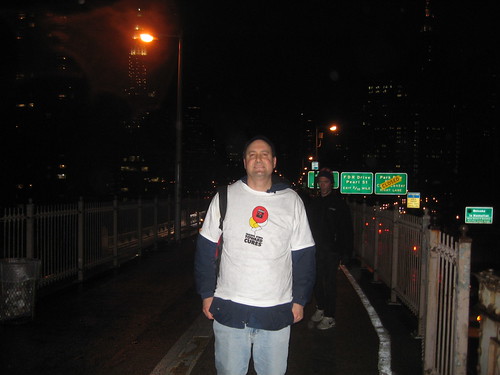
On Thursday night, I took part in my first “Light The Night” walk sponsored by the Leukemia & Lymphoma Society’s New York Chapter. It was overwhelming to see thousands of participants and volunteers braving the blustery wind and cold rain on the Brooklyn Bridge to support the efforts of those working on blood cancers. It was exhilarating to be able to mark this milestone in that way.
WALKING ON THE BROOKLYN BRIDGE THURSDAY NIGHT AT THE LEUKEMIA & LYMPHOMA SOCIETY’S “LIGHT UP THE NIGHT”
This past week, I happened to hear Roseanne Cash’s beautiful song, “God Is In The Roses,” for the first time. It seemed so fitting for how I feel about the past year (and the lyrics are particularly appropriate for a disaster blog):
God is in the roses/The petals and the thorns/Storms out on the oceans/The souls who will be born/And every drop of rain that falls/Falls for those who mourn/God is in the roses and the thorns
Yes, there have been some thorns this year, but it has also underscored how many roses I have to be thankful for. And, sometimes it takes a crisis to remind you of that. Thanks, everyone.
These icons link to social bookmarking sites where readers can share and discover new web pages.
IN SAN FRANCISCO, ACADEMY OF ART UNIVERSITY STUDENTS LISA ALLEN AND SHAOFU ZHANG DROPPING AND COVERING AS PART OF THE GREAT CALIFORNIA SHAKEOUT (Photo: Associated Press)
Schools, businesses, emergency responders and hospitals across the state took part in the drill which came two days short of 20 years since the Loma Prieta earthquake that killed 63 people in the San Francisco-area. To get a sense of how individuals throughout California readied for the simulated 7.8 quake, some participant photos are here.
The ShakeOut offers many lessons for citizen preparedness, including the value of picking one day to focus on, involving adults and children together, as well as making things fun. This is the type major civilian preparedness drill that should be replicated in states and localities around the U.S., tailored of course to the particular risks in that area. But I would argue that taking events like these — and other local preparedness models — Â and spreading throughout the nation would be made far easier if there was a federal citizen preparedness person/office responsible for helping coordinate the issue.
By the way, I checked the three cable news channels at 1:15 ET, and none of them picked up the ShakeOut live. As they weren’t covering any other breaking news (the boy in the flying balloon coverage would not start for a couple more hours), it would have been nice had they given this great preparedness event live national exposure. But there’s another chance: on Saturday, another major earthquake preparedness drill, ‘The Big Rumble,” will take place in San Francisco.
These icons link to social bookmarking sites where readers can share and discover new web pages.
With the H1N1 flu vaccination program now underway, I thought I would ask a public health expert — whose opinion I trust a great deal — what (if any) concerns he had about vaccine’s rollout to the public. I have reprinted his answer in its entirety as I found it useful in highlighting some issues to be looking at. Again, these are potential concerns, but are things to watch going forward:
“My biggest concerns as of the moment:
1) Concerned that a substantial portion of country may be infected before vaccine arrives — will depend on speed with which epidemic moves in next month, as well as speed with which vaccine can be delivered to states, as well as how fast states are able to get vaccine into people.
2) Concerned that large numbers of persons who could get vaccine will choose not to vaccine because of concerns that it is experimental or untested — great deal of misinformation out there on the streets. The Paul Offit editorial in [Monday's] New York Times describes many of the widely circulating beliefs about the vaccine and the actual facts. Poll about 2 weeks ago showed that while 60% of American parents willing to get their kids vaccinated for seasonal flu, only 40% were planning on their kids vaccinated for H1N1 – even though almost all of the flu circulating now is H1N1.
3) Concerned that antiviral resistance could develop –so far there is no sustained neurominidase inhibitor resistant strain circulating, just single cases popping up and very rarely. If sustained resistance occurred, we would lose key tool for treating the sickest patients. It is good sign that no sustained resistance has developed so far, but it would be a non-linear event if it happened. No accepted view from the hard core flu virology community on the likelihood of this happening or not.”
These icons link to social bookmarking sites where readers can share and discover new web pages.
Today, the UN International Strategy for Disaster Reduction (UNISDR) dedicates its annual International Day for Disaster Reduction to the urgent need to make “Hospitals Safe from Disasters.” Dozens of hospitals and heath facilities each year are themselves impacted by floods, hurricanes, cyclones, earthquakes and other natural hazards because safety measures were not integrated in their design, location or construction.
The “Hospitals Safe from Disasters” theme was also used for the 2008-09 World Disaster Reduction campaign that culminates today. This two-year campaign has been a joint initiative of UNISDR, the World Health Organization (WHO) and the World Bank aimed at ensuring people’s access to functioning health facilities during and after natural hazards. The ISDR system is using today’s event to highlight the gains made during the campaign and the work that still needs to be done in making hospitals safer from disasters.
“Since the beginning of the campaign, much has been achieved to make hospitals safer but more investments are still needed to improve the functionality of hospital when disasters occur,†says Margareta Wahlström, Special Representative of the UN Secretary-General for Disaster Risk Reduction. According to a recent WHO survey, only 50% of all country’s health sectors have a budget allocation for risk reduction and emergency preparedness.
For more information, go to the UNISDR website here. (Thanks to friend of this blog, Roberto De Vido who writes the Notes From The Congo blog for bringing the Day to my attention.)
These icons link to social bookmarking sites where readers can share and discover new web pages.
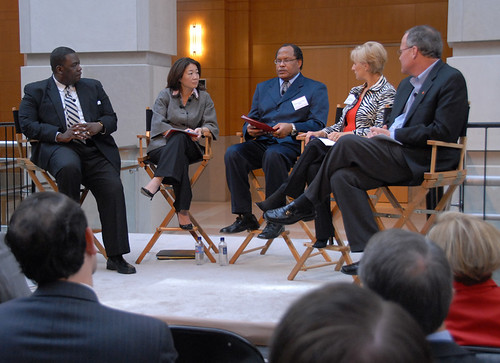
I had the nice opportunity this past week to be the moderator of an American Red Cross “Town Hall” focusing on the growth and evolution of the organization’s partnerships with non-profit groups in disaster preparedness, response and recovery, particularly since the aftermath of Hurricane Katrina.
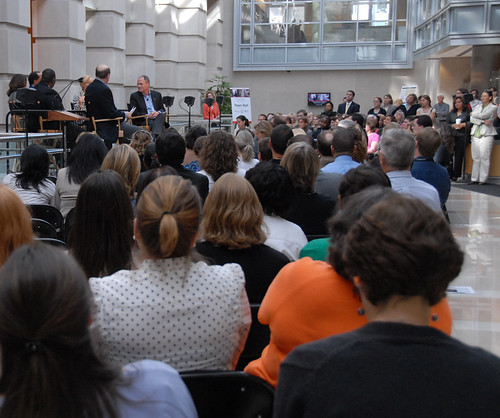
The forum, titled “Convergence and Cooperation: Town Hall With Our Service Delivery Partners,” was held in the atrium of the Red Cross’ headquarters in Washington, D.C. The audience included Red Cross employees and donors.
The panelists were Gene Collins, a Disaster Relief Co-Chair for the NAACP; Â Antonio Boyd, Worldwide Vice President for HOPE Worldwide; Â Kay Wilkins, CEO of the Southeast Louisiana Chapter of the Red Cross;Â Juliet Choi, the Senior Director, Disaster Partner Services, American Red Cross; and Joe Becker, the Senior Vice President Disaster Services, American Red Cross.
AMERICAN RED CROSS “TOWN HALL” PANEL FROM LEFT: ANTONIO BOYD, JULIET CHOI, GENE COLLINS, KAY WILKINS, AND JOE BECKER (Photo by Jennifer Willis, JWillis Photography)
In his remarks, the NAACP’s Collins, whose organization has a long relationship with the Red Cross, highlighted the value of partnerships with non-profit service organizations as a way to best leverage the breadth and depth of emergency resources in communities, especially for underserved populations.
Hope Worldwide’s Boyd told the audience about the successful “Pastors In Disasters” program organized jointly by his group and the Red Cross which helps prepare church leaders for disasters. Hope is a newer partner of the Red Cross, yet it helped mobilize 1,000 volunteers to assist in sheltering operations during hurricanes Gustav and Ike.
Wilkins’ New Orleans-area Red Cross chapter has set up partnerships with the local faith-based community (in a program called Operation Brothers Keeper) and for non-English speaking residents (through the Language Access Coalition). And, Choi cited the role of partnerships in the current disaster operations the Red Cross is involved with in Georgia and American Samoa.
Joe Becker said that partnerships can be challenging, but they are necessary to expand the impact and reach of the service delivery after disasters, particularly to rural, minority, disabled, immigrant and youth populations. And, if Katrina taught the organization anything, it’s that the Red Cross cannot and should not do it alone. Becker pointed out that the Red Cross’ expansion of partnerships with community groups is emblematic of what is happening in the emergency management field generally, which is being reoriented from a strict closed and top-down approach to one that is more dynamic, open and bottom-up.
In fact, the theme of increasing collaboration in disaster preparedness and response was underscored during two events in the days before the panel. First was DHS Secretary Napolitano’s major National Preparedness Month speech given at the Red Cross’ Hall of Service in which she said homeland security was not just a governmental task but instead a “shared responsibility†among all stakeholders.
And then a couple days later at a U.S. House Subcommittee hearing on community preparedness, Homeland Security Committee Chairman Bennie Thompson and lawmakers of both political parties emphasized the importance of strengthening outreach with non-profit groups, particularly in rural and other underserved communities.
“CONVERGENCE & COOPERATION TOWN HALL” HELD IN ATRIUM OF RED CROSS HEADQUARTERS IN WASHINGTON, D.C. (Photo by Jennifer Willis, JWillisPhotography)
These icons link to social bookmarking sites where readers can share and discover new web pages.
Yesterday, DHS Secretary Napolitano visited two pillars of the ‘new’ New York City-based national television establishment — she first appeared on “The View” and then was a guest on “The Daily Show With Jon Stewart”.
It was part of the Secretary’s effort to engage a broader audience, particularly as part of the H1N1 flu public information effort. I thought that both shows in their own styles elicited some interesting, informative and sometimes humorous answers on a variety of questions, many of which may be on the minds of their viewers.
On “The View,” Barbara Walters called Napolitano a “brave woman” for taking the top DHS job, adding with a laugh: “If it works, great. If it doesn’t, it’s all your fault.” Napolitano then took questions from the four-woman panel on a number of hot button homeland security-related issues. The link to the video of the show is here.
The questions (and answers) included: does the government’s H1N1 response comes under the umbrella of Homeland Security? (”It does in a way…We have a coordinating role”); why is the government only vaccinating half the population for H1N1? (They’re not; everyone can be vaccinated.); did the ‘Right-Wing Extremism’ report “discredit the Department” (”It was poorly done as you suggest, and we retracted it.”); “You have not been without controversy?” (”The office is not without controversy.”); what’s the current status of terror alerts system or as Whoopi Goldberg broke out into song, “Where have all the colors gone?” (”The problem is ‘a’ people use it for humor, thank you. But also it didn’t communicate information. ‘What are you supposed to do?’…We are relooking at that system. Is it the right way to communicate good information to people?”); and should Americans still be preparing for terrorism and other disasters? (”Yes.”).
Finally, Barbara Walters asked: “Do you think it’s still ‘if and not when’ in terms of a terrorist attack?” The question was asked, I think, out of real curiosity and not as a gotcha. But it’s something I have not heard the Secretary answer in a public setting. As she started to do so, Walters about to hit a commercial break, asked for a quick answer: “We’re going to be prepared either way,” Napolitano said. A video of Monday’s episode can be found here. The interview comes at the end of show.
DHS SECRETARY NAPOLITANO AT “THE VIEW”
On “The Daily Show,” Jon Stewart’s first question was also about the terror color alert system. Napolitano told him that the Department was “revisiting” it, because “They are the subject of late night humor as you might have noticed.” The video of the “Daily Show” interview can be found here.
Stewart asked about the H1N1 vaccine in his own typical way: “Is it something you would recommend to people or do you not trust the government?” It gave Napolitano a chance to get the government’s flu prevention message out to the “Daily Show’s” young demographic, a focus of the flu outreach effort. She said “this is a bad flu, and it’s a very safe vaccine.” Stewart asked if the government was adding LSD to the vaccine. (Napolitano denied it; Stewart seemed convinced.) Even without the use of LSD, Napolitano said the nation would handle whatever the H1N1 dealt us this year. ”We’ll work the problem…We’ll get through it.”
Stewart concluded the interview by noting, “And if we see something…we should say something” adding, “because I live in New York City, and I see a lot of unusual things.” That actually was a good transition to the third television appearance Napolitano did yesterday — with another ‘new’ pillar of the media establishment Bloomberg Television yet in a more traditional format. In the interview, the Secretary said that there are people with terrorist leanings are currently in the U.S., “It is fair to say there are individuals in the United States who ascribe to al-Qaeda-type beliefs.â€
These icons link to social bookmarking sites where readers can share and discover new web pages.
In a speech concluding National Preparedness Month, DHS Secretary Janet Napolitano urged Americans — when they are in their workplaces and social organizations — to ask a simple question:
“…we’re asking you to raise your hand and ask whenever you are in one of those groups, ‘What’s our plan? You know, the next time your group meets or your staff gathers for lunch, I want you to raise your hand and ask, “What’s our plan?â€Â Any time that you’re with your family and you have a moment, take a moment, say, “What’s our plan?â€, and take time to discuss what will happen if disaster strikes—if there’s an emergency of any type, so that we respond with resilience and preparedness, not with fear.”
It is a simple request but one that can have a lot of impact, particularly as a catalyst for action. I say that from experience. As some of you may know, it was a similar simple question from my wife that led me to my current involvement in citizen preparedness. I wrote about it in an article for the Washington Post:
In the weeks after 9/11, my worried wife asked me, “What should we be doing?” We lived directly across the street from the Manhattan hospital where a woman had just died from anthrax exposure; I worked only a couple of blocks from the World Trade Center. Initially, I thought that the answer to her question would be pretty straightforward. But 6 1/2 years later, I’m still trying to pin it down.
I have found that there can be a lot of value in asking the basic — some might say the ‘dumb’ — question when it comes to public preparedness, in part because the often it has not been fully answered (or in some cases not even asked). I hope that DHS follows up on the Secretary’s call to Americans and highlights how workplaces and social organizations respond.
By the way, Napolitano will be answering a lot of questions — some basic and ‘dumb’ but also probably illuminating — later today when she appears here in New York City as a guest on both the “The View” and “The Daily Show with Jon Stewart”.
These icons link to social bookmarking sites where readers can share and discover new web pages.
Michael Coston at the Avian Flu Diary had another helpful post today in which he highlighted a good citizen H1N1 prevention idea from Seattle’s Carol Dunn (also a terrific preparedness resource).
She suggests that when it comes to the flu every American should make this commitment: “If you get sick, pledge to yourself: ‘This germ stops with me.’ Don’t pass it forward.” In his post, Coston writes:
“Yesterday, on Twitter, this `tweet’ came across my desktop from @Caroldn. It was so good, I immediately re-tweeted it.
“A simple enough message. Yet – if we all followed this advice – we could substantially reduce the impact of this pandemic virus practically overnight. You see, this novel H1N1 virus needs fresh, susceptible hosts in order to survive. Each person who gets infected, on average, ends up passing on the virus to between 1.5 to 2.0 other people. If we can reduce that number, we slow the pandemic. We break the chain of infection. Which means, if you are sick. Please stay home.”
Of course, for some workers — who may fear losing their jobs or being docked pay — staying home may not seem like a viable option, particularly if they can physically make it into the workplace. However, hopefully, employers increasingly will be making special allowances including sick leave in the event of a major outbreak. Because as Coston points out, “the marginal gain you might get out of having that person working isn’t worth the risk of their infecting other employees or your customers.”
These icons link to social bookmarking sites where readers can share and discover new web pages.
In a recent post ‘An Appropriate Level Of Concern’ on his very helpful blog Avian Flu Diary (AFD), Michael Coston, asks and answers a key question a lot of people have about the H1N1 flu:
“Just how concerned should the average (insert your nationality here, AFD gets visitors from more than 100 countries) be about this novel H1N1 pandemic virus? It isn’t an easy question to answer. Particularly since many people have a bad tendency to either ignore a threat completely, or go overboard in an extreme over-reaction to it. In view of what we’ve seen over the summer months, I still believe that what is needed is more of a measured `middle-ground’ approach…”
And, he outlines what that “measured ‘middle ground’ approach” means for members of the public:
“So . . . what is the appropriate level of concern you should have about a possible pandemic? Well . . . if you’ve followed the advice that has been offered by this blog and numerous agencies for the past several years and . . .have a good family and business emergency plan, have acquired at least a 2-week supply of emergency supplies, routinely practice good flu hygiene, get the appropriate vaccines when they are available, have and are a flu buddy, are looking out for your neighbors and greater community. . . . then I think (for now, at least) you can simply keep a wary eye on developments and go about your life.
I see no need to hunker down at home, or to live in fear over this virus. This is a serious situation, of course. And tragically, this virus will claim thousands of lives over the next few months. It certainly deserves your attention, vigilance, and respect. But not your fear. Stay informed, of course. Check back here, with Flu.gov, and with my fellow bloggers often. It is, after all, an evolving and fascinating story.
We are likely to remain at pandemic level 6 for a year, perhaps two. Maybe longer. This is the `flu normal’, and we all need to get used to living life in a pandemic. If you’ve done all of these things, and this pandemic hits your community hard (or a hurricane, or a flood, or a forest fire), you will be about as well prepared to deal with it as you can reasonably expect to be. The point, you see, isn’t to be afraid.”
These icons link to social bookmarking sites where readers can share and discover new web pages.
![[frances+townsend+wh+pr.jpg]](http://1.bp.blogspot.com/_VoTMOdI9adk/SYMWZr2pHPI/AAAAAAAAFGQ/bTtH_O_SDjc/s1600/frances%2Btownsend%2Bwh%2Bpr.jpg)