A major aim of this blog is to highlight ways that average citizens can get involved in the emergency preparedness and response activities of their community and their nation. One of these useful and fulfilling opportunities is America’s Waterway Watch, a combined effort of the Coast Guard and its Reserve and Auxiliary components, which enlists the participation of those who live, work or play around America’s waterfront areas. According to the Waterway Watch website.
If you are a tow boat operator, a recreational boater, a fisherman, a marina operator, or otherwise live, work or engage in recreational activities around America’s waterways, the United States Coast Guard wants your help in keeping these areas safe and secure. You can do this by participating in its America’s Waterway Watch (AWW) program, a nationwide initiative similar to the well known and successful Neighborhood Watch program that asks community members to report suspicious activities to local law enforcement agencies.
As a person who spends much of your time on or near the water, you already know what is normal and what is not, and you are well suited to notice suspicious activities – activities possibly indicating threats to our nation’s homeland security. And as a participant in America’s Waterway Watch we urge you to adopt a heightened sense of sensitivity toward unusual events or individuals you may encounter in or around ports, docks, marinas, riversides, beaches, or waterfront communities.
You should always remember that people are not suspicious, behavior is. And if you observe suspicious behavior or activity, you should simply note the details and contact local law enforcement. You are not expected to approach or challenge anyone acting in a suspicious manner.
America’s Waterway Watch is a public outreach program, encouraging participants to simply report suspicious activity to the Coast Guard and/or other law enforcement agencies. Unlike some Neighborhood Watch programs, for example, you are not formally joining an organization — there are no meetings, membership cards or membership requirements — and you do not become an agent of the Coast Guard or any other law enforcement agency.
A U.S. Coast Guard YouTube video about the program is below:
America’s Waterway Watch Introductory Video
If you are interested in more information on Waterway Watch, go to its website here. If you would like to volunteer in your area, call your local Coast Guard Auxiliary Flotilla — contact info for the closest branch can be found at its site www.cgaux.org/units.html.
These icons link to social bookmarking sites where readers can share and discover new web pages.
There was an interesting story on WNYC, the New York City National Public Radio affiliate, this weekend, “How NY Officials Prepare for Threat of Dirty Bomb,” by Bob Hennelly. The piece described the City’s extensive efforts to prevent and respond to the use of a so-called ‘dirty bomb,’ a traditional explosive laced with radiological material, which is considered a likely terrorist weapon. The dirty bomb would not have the same physical impact of a nuclear device, but according to experts it could have a huge psychological impact, particularly if the public is unfamiliar with the weapon.
That’s why this story was so striking. It showed how the City, along with federal officials, have developed an impressive operation to combat radiological weapons — since 9/11, the New York Police Department has assigned 1,000 officers to counter-terrorism — but also underscored how uninformed and unprepared the public is for such an attack. Though the authorities have worked extensively on their plans, they have yet to really include the citizenry. According the WNYC story:
[New York Office of Emergency Management Deputy Commissioner] Kelly McKinney says one of the biggest challenges for city planners is having to inform the public about a specific emergency while at the same time educating people about an invisible threat they know little about. “Radiation is a risk that is perceived very differently by the public than it is by the experts,” McKinney says.
Lisa Gordon-Hagerty, a health physicist and one of the nation’s top experts on radiological event response, agrees. “It’s not something that is taught in schools, and it is not something that gets a proper and objective view,” she says. Gordon-Hagerty has served in leadership posts at the U.S. Department of Energy and the National Security Council and says it’s hard to inform the public about relative risk if they don’t know that radiation at background levels already occurs naturally or that forms of radiation can save lives.
“More often than not, you hear people talking about the horrific effects of being exposed to radiation,” she says. “Well, we live with it in our everyday lives and we are exposed to it in the countless numbers of people that have been saved from cancer treatments to other types of treatments involving other kinds of radioactive materials.”
Hagerty explains why the lack of citizen knowledge is dangerous:
She says without a basic understanding of radiation the public will fall back on their survival instincts, and this could have dire consequences for them and their families. “When being exposed to radiation, we have the desire, as humans, to fight or flight. Sometimes sheltering in place is the best way of minimizing exposure. So staying in the house, closing off ventilation systems, and things like that are often the most suitable way of protecting yourself,” Gordon-Hagerty says.
Dr. Michael Edelstein, a social psychologist and professor at New Jersey’s Ramapo College, noted in the story the delicate balance involved in briefing the public on these issues:
…while officials have to worry about not panicking the public, they can’t be perceived as having a hidden agenda either. He says the job for New York City officials coping with a radiological attack will be complicated by public skepticism. The Environmental Protection Agency under the Bush Administration hurt the government’s credibility, Edelstein says, when it announced that air quality around the World Trade Center after September 11 was all clear.
This may not seem like an easy discussion, but it is time for officials on the national and local levels to start it. Because as the story indicates and I have been writing on this blog, the public’s lack of knowledge is a weak link when it comes to terror readiness. David Shenk, who wrote Slate’s Survivalist column and is the author of the new best -selling and well reviewed book, The Genius In All Of Us, brought this radio story to my attention. He had his own suggestion on how to address it: “They ought to have a half-dozen Saturday press conferences with the mayor etc. educating the public about the basic to-dos and not-tos in specific emergencies.”
In a speech last week, DHS Secretary Janet Napolitano said Americans deserve a “clear appraisement” of terrorist threats. Part of that appraisement should include more specific information. It is not enough to say citizens face ‘dirty bombs’ — or nuclear, biological, chemical and other threats for that matter — without specifically explaining what they would entail and how would the public be expected to deal with them.
These icons link to social bookmarking sites where readers can share and discover new web pages.
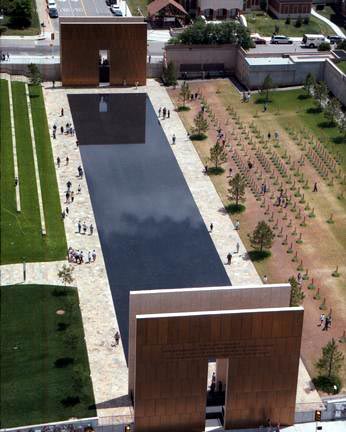
At 9:02 am, fifteen years ago today, a truck bomb detonated in front of the Alfred P. Murrah Federal Building in Oklahoma City, Oklahoma killed 168 people and injured over 800. President Obama issued a proclamation designating April 19th as a National Day of Service and Remembrance for Victims and Survivors of Terrorism:
There is no greater evil than willful violence against innocents. On this National Day of Service and Remembrance for Victims and Survivors of Terrorism, we pause to remember victims of terrorism at home and abroad, we honor the heroes who have supported them, and we redouble our efforts to build the kind of world that is worthy of their legacy.
Fifteen years ago, terrorists bombed the Alfred P. Murrah Federal Building in Oklahoma City, killing over 160 men, women, and children, and injuring hundreds more. Even before the dust settled, heroes had emerged. First responders, medical professionals, clergy, relief organizations, local leaders, and everyday citizens stepped forward to help victims and their families.
Again, when terrorists struck on September 11, 2001, and thousands of Americans –- and scores of foreign nationals — perished in New York City, at the Pentagon, and in Shanksville, Pennsylvania, Americans made a historic effort to assist all those affected. The dignity of those who were attacked — and the courage of those who came to their aid — reaffirmed the strength of our Nation, and the human spirit.
These icons link to social bookmarking sites where readers can share and discover new web pages.
As part of its public outreach, the Department of Homeland Security has launched the National Cybersecurity Awareness Campaign Challenge whose goal is “to get the best ideas from organizations and individuals for clearly and comprehensively communicating about cybersecurity with the American public.” (I’m a little late on this, but it was announced while the blog was on hiatus.)
A selection committee from across the Department will select the best ideas and will incorporate them into a national public education campaign to be launched in the fall. The Challenge is open to Americans of all ages with parental consent required for participants under the age of 18. Proposals should be submitted electronically by April 30, 2010.
Selected participants of the Challenge will be invited to an event in Washington, DC, at their own expense, in late May or early June. Selected participants may be invited to work with the Department in the planning of the National Cybersecurity Awareness Campaign that will launch during National Cybersecurity Awareness Month in October. For more information on entering the challenge, click here.
These icons link to social bookmarking sites where readers can share and discover new web pages.
In a speech aimed at the public and delivered last night at Harvard’s John F. Kennedy School of Government, Homeland Security Secretary Janet Napolitano said U.S. citizens deserve a “clear appraisement” of the terror threats and challenged Americans that “every single one of us can become smarter, can become better informed, and better prepared.”
At the beginning of her remarks, Napolitano interestingly cited Secretary of State George Marshall’s famous address to Harvard graduates in 1947 in which he announced the Marshall Plan for post-war reconstruction:
“Marshall described the scale of devastation after WWII, and told the students,
‘the problem is one of such enormous complexity that the very mass of facts presented to the public by press and radio make it exceedingly difficult for the man in the street to reach a clear appraisement of the situation.’
Today, America’s challenges are quite different. And in our information age, so too are the ways the person in the street gets their information. But George Marshall’s central point still rings true. And, arguably, it’s more important than ever that our citizens have a clear understanding of today’s security challenges.
Tonight, I want to share that ‘clear appraisement of the situation’ because I believe the American people want, and deserve, candor about what we face. I will talk about the threats we’re seeing at the Department of Homeland Security (DHS), what we’re doing to confront them, and what I think every American can do to help.”
She explained that DHS has organized itself to confront four categories of threats: foreign terrorism, “home-based” terrorism, cyber terrorism, and
“Finally, I would add a fourth kind of concern we’re trying to counteract—and that’s the threat of complacency and of unrealistic expectations. Since I became Secretary more than a year ago, I’ve emphasized that the American people need to be prepared, not scared.
But rejecting the politics of fear doesn’t mean the threats are any less real, or that we shouldn’t consider what they mean for our families and our communities. In a world of fast-changing threats, we simply must resist the urge to become complacent or cynical about what’s before us. We must not leave ourselves, our families, and our communities less than fully prepared.”
In order to better prepare the public, Napolitano said government has to better inform them about those threats. But acknowledged that there is still a ways to go.
“…to fight against complacency, and make our nation more ready and resilient, we’re working to engage and empower the public to take the most basic steps: to get an emergency kit, make an emergency plan, and be informed. Are we there yet? The short answer is no. We need all families, all communities, all of our businesses, to be talking about their plans, and thinking about how to get smarter and better equipped to deal with a range of potential emergencies. How do we get there? Well, the government certainly has a role, and part of that role is being straight about the nature of the threats we face…”
I would argue — and have on the blog, including this past week — that to “get there” when it comes to engaging and empowering the public the Administration needs to provide Americans with more specific information about those challenges. It is not enough to say Americans face nuclear, radiological, biological and chemical threats without specifically explaining what they would entail and how would the public be expected to deal with them. That is not an easy conversation, but it’s necessary.
Another important theme of the speech was tempering the expectations for the public about what can and cannot be done when it comes to a potential terrorist attack on U.S. soil, a break from the Bush Administration’s public approach:
In the past, we’ve heard some argue that to defeat terrorism, the government has to be right 100 percent of the time, while the terrorists only have to be right once. I reject that premise. We can’t put a dome over our country. We can’t guarantee there won’t be another attack. No one can.
But we are a strong, resilient country. And we must resolve that even a successful attack will not be a defeat for our way of life. We can target our resources against emerging threats and evolving risks. We can better empower the American public, and draw on what President Obama has called our greatest national security asset: our values.
We must then leverage the shared American values that have led us to victory before. Every single one of us can become smarter, can become better informed, and better prepared. But that becomes possible when the “man on the street” knows and understand the kinds of threats I’ve described tonight.
On a concrete level, Americans have to work to build preparedness—to ensure that our communities are prepared to address any danger that comes their way, from terrorist threats to natural disasters. On a more abstract level, Americans also must work to build resilience—the ability to get up and come back stronger if we get hit.”
The warning came in a White House document, “Planning Guidance for Response to a Nuclear Detonation,” which was sent to state and local government officials earlier this year. But I’m sure that news did not come as a surprise to any of them. The article quotes a couple of experts who point out the public’s lack of knowledge and preparedness when it comes to a possible nuclear incident. But they say that even a little information could turn out to be very useful:
The prospect [of a nuclear explosion here] is anything but far-fetched, says Rick Nelson of the Center for Strategic and International Studies. “Do I think in my lifetime I’ll see the detonation of a nuclear device? I do.”
One challenge he says, will be to persuade survivors to stay indoors, shielded from dangerous radiation until they’re given the all-clear or told to evacuate. “In all likelihood, families will be separated,” he says. “It’s going to be scary to sit tight, though it’s the right thing to do.”…
…Disaster experts say local governments aren’t prepared for a nuclear attack. “There isn’t a single American city, in my estimation, that has sufficient plans for a nuclear terrorist event,” says Irwin Redlener of Columbia University’s Mailman School of Public Health.
The message for families is simple, he says: Stay put. Wait for instructions. If you’ve been outside, dust off, change, shower. “What citizens need to know fits on a wallet-sized card,” Redlener says. “A limited amount of information would save tens of thousands of people.”
These icons link to social bookmarking sites where readers can share and discover new web pages.
I received an email this week from the City of New York about taxes. It wasn’t the Department of Finance reminding me to file but instead it was from the Office of Emergency Management with a reminder about making (and securing) copies:
“As the tax return filing deadline looms (this Thursday, April 15), OEM reminds New Yorkers to make extra copies of their returns. Following a disaster, insurance providers may request up to three years of tax returns to support a claim. Store copies of your tax returns in your Emergency Financial First Aid Kit while finances are still fresh on your mind.”
The Emergency Financial First Aid Kit was created to help the public identify important financial documents and serve as a quick reference guide for critical information. The American Red Cross also has a financial guide for disaster preparedness here.
To sign up for the weekly NYC OEM e-mail tip of the week, click here.
These icons link to social bookmarking sites where readers can share and discover new web pages.
With today’s 7.1 earthquake in western China on the heels of the quakes in Haiti and China as well as those last week in Baja California and Indonesia, seismologist Roger Musson has a timely op-ed in the New York Times addressing the question: “Are earthquakes becoming more frequent?” His answer: “no.”
It’s true that more earthquakes are recorded than used to be the case, but that’s simply because there are more monitoring stations that are able to pick up minor earthquakes that once went undetected. If we compare the average global rates of large earthquakes, we find that these are stable as far back as we can trace them. On average, we record an earthquake with a magnitude over 6 every three days or so, and over 7 at least once a month.
Basic geology explains why the number of earthquakes remains relatively constant. Quakes release a lot of energy, and that energy has to come from somewhere. Ultimately, the source of it is heat released by the steady decay of radioactive material deep inside the earth. For a real long-term increase in earthquake activity, there would have to be an increase in that energy supply, and it’s hard to see how that could happen.
But he explains why the concern if not the volume is now greater:
One problem that we do have to face is that our exposure to earthquakes is increasing. As the world becomes more populated and cities grow ever bigger, the potential for quakes to become disasters rises. Tehran, for instance, has been destroyed by earthquakes several times, but it was still quite small at the time of its last damaging quake, in 1830. Now the city is home to millions, and when the next major quake hits, the results will be catastrophic.
Unless we devote more effort to protecting communities, the number of earthquake disasters will grow, even if the number of earthquakes stays the same.
Join the Blowout now and stay with us throughout April and May as surprise celebrities and experts will guide you through the right steps to get you and your home prepared.
Follow us as the six phases unfold and get the whole family involved. As each phase goes live, it will build on the last to create a comprehensive preparedness plan that answers important questions like: Where will you go if you have to evacuate? What will you take with you? Will you stay home and shelter in place with your disaster supply kit? What will you keep in your kit? How will your home and your belongings fare if a storm strikes?
Move through the Blowout with us and, by the beginning of hurricane season on June 1st, you will be able to answer these questions and breathe easy knowing that you’re ready. On June 1st, you can join us and Dine in the Dark to test your new disaster supply kits by cooking up celebrity “power-free” recipes and more.
For more information, you can visit www.GreatHurricaneBlowout.org and view materials, tools, videos and photos to help them prepare for home emergencies caused by natural disasters.
These icons link to social bookmarking sites where readers can share and discover new web pages.
The information networks that nearly every American relies on are under constant attack by sophisticated cyber adversaries. These adversaries target our identities, our money, our businesses, our intellectual property, and our national security secrets. They often succeed. What’s more, they have the potential to disrupt or disable vital information networks, which could cause catastrophic economic loss and social havoc. We are not prepared.
Rockefeller and Snowe are sponsors of the Cyber Security Act of 2010. What’s particularly relevant for this blog is that the legislation has a section focused on what citizens can do to contribute to the nation’s cybersecurity. In fact, the second proposal in the op-ed is to: ”Launch a new public awareness campaign to make basic cybersecurity principles and civil liberty protections as familiar as Smokey the Bear’s advice for preventing forest fires”
Much of cyber security effort is the responsibility of the government and private sector, but there is also public role. That has been underscored by DHS Secretary Napolitano and other experts. Yet, as the senators point out, more work needs to be done to get that message through to the average user.
These icons link to social bookmarking sites where readers can share and discover new web pages.