I just wanted to mention something quickly, which I thought was a nice – albeit small – touch. The Louisiana Governor’s Office of Homeland Security and Emergency Preparedness has a Twitter feed @GOHSEP which has been very active during the oil spill response. It has been distributing a lot of spill-related information for the public, and has asked its ‘tweeps’ to retweet their announcements. What I found striking is that GOHSEP has been thanking each person who did so by mentioning their Twitter name on its feed.
It’s a small thing. But it’s the type of tiny (and cost-free) reward/positive reinforcement that isn’t always done by government agencies. It is also a good use of social media to accelerate the two-way communication between government and citizen and helps develop a community of civilians who can be a resource going forward. Further, it engenders good will for the agency. So, when @GOHSEP asked its tweeps to consider using its “I support Louisiana’s Coast” Twitter page background on their pages, they’re more likely to do so.
These icons link to social bookmarking sites where readers can share and discover new web pages.
All three cable news channels offered blanket coverage Friday afternoon of the New York Police Department’s (NYPD) investigation of a “suspicious” package in Times Square. It was only one of several phone tips that the NYPD’s Bomb Squad had checked out that day. Each turned out to be a false alarm but clearly more people are ‘Seeing and Saying Something’ in the aftermath of last week’s bombing attempt. And it has put more focus on the role of the citizen in homeland security.
Politicians, newspaper editorial pages and fellow citizens have all rightly celebrated the campaign and the T-shirt vendors over the past week. But there has still been little discussion about whether “See Something, Say Something” and citizen involvement in homeland security in general are working as well it could. And if not, how it might be improved?
NYPD Commissioner Raymond Kelly said the number of reported suspicious packages was up about 30% since last Saturday, according the New York Daily News. There were 145 calls to the NYPD on Thursday, Kelly said, up from the typical 90-100 per day. And, many experts say that the City and the nation may need to prepare for more of these attempts as terrorists shift their strategy to smaller less-sophisticated violent attacks on soft targets.
Law enforcement in New York and around the U.S. will continue to be receiving and relying on the kind of “See Something, Say Something” tips that helped short circuit the Times Square car bombing. However, I would argue that presently there is not a very good understanding of these citizen tip programs, both among the citizens themselves as well as the media. (In fact, during Friday’s coverage more than one news anchor who seemed surprised by the volume of tips that come in regularly to the NYPD.)
The Police Department and other security officials don’t speak much about citizen tips (other than asking for them), which is understandable due to the sensitivity of the subject. But I think it would be helpful to them to brief the citizenry a little bit more — both in giving more guidance but also in helping understand the work of law enforcement in homeland security. I wrote on this topic last week but wanted to elaborate a bit.
The lack of attention on and public/media knowledge of the subject of citizen tips was underscored in a 2008 New York Times article by William Neuman about the transit authority’s “See Something, Say Something” subway and bus campaign posters that featured the tagline: “Last year, 1,944 New Yorkers saw something and said something.â€: Neuman had a couple of questions.
But the new posters, also placed in the commuter railroad trains, left out two things: What, exactly, did those 1,944 New Yorkers see, and what did they say? Presumably, no active terror plots were interrupted, or that would have been announced by the authorities.
Neuman wasn’t able to find the answers:
“[The Metropolitan Transit Authority's Christopher] Boylan said he did not know exactly how the authority had come up with the number. “I don’t want to say that the accuracy of the number is secondary to the message,†Mr. Boylan said, “but the message that we wanted to get across is that those calls are, in fact, having an impact.â€
For the article, the Times requested the (theretofore undisclosed) “See Something, Say Something” statistics from NYPD:
The hot line received many more calls in 2007, possibly because of the authority’s advertising campaign, Mr. Browne said. Through early December, the counterterrorism hot line received 13,473 calls, with 644 of those meriting investigation. Of that group, 45 calls were transit related. Indeed, no terrorists were arrested, but a wide spectrum of other activity was reported.
In fact, one reason I would guess why authorities have kept these numbers close to the vest is that it might seem as if the program is not succeeding in helping fight terrorism. But I would contend that’s actually an opportunity to underscore that public involvement for terrorism prevention is not so different than civic vigilance on street crime — that terrorism awareness is just another part of general community resilience.
Communicating with the public in this area is a careful balance. Authorities want to: encourage tips but don’t want to make it an obsession, keep citizens vigilant but not frightened, and not overstate the terror threat but not understate it either. Yet more information would be useful in providing the public with more context and a better understanding of how they fit into the nation’s security effort.
Among the questions that could be addressed: Is law enforcement satisfied with the current level of public input? Do they think it could be improved? When reporting tips, do the authorities rather citizens err on the side of calling if they’re not sure? When citizens offer tips, are law enforcement officials encouraging and positive even if the tip doesn’t pan out? And is there follow up with citizens when possible?
Whether the U.S. was lucky or good (or little of both) that the attempted terror incidents in Times Square last week and on the airliner near Detroit on Christmas Eve failed, the fact is that terrorists are going to pull off a successful attempt at some point, maybe soon. So, it is important that the Administration focus the nation on what happens when that happens. And, that’s where former presidential terrorism adviser Richard Clarke has been focusing on of late.
But I was even more struck by an interview he gave to Fareed Zakaria on Sunday’s CNN show “GPS”. Clarke came to national attention for stating, during the 9/11 Commission Hearings, “Your government failed you, those entrusted with protecting you failed you, and I failed you.” He made a similar kind of declaration in this interview, saying: “we panicked, everyone did, we overreacted.”
“We are going to have one of these attacks succeed and I think what we have to start talking about now, as a nation is what our reaction is going to be, because the last time 9/11 happened and we panicked. I panicked, everyone did, we overreacted, and in many ways the things we did were counterproductive.Other things we did were wasteful. Some things we did destroyed our own value system. So, we should have this discussion now, if there is another attack and it’s successful, what are we going to do and what are we not going to do this time?”
Though his statement may be taken as a political point, put that aside for the moment and focus on the general theme. I think most Americans would agree that after 9/11 many of our institutions reacted (understandably) in sometimes extreme or at least abnormal ways — some counterproductive, some productive, some necessary, some still debateable. Clarke is just saying it would be helpful to discuss how we should as a society and a political system deal with the next successful one, particularly as we are getting so many warnings it is going to happen.
I’m just in awe of the way Nashville is responding in the face of this surreal, overwhelming crisis. And the way Nashville’s geek community pulled together to create DonateNashville.org, a collaborative effort among a group of local web developers, is no exception.
Driven by Nashville Predators geek Patten Fuqua’s powerful post that started the We Are Nashville movement, these guys and gals have created a site to match folks in need with folks ready and able to give. DonateNashville allows users may click on “I Need†or “I Have†to get started. You may also follow them on Twitter.
And speaking of geek sites, I’m completely giddy by the way Nashvillians are using social media platforms to communicate, connect and share information in such a meaningful way. If you doubted “the Twitter†had any practical use, just give #nashvilleflood and #wearenashville a search.
On Facebook, Metro Water has done a fantastic job keeping folks up-to-date on water conservation needs; the Nashville Downtown Partnership’s page has been a constant source of business opening/closing announcements, volunteer needs and the like.
The creators of Twitter and Facebook never sought out to create a real-time volunteer seeking service for crisis communications, but that’s exactly what they’ve done–because you’ve chosen to use them that way.
Technology is a beautiful thing.
Thanks to the American Red Cross’ Gloria Huang for bringing this article to my attention.
These icons link to social bookmarking sites where readers can share and discover new web pages.
In today’s Washington Post Outlook section, former presidential terrorism adviser Richard Clarke has an op-ed piece, “The Times Square Bomb Failed. What Will We Do When The Next Bomb Works.”Clarke’s overall theme is that another terror attack is inevitable, and “right now, after a near-miss, there is a better opportunity to adjust than in an emotionally charged period when the nation is mourning.”
Clarke thinks it would be ideal “if leaders could come together now and agree on a few key points about our efforts to battle terrorism” Most of his proposals are directed at political officials, however, those politicians will also act based on how their constituents react. So, while the “We” in the article’s headline may refer more to our leaders, there is also a role here for we the citizens. Below are three of Clarke’s points that I think are particularly relevant for the public:
First, no matter how good a job our government does in protecting the homeland, we must anticipate that someday another terrorist may succeed. If that happens, we will refine our tactics and procedures, but we will not overreact…
Fifth, as willing as we may be to pay a high price to rid ourselves of terrorism, throwing more money at the problem or abandoning our civil liberties and way of life will not reduce the threat, nor will it accelerate the day when it disappears.
Sixth, in an attempt to show that we are doing something new after an attack, we should not adopt procedures that inconvenience the public more than they do the terrorists and amount to little more than security theater.
The full op-ed can be found here. At the bottom of the Clarke article on the Post’s website is an article by Stephen Flynn, President of the Center For National Policy, and one of the leading experts on societal resilience.
William R. “Bill” Cumming has joined the blogosphere with the launch of the Vacation Lane Blog. Bill is a former FEMA official who now runs the Vacation Lane Group. He is a frequent commenter on homeland security blogs, and I am sure I wasn’t the only person who suggested he should definitely start one of his own.
Bill is a thoughtful and bountiful resource on homeland security and emergency management, among other issues. He gets into a level of detail and historical context that is often missing in discussions on these topics. The blog can be found here.
These icons link to social bookmarking sites where readers can share and discover new web pages.
In the short video, Allison explains the steps every pet owner should do to prepare their animals for emergencies. In the background there is a Golden Retriever, Hunter, who stopped by (with his owner) to be microchipped and have a ‘go bag’  photo taken. I have found that pet owners tend to be among the most prepared groups, but I’m sure Allison’s recommendations will be helpful.
Allison Cardona, ASPCA, Disaster Response Director
These icons link to social bookmarking sites where readers can share and discover new web pages.
This blog has long been an advocate of better integrating the public and its perspective into major governmental emergency drills. So, it was good to hear about some citizen-focused initiatives employed during Liberty RadEx, the National Tier 2 full scale exercise sponsored by the U.S. Environmental Protection Agency. It was held in Philadelphia late last month to test the country’s capability to clean up and help communities recover from a ‘dirty bomb’ terrorist attack on a city. The exercise was set in Philadelphia 30 to 90 days after the explosion. The specific scenario, #11 of the U.S.’s National Planning Scenarios, can be found here.
I am excited to have a first person report about the exercise from a participant, James Garrow, the Operations and Logistics Manager of the Bioterrorism and Public Health Preparedness Program of the Division of Disease Control and Emergency Preparedness at the Philadelphia Department of Public Health. Garrow, whose expertise is public health communications, reports that the exercise planners made an significant effort to get a citizens’ point of view in the drill, including the creation of a Community Advisory Panel. He writes:
This was an interesting exercise for a number of reasons. First, to the best of my knowledge, this was the biggest exercise ever done for ESF-10 (Hazardous Materials). Given what’s happening in the Gulf of Mexico right now, that’s simply amazing. Second, this is the first exercise I’ve ever heard of that dealt with the recovery phase. Most planners are so worried (and focused) on the immediate aftermath of a disaster that we never get around to planning what would happen after the sirens were turned off and the media went home. This is unfortunate because, ultimately, the success or failure of rebuilding from a disaster is predicated on actually rebuilding. One need only look at the gaping void in lower Manhattan to understand the infrastructure healing process that’s needed to help us recover.
The last reason I found the exercise interesting is really, I think, the most important. And it may have been included just because it’s standard operating procedure for USEPA, but the exercise planners made a real effort to simulate dealing with the public. And not in a “they’re panicky, lock ‘em up” kind of way. Inclusion of the public, both real and notional, took place in two different ways.
The first, and I would argue most important, was in the inclusion of a real-life Community Advisory Panel, or CAP. The CAP was comprised of 10 community leaders in Philadelphia. Each represented different parts of the city, different ethnicities, different business interests, different communities. They were briefed about the exercise scenario and were encouraged to attend the two scheduled Technical Advisory Panel (TAP) sessions, which were peopled with subject matter experts from the US Coast Guard, the US EPA, the PA DEP, the Phila Health Department, and a number of other experts who would be called upon in just such an emergency to help EPA develop a plan for remediating the affected area.
The TAP was charged with developing choices for how to proceed with cleanup priorities and contaminated waste storage. The CAP was then presented with those very same choices to make sure that the recommended course of action was palatable to the public – to the real public. And, amazingly to us planners, they not only reviewed all of the choices, but actually recommended their own choices based upon their knowledge of the community. By the end of the exercise, there was talk of the CAP members continuing to meet and discuss problems just like this. What an amazing outcome!
An exciting online initiative, the CrisisWiki, is looking for citizen volunteers for help in its response to the Nashville-area flood and the Gulf oil spill.  According to the site, the goal of CrisisWiki:
is to create an editable directory of resources related to disasters and crises around the world. An example of how we’ve done this in the past can be seen at HurricaneWiki.org. What sets CrisisWiki apart from other disaster wikis is that we intend to design the wiki so it can accommodate resources for any disaster, rather than just one specific event, as well as aggregate local, state, national and international emergency preparedness resources before a disaster strikes.
The Wiki offers news, ways of helping & getting help, and many other resources. But it relies on the work of volunteer contributors. For more information, go to its project wiki or contact Andy Carvin (Twitter: @acarvin) who developed the idea.  (Btw, an article I saw on the Nashville Flood Wiki “So Nashville Is Flooded…I Can Help” from Nashvillest.com, offers a comprehensive list of how to assist in the town’s recovery.)
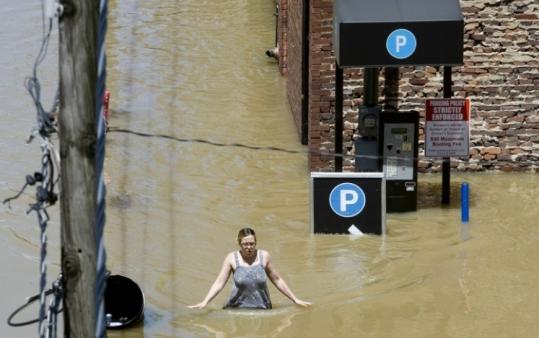
A woman wades through flood water on a downtown sidewalk in Nashville (Getty Images).
These icons link to social bookmarking sites where readers can share and discover new web pages.
Here is what MIT student Jeffrey Warren plans to do Thursday: Walk up and down the Louisiana coast holding a kite string that’s tethered to a helium-filled trash bag and a point-and-shoot camera. The set-up may sound goofy. But Warren’s aim is serious. The 26-year-old is trying to monitor the effects of the oil spill that threatens to wreak environmental and economic havoc on the Gulf Coast of the United States…
Warren, who has been working on these “grassroots mapping” efforts for several months, is among a number of people and organizations trying to empower ordinary citizens to document the effects of the massive oil slick, which, according to the U.S. Coast Guard, has released more than 1.6 million gallons of crude into the waters of the Gulf of Mexico.
As that pollution heads toward the coast, it becomes all the more important that local people help monitor its effects on people, the environment and wildlife, local workers said. They also aim to involve local people in the disaster response, both to keep them from feeling helpless in the wake of the incident and to collect useful data about the extent of the damage.
The volunteers are using a number of new and newly improvised technologies to accomplish these goals, which generally fall within the trend of “crowdsourcing,” or using the skills of many people, in response to a disaster or conflict…