The Colorado Division of Emergency Management and READYColorado are among the most innovative and energetic state operations in the nation when it comes to citizen preparedness.
So, it’s not surprising that the agencies are developing a special social media response team comprised of teenagers to assist the state’s efforts in dealing with disasters. Tentatively called the Colorado Social Media All-Hazards Response Team (COSmart), it will aim to create a cadre of high school and college age citizens to assist the state in better integrating social networking and other new personal technologies into disaster preparedness and response.
It is part of Colorado’s aggressive effort to involve youths in preparedness activities, including training programs and internships. The state sees the response team as a way to provide a platform for young people to offer their ideas on emergency readiness and tap their technological expertise, according to READYColorado’s Brandon Williams.
Williams told me that he hopes the team members will serve as “eyes and ears” in the community on disaster preparedness before and during emergency situations, helping to collect and disseminate information between citizens and the authorities and creating situational awareness with social media and other communications tools.
He says the program is still in the developmental phase. But what I like about this idea is that it addresses an aspect of the emergency management community’s challenge in figuring out how best to take advantage of the potential of new personal technology in disasters. A major question is how to institutionalize a relationship in advance with citizen users that can be tapped during emergency situations. One way to do so is to reach out to the civilians beforehand — similar to pre-positioning supplies before an emergency — and this Colorado initiative could be an important model of how do so.
Plus, it utilizes the unique knowledge of young people in social media and engages them in preparedness on their own terms. I look forward to following the initiative as it develops. Thanks to Eric Holdeman (via Garry Briese) where I first heard about this idea.
These icons link to social bookmarking sites where readers can share and discover new web pages.
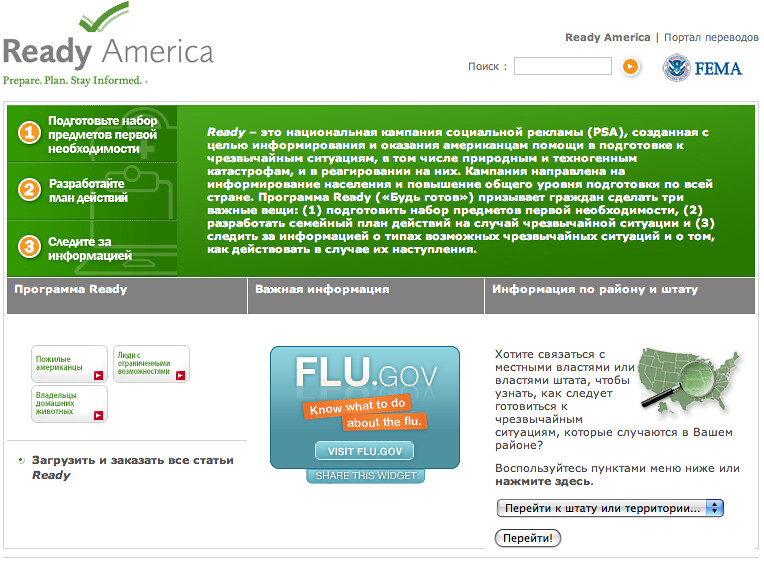
The ReadydotGov Twitter feed proudly announced Thursday that: “We just translated 16,000 words of preparedness information into Russian!”
The Ready.Gov site is now offering 8 languages in addition to English — Russian, French, Tagalog, Chinese, Korean, Vietnamese, Haitian Creole and Spanish.
A screenshot of Ready.Gov’s Russian language site.
These icons link to social bookmarking sites where readers can share and discover new web pages.
Two new studies released yesterday indicate that doing “hands-only” CPR without mouth-to-mouth resuscitation is just as effective. That’s good news as it is widely believed that a hesitancy to do rescue breaths keeps people from attempting the procedure.
Many people are uncomfortable with mouth-to-mouth resuscitation, so they don’t attempt CPR at all. And when they do, they interrupt chest compressions too long to do rescue breathing.
Scientists now think that chest compressions are more crucial, because immediately after the heart stops, the blood contains residual oxygen for a few minutes. Circulating this blood — until the EMTs arrive and can begin more effective oxygen supplementation — is probably more important.
Another advantage to a more streamlined form of citizen CPR: It’s easier to coach over the phone. So the EMTs who field 911 calls will be more likely to persuade bystanders to try CPR.
Making CPR easier to do — as well as to learn and then renew — is a topic that has frequently come up on the blog. Don’t tell anyone but my CPR certification has expired, and I need to take the refresher course.
A CPR training held by the Red Cross of Greater New York where I took my course.
These icons link to social bookmarking sites where readers can share and discover new web pages.
The well-respected environmental writer, Michael Grunwald, offers a provocative article today in the current issue of Time magazine asking whether the damage from the Gulf Coast oil spill has been exaggerated by politicians, non profit groups and the media.
It’s an interesting piece which I wanted to post in part because it is offers a good case study on how various stakeholders often portray disasters to the public. Grunwald writes:
President Obama has called the BP oil spill “the worst environmental disaster America has ever faced,” and so has just about everyone else. Green groups are sounding alarms about the “Catastrophe Along the Gulf Coast,” while CBS, Fox and MSNBC slap “Disaster in the Gulf” chryons on all their spill-related news…
… The Deepwater explosion was an awful tragedy for the 11 workers who died on the rig, and it’s no leak; it’s the biggest oil spill in U.S. history. It’s also inflicting serious economic and psychological damage on coastal communities that depend on tourism, fishing and drilling. But so far — while it’s important to acknowledge that the long-term potential danger is simply unknowable for an underwater event that took place just three months ago — it does not seem to be inflicting severe environmental damage. “The impacts have been much, much less than everyone feared,” says geochemist Jacqueline Michel, a federal contractor who is coordinating shoreline assessments in Louisiana.
Grunwald explains why he thinks there has been some exaggeration. It is a dynamic that often happens in disaster situations.
Anti-oil politicians, anti-Obama politicians and underfunded green groups all have obvious incentives to accentuate the negative in the Gulf. So did the media, because disasters drive ratings and sell magazines; those oil-soaked pelicans you keep seeing on TV (and the cover of TIME) were a lot more compelling than the healthy pelicans I saw roosting on some protective boom in Bay Jimmy.
Mark Twain would probably be happy to know that finally citizens aren’t going to be limited to talking about the weather, but now they can do something about it –or at least something about the National Weather Service (NWS).
The strategic plan will provide the framework for guiding NWS activities over the next ten years. In an introductory letter, NWS Assistant Administrator Jack Hayes writes:
…population growth, vulnerable infrastructure, and an increasingly interdependent economy are creating new challenges for the Nation – including increased vulnerabilities to weather and climate. At the same time, science and technology are rapidly advancing and providing potential solutions that will enable the National Weather Service to better meet our country’s needs. This strategic plan is our best effort to anticipate service needs in the 2020 time frame, project what science and technology will allow, and establish meaningful outcome-oriented goals and objectives for NWS 2020.
To participate, click here. The public comment period ends on September 7th.
These icons link to social bookmarking sites where readers can share and discover new web pages.
Last night, I watched the premiere of the Discovery Channel’s second season of “The Colony” ‘reality’ show. “The Colony” attempts to answer the questions: “What would you do in the wake of a global catastrophe? Even if you survived it, could you survive the aftermath?”
The show brings together an eclectic group of “colonists” and puts them down in a post-pandemic world (actually 10 acres of abandoned neighborhood on the Gulf Coast of Louisiana left decimated by Hurricane Katrina, a naturally occurring disaster zone that was slated to be bulldozed and turned into a public park.)
It is in that stark environment of empty buildings, weedy streets and the backwoods that the colonists will be working over the 10 episodes to scavenge essentials for survival from their surroundings while fending off threats such as wild animals and malicious outsiders without electricity, running water, government or outside communication.
The show also includes features on-going play-by-play commentary experts in homeland security, engineering, psychology and the medical community. Unlike the “Survivor” show, the colonists aren’t eliminated in a tribal council every week; instead, the emphasis on how they will work together as a team to survive.
I found the first episode pretty engaging. Of course, I will admit that I like — much to my wife’s consternation — a lot of reality shows. But at least this one (unlike “The Bachelorette” or “Top Chef”) I could tell her I was watching  for my work.
In fact, while it is heavy on the drama — about half the first show involved fistfights between the “colonists” and some interlopers — the show makes you consider how you would react in the event of a major catastrophe and think about your own self sufficiency. It will be intriguing to people interested in the topic of disaster response and survival skills. I probably will be checking in and out of the show of the next 10 weeks.
For more more information on “The Colony” including schedule information, click here.
These icons link to social bookmarking sites where readers can share and discover new web pages.
In a radio interview this week, a leading expert on weapons of mass destruction preparedness said that the public needs to realize that a nuclear terror incident is a possibility, and they should learn some protective response steps for themselves and their families.
Inglesby said that despite how difficult the scenario may be for Americans to imagine, we have to accept “this could happen” because then people “at least will be familiar with what it could be like” so they can be prepare.
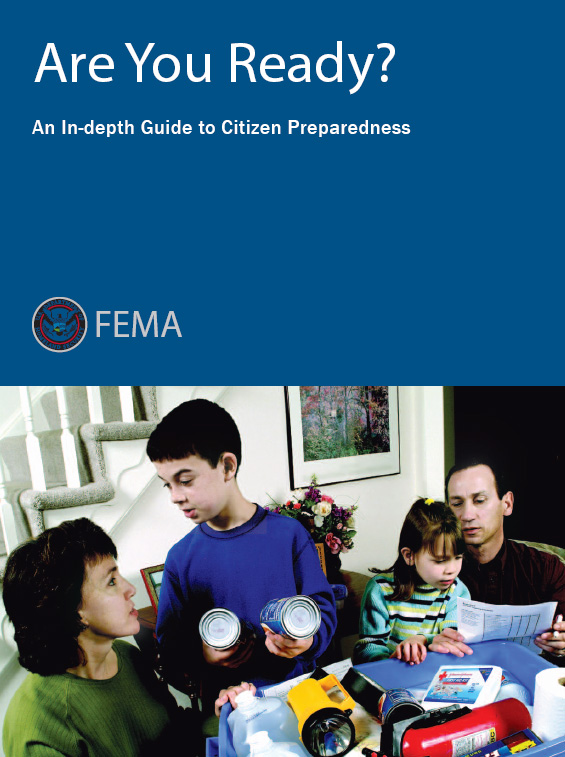
The Facebook post piqued my curiosity about the FEMA course whose introductory Overview explains:
“has been designed to help the citizens of this nation learn how to protect themselves and their families against all types of hazards…By reading and following the instructions in this guide you and your family can say, Yes, we are ready!”
As this is ostensibly the government’s baseline for judging whether citizens are “ready” for disasters, I thought I would read through the course material. After finishing it, I had two overall reactions:
1) there is a real need to review and refine what government authorities are telling the public about preparedness and what “we are ready” should mean for American citizens.
2) as part of that review process, it would be very useful for top federal (as well as state and local) emergency management officials to hold open forums — maybe using the “Are You Ready” class format somewhat along the lines of the Kansas City Medical Reserve Corps course writ large — in order to solicit questions and input about preparedness from Americans. These types of events would bring new attention to the subject as well as stimulate an important and overdue dialogue integrating the public in helping determine policy about public preparedness.
Learn about the hazards that may strike your community, the risks you face from these hazards, and your community’s plans for warning and evacuation. You can obtain this information from your local emergency management ofï¬ce or your local chapter of the American Red Cross…
Ask local authorities about each possible hazard or emergency and use the worksheet that follows to record your ï¬ndings and suggestions for reducing your family’s risk…
There is a major problem here: the government is putting far too much of the onus on the public — telling citizens it is only their responsibility to ask rather than taking the initiative to inform them if it is that important. The fact is that in many parts of the nation (including here in New York) the average citizen cannot just contact the local emergency management office and get a hazard briefing. Further down in the same chapter, the public is also told to request information that is not fully accessible or available to them:
Ask local authorities about methods used to warn your community…
Ask local authorities about emergency evacuation routes…
Ask local ofï¬cials the following questions about your community’s disaster/emergency plans. Does my community have a plan? Can I obtain a copy?
The fact is that FEMA is recommending people undertake a time consuming and unfamiliar task that in many cases they actually will not be able to accomplish by themselves. Shouldn’t the government at all levels have more responsibility to take the initiative in communicating this the information to the community rather than wait until individual citizens contact them?
Ok, so how do you begin this discussion? I have an idea that was provoked by seeing the photos from this weekend’s Kansas City class: why not hold open public forums on preparedness? These national seminars would be coordinated with similar events run by state and local emergency managers. This would bring new attention to citizen readiness and provide the public with the opportunity to both ask questions and as importantly offer input. I think FEMA head Craig Fugate would do a terrific job of leading such forums as would a number of state and local officials.
As Tip O’Neill might have said, (almost) all disaster preparedness and response is local. But the federal government does have a significant role in public education, particularly when it comes to terrorism and major disasters. In fact, Homeland Security Janet Napolitano in a speech at Harvard University earlier this year made that point saying that Americans deserve a “clear appraisement†of the terror threats, “because I believe the American people want, and deserve, candor about what we face.” That appraisement still needs to be delivered. National officials also have a megaphone and platform that is necessary to get the issue on the media and political agenda.
Whenever I attend local public events on preparedness, citizens always have specific questions about specific threats, evacuation plans, emergency communications that cannot be answered fully with general preparedness boilerplate. The fact is that government officials have not fully leveled with the public on preparedness, giving them all the information they need to be really prepared. Without having an open, interactive discussion we are not really going to make progress on really ‘getting informed’ or figuring out if “you [and I] are ready?” and what that means. I think a series of preparedness forums at a national and then state and local level would be very helpful as part of that process.
These icons link to social bookmarking sites where readers can share and discover new web pages.
To mark today’s 20th Anniversary of the Americans With Disabilities Act (ADA), FEMA Administrator shot a short video and wrote an article for CNN.com “Are Disabled Still At Risk In Disasters,” focusing on disabled preparedness which has been a priority of his tenure.
The video urges emergency managers to continue to better integrate the disabled into preparedness planning and for the disabled community to continue to both advocate their interests with emergency managers as well as prepare themselves for emergencies.
In the CNN.com piece, Fugate discusses the agency’s efforts in this area:
For years, our nation’s emergency management community simply has not done a good enough job planning for and meeting the needs of people with disabilities…
The root of the problem lies here: Historically the U.S. emergency management field has treated people with disabilities as a separate population, rather than as part of the larger community. This limited approach not only directly violates the intent of the ADA, but ties up personnel and resources when a disaster strikes. It jeopardizes everyone’s safety.
Fugate writes that FEMA and the emergency management community is making progress:
On Friday evening at 8:19 PM, I received the following notification (via both text and e-mail) from New York City’s NotifyNYC alert system:
“Alert issued 7/23/10 at 8:20 PM. The National Weather Service has issued a Tornado Warning until 9:00 PM for Queens, Brooklyn, Manhattan, and the Bronx. Immediately go indoors and/or to the lowest floor of your building for shelter. Stay away from windows.”
Though thunderstorms had been predicted, a tornado warning — along with the urgent and specific instructions — was a bit of a surprise. I am sure I was not the only New York apartment dweller receiving a NotifyNYC alert that was a little perplexed what to do. Should we all actually be going to the lobby of our buildings? Should we be warning our neighbors (who aren’t signed up for the City’s alerts) to do so as well?
I happened to be watching television — “Friday Night Lights,” appropriately it turned out, as thunder was flashing through the Gotham sky. The local affiliate, WNBC-TV, cut into the show to announce the tornado warning. The meteorologist did not recommend any of the preventive actions mentioned in the NotifyNYC alert, though a scroll on the screen was suggesting that the safest place to be in a tornado was a basement, closet or hallway.
It was an example of how e-mail/text alerts can effectively relay immediate information directly to citizens no matter where they are. (And that people should be signing up for these free notifications.) But only a relatively small percentage of New Yorkers are enrolled (approximately 45,000 subscribers) so Friday night there was an information gap between those who receive the alerts and those who get their emergency information from the news media.
‘Friday night lights’ over Manhattan but no tornado (photo by Richard Caplan/WNBC)
Friday evening when the National Weather Service issued the tornado alert, the City’s Office of Emergency Management (NYC-OEM) faced an interesting (and new) communications policy question: should it send out the information (and the safety instructions) in a limited alert format to subscribers, which were going to come as an out of the blue surprise to us? (Tornado response may be second nature in the Midwest but not in Manhattan.). It would also mean that subscribers were going to know more than about it than the rest of the public.
I think they made the right decision to distribute the alert. However, the City also needs to make sure that whatever emergency information it is sending out through the e-mail/text NotifyNYC system that the same message is being communicated through the news media, which is still the main information medium for most of the public. Friday night, the messaging was not totally aligned.
It turned out that a tornado did not end up touching down in the Big Apple Friday night. But I thought this was an interesting case study of how government is disseminatjng emergency news to the public with its new tools. In fact, I would recommend the City’s OEM highlight this example publicly as a reason why more people should sign up for these alerts so they have the most updated information in a potential crisis situation.
These icons link to social bookmarking sites where readers can share and discover new web pages.