In the Boston Globe’s Sunday Travel section today, there’s an article about preparing for emergencies, including weather, health, politics and security, while going abroad. The piece notes:
Traveling should be fun-filled and worry-free. But vacationers leave behind the predictability and convenience of home. Travel can be complicated by unforeseen crises — medical emergencies, canceled flights, lost luggage, natural disasters, political turmoil. In tough economic times, amid less sympathetic airlines, a dream getaway can devolve into a logistical challenge or worse.
Knowing how to handle travel emergencies can salvage a trip or, in the most dire situations, save a life. Preparedness can make a huge difference.
Emergency management experts often say that developing social relationships in the community in advance can be the key to helping people deal with a crisis situation in the short-term. A new study offers another reason for setting up that type of support system: it indicates that having those relationships can also be key to long-term good health as well.
The post notes that Americans have been donating to Pakistan relief from their cell phones, by texting the word “SWAT” to the number 50555 as they did after the Haiti earthquake. The blog’s “Question of the Week” is what other new initiatives how the international community can help there and in future disasters.
It’s unclear whether this request will come up with any new “innovative” ideas that the State Department has not received through other channels, but it is good to see it reaching out directly to the public using the blog. If you would like to send in an idea to State, click here.
These icons link to social bookmarking sites where readers can share and discover new web pages.
The show airs live this evening from 7pm-9pm (Central Time) on www.blogtalkradio.com/doctorprepper. An audio file of the episode can be downloaded below:
A new Brookings Instiitution report says that on the eve of the fifth anniversary of Hurricane Katrina, “greater New Orleans is rebounding and, in some ways, doing so better than before” though “key economic, social, and environmental trends in the New Orleans metro area remain troubling.”
The fascinating study notes that the recovery effort — “in the last five years, hundreds of citizens, government leaders, business and civic leaders, nonprofits, and philanthropies have been tirelessly working together” — is becoming a case study of regional community resilience.
It has been often said that New Orleanians are resilient. They have to be after being dealt three crises in five years—Hurricane Katrina and the levee breaches, the Great Recession, and now the oil disaster in the Gulf of Mexico. To be resilient is to be able to recover from a major stress or shock. But New Orleanians have issued a more laudable challenge for themselves after Hurricane Katrina: They must not only bounce back, but do so better than before.
Yet, as the nation witnesses another disaster unfolding in the Gulf Coast region on the eve of the fifth anniversary of Hurricane Katrina, some have questioned whether New Orleans can rebound at all. The answer is yes. The city and metro area have been recovering from Katrina and, in fact, may even be on the path to transformation.
National attention on the massive oil spill in the Gulf of Mexico has overshadowed the more mundane but herculean task of reinventing New Orleans. In the last five years, hundreds of citizens, government leaders, business and civic leaders, nonprofits, and philanthropies have been tirelessly working together to ensure that the city they love emerges from the 2005 hurricanes with all of the city’s assets preserved but its flaws corrected.
My daughter Rebecca had the terrific idea for this post. We were watching the movie “Grease 2″ together this past weekend, and there was a scene involving a bomb shelter. Rebecca suggested I should mention it on my blog. It turns out that both this sequel to “Grease” from 1982, and the popular 1970’s tv sitcom, “Happy Days” are instructive in building citizen preparedness now.
In the “Grease 2,” which is set in the early 60’s, one of the characters, Rydell High student Louis DiMucci takes his girlfriend Sharon into a fallout shelter for a date and sings the song “Let’s Do It For Our Country” (video below).
“Let’s Do It For Our Country” video from “Grease 2″.
The scene is a bit goofy (like the rest of the movie), and the song’s double entendre title “Let’s Do It For The Country!” and lyrics are a bit suggestive for a family audience. But for the purposes of this blog, it actually makes a couple of revealing points about the difference in how the nation viewed preparedness in 50 years ago, and how we do now.
In the run up to the scene as he tries to coax Sharon into the shelter (though it is not in the video), Louis cites President John F. Kennedy’s plea that Americans prepare for a possible nuclear attack. Now, the efficacy of bomb shelters and ‘duck and cover’ to deal with Russian missiles may not have been the a viable public preparedness strategy. However, the focus and mobilization on preparedness starting at the top clearly get through to the public (even if the recommendations were flawed). if high school student Louis DiMucci knew that President Kennedy had asked the country to take the subject seriously. The song that Louis sings in the video “Let’s Do It For The Country!” is mischievous but does indicate the preparedness was viewed in 1961 as patriotic, which is not how it is viewed in 2010.
After we finished the movie, my wife suggested that the 70’s sitcom “Happy Days,” also had an episode in which the Cunningham family considered building a fallout shelter. Checking YouTube I watched “Be The First On Your Block,” which turned out to be quite interesting. As you can see below, the decision process portrayed on the show mirrored the deliberations of many Cold War-era Americans. There was a serious consideration of preparedness even if no steps were eventually taken.
“Be The First On Your Block” fallout shelter episode video from “Happy Days” (part 1)
The Cunninghams held a family meeting about the shelter in which the dad said his aim was not “to scare anyone but to try to protect the family” and it was “important” enough to talk about in front of their teenage children. The initial decision to go ahead (like “Grease 2″ it also involved a shelter’s value for teenage dating) soon did not seem as smart when the kids were beseeched by all their friends for a place and that “surviving” a nuclear attack alone wasn’t such an appealing prospect even if it worked.
This type of family debate (and even a family drill) on preparedness was common in the “Happy Days” era, but these days it’s rare that families talk about the subject. (And, ironically, there are more things that a family can do to protect themselves from disasters, including attacks, these days than they could then.) Particularly for those who didn’t live through the Cold War, it’s worth taking a look at these two shows to see the huge difference in how we as a society approach preparedness.
These icons link to social bookmarking sites where readers can share and discover new web pages.
The U.S. Army has declared August as Anti-Terrorism Awareness Month with installations throughout the country running programs stressing vigilance, reporting suspicious activities and protecting Army communities. The campaign is focused on families as well as uniformed personnel on bases.
In February, the Department of the Army determined Anti-Terrorism Awareness Month would be held in August each year — a month Army leaders have deemed an appropriate reminder of the Sept. 11, 2001 terrorist attacks.
“August is a very appropriate month, given that it’s just a month before September, keeping in mind 9/11, and also September is National Preparedness Month,†said Brig. Gen. Colleen L. McGuire, provost marshal general of the Army.
The link to National Preparedness Month raises the question whether an Anti-Terrorism Awareness Month would be useful for the civilian world as well, particularly as the Department of Homeland Security ramps up a national “See Something, Say Something” terrorism tips campaign. Another possibility would be to integrate more anti-terrorism content into National Preparedness Month activities in September.
Throughout August, according to the article, Army bases across the nation will be promoting the observance by using posters, banners and displays:
“Here’s an opportunity to focus on anti-terrorism –- particularly for children and Family members who live on an installation,†McGuire explained. “It gives them the chance to become acquainted with their neighbors and become more aware of their surroundings.â€
Part of the anti-terrorism, or AT awareness campaign is a focus on Army iWatch –- a community program which encourages vigilance and proper reporting to base authorities.
Some of the suspicious behaviors iWatch asks Army community members to look for include people asking security-related questions, loitering, drawing or taking photos of important buildings or entry points, wearing bulky or baggy clothes, chemical smells, and unattended cars lefts in parking lots or no-parking zones.
These icons link to social bookmarking sites where readers can share and discover new web pages.
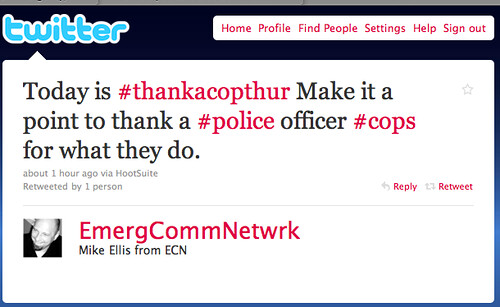
This afternoon, Ellis gave me an update on the effort:
“The response to #ThankACopThur was immediate and continues today. I sincerely have lost track of how many times #ThankACopThur has been RTd and shared with others in the Twitterverse. In addition to numerous tweets from tweeps in the United States, my friend @lawscomm told me that she has seen #ThankACopThur tweets from the Netherlands, Canada and the UK.”
These icons link to social bookmarking sites where readers can share and discover new web pages.
On this blog, we’re always on the lookout all over the continent (and the world) for fun and creative preparedness ideas. One I just read about is a “Disaster Dining” cook-off held yesterday by the Red Cross in Atlantic Canada.
According to an article in the Telegraph Journal of St. John, New Brunswick, the Red Cross invited three teams of cooks and gave them the challenge of cooking a meal using only non-perishable ingredients. The event — aimed at promoting the value of creating a 72-hour emergency kit — was held at a local Walmart which has been working with the Red Cross in August to raise awareness and funds for emergency preparedness:
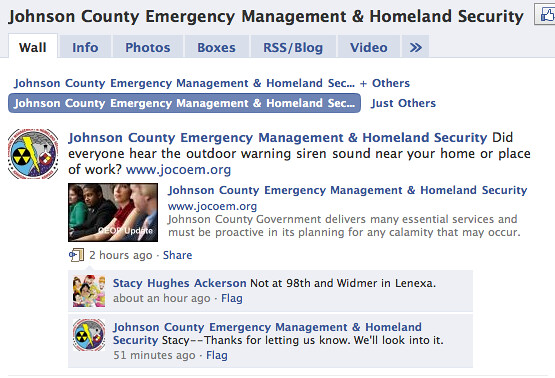
The same people who brought you Preparedness Piggy, Johnson County Emergency Management & Homeland Security in Kansas, have come up with another creative idea — using Twitter and Facebook to ask the public whether its emergency sirens are covering the area adequately.
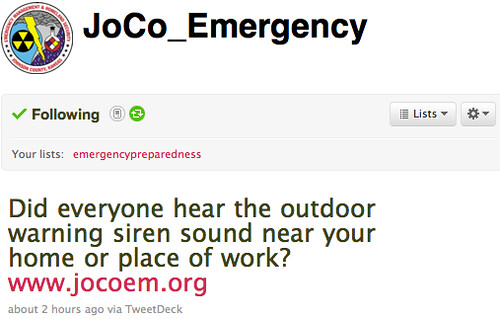
Today, just after drill testing its 177 outdoor warning sirens, officials requested through Facebook and Twitter that residents tell them if they had heard or not heard it. On Facebook (below) they received a “fail” from one resident.
Below is the Twitter tweet:
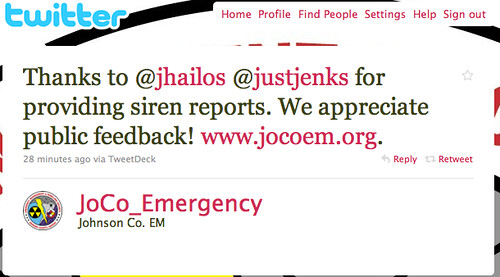
They received two positive confirmations (below).
I think this a terrific use of Facebook and Twitter by emergency managers to get instant public feedback. Johnson County Assistant Director Adam Crowe told me by e-mail that it has also has helped improve the relationship between the office and the community:
“In the past we have always struggled with getting feedback from the community-at-large in a constructive format. Typically, we only heard from citizens who were extremely upset about the timing or location of our siren testing, while now it has become more of a partnership with the community to know when, why, and how our emergency preparedness program works.”
These icons link to social bookmarking sites where readers can share and discover new web pages.